On this page
Loading guide controls…
Continue lessonNew guided lessons are not available yet.
Guided lesson options
You stopped at:
ContinueRevision Mode is on. Questions and activities are hidden.
The linked question or activity is hidden by Revision Mode.
Integration measures more than area under a curve. Cut a curve, a solid or a surface into tiny pieces whose size you can write down, add the pieces, and let them shrink: the sum becomes an integral. This lesson uses that one idea three times, to find the length of a curve, the volume of a solid of revolution by discs or by cylindrical shells, and the curved surface area of a solid of revolution. In each case the skill is to choose the right small piece and then to keep the algebra exact.
Arc length
A short piece of a curve is close to the hypotenuse of a right-angled triangle with sides δ x and δ y, so its length is
Adding the pieces and letting δ x → 0 gives the arc length from x = a to x = b:
Most curves give an integrand with no elementary antiderivative; then a graphing calculator evaluates the integral numerically. Exam questions that ask for an exact length use curves for which 1 + (dy/(dx))² simplifies to a perfect square or a power of a linear expression.
Worked example 1
An exact arc length
Worked example 1
An exact arc length
Find the exact length of the curve y = (2/3)x^(3/2) from x = 0 to x = 3.
Show full solutionHide solution
Simplify the integrand
Method
dy/(dx) = x^(1/2), so 1 + (dy/(dx))² = 1 + x.Reason
The square root of 1 + x is a power of a linear expression, so it integrates exactly.Working
Answer
s = ∫₀³ square root of (1 + x) dx; = [(2/3)(1 + x)^(3/2)]₀³; = (2/3)(8-1) = 14/3.
Quick check
The chord from (0,0) to (3,2 square root of 3) has length square root of 21 ≈ 4.58, a little less than 14/3 ≈ 4.67, as it must be for a curve between the same two points.
Spot the mistake 1
An arc shorter than a straight line?
Spot the mistake 1
An arc shorter than a straight line?
A student finds the length of y = x² from x = 0 to x = 1 as
Explain why this cannot be right, and find the correct length to 4 significant figures.
Write your answer, then compare it with the solution
Show full solutionHide solution
Restore the square and the root
Method
Use square root of (1 + (dy/(dx))²) = square root of (1 + 4x²).Reason
The length element comes from Pythagoras, so the gradient is squared inside a square root; 1 + dy/(dx) is the length of the two legs of the triangle added together.Working
Answer
s = ∫₀¹ square root of (1 + 4x²) dx ≈ 1.479using a graphing calculator. This lies between the chord length square root of 2 ≈ 1.414 and the path along the axes, 1 + 1 = 2.
Common mistake
The student’s answer, 2, is the length of the route from (0,0) along the x-axis to (1,0) and then up to (1,1). A smooth curve between the two points must be shorter than that route and longer than the chord, so a quick bound catches the error.
Discs or shells
When a region is rotated about an axis, you can slice it in two ways:
- Discs (or washers) slice perpendicular to the axis. Each slice is a thin disc of radius y about the x-axis, or radius x about the y-axis.
- Shells slice parallel to the axis. About the y-axis, a strip at distance x with height y and width δ x sweeps a thin cylindrical shell of circumference 2π x, so its volume is about 2π xy δ x.
Shells about the x-axis work the same way, with V = 2π∫ y x dy. Both methods give the same volume; choose the one that uses the curve in the form it is given and avoids splitting the region.
Worked example 2
One bowl, two methods
Worked example 2
One bowl, two methods
The region bounded by y = x², the line y = 4 and the y-axis, with x ≥ 0, is rotated through 2π about the y-axis. Find the volume by discs and by shells.
Show full solutionHide solution
Discs: slice horizontally
Method
At height y, the disc has radius x = square root of y, for 0 ≤ y ≤ 4.Reason
Discs about the y-axis need the radius as a function of y.Working
Answer
V = π∫₀⁴(square root of y)²dy = π∫₀⁴y dy = 8π.Shells: slice vertically
Method
At distance x, the strip runs from the curve up to y = 4, so its height is 4-x², for 0 ≤ x ≤ 2.Reason
The shell height is the length of the strip inside the region, not the value of y on the curve.Working
Answer
V = 2π∫₀²x(4-x²)dx; = 2π[2x²-(1/4)x⁴]₀² = 2π(8-4) = 8π.
Quick check
The two methods agree. The solid is a cylinder of radius 2 and height 4, volume 16π, with the region under the curve removed, so 8π is exactly half of it.
A thin strip becomes a cylindrical shell
An arch-shaped curve rises from (0, 0) to a maximum height of 0.25 at x = 0.5 and returns to (1, 0). The area under it is lightly shaded. A narrow vertical band between x = 0.7 and x = 0.75 is marked as the strip. A dashed horizontal line at y = 0.15 crosses the arch at two points, about x = 0.18 and x = 0.82.
Scroll across to read every label.
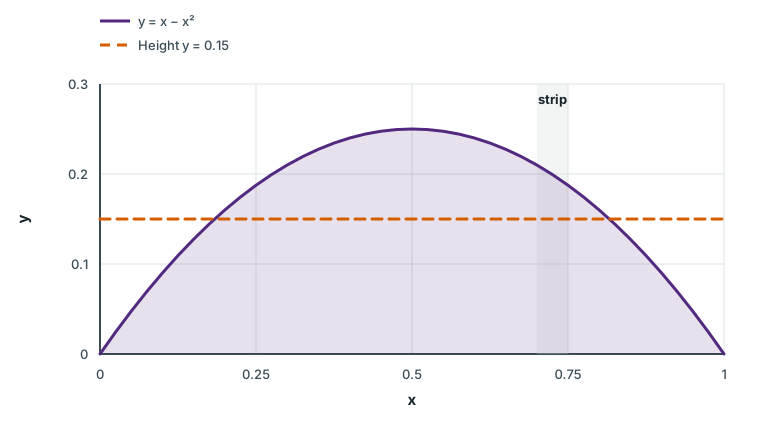
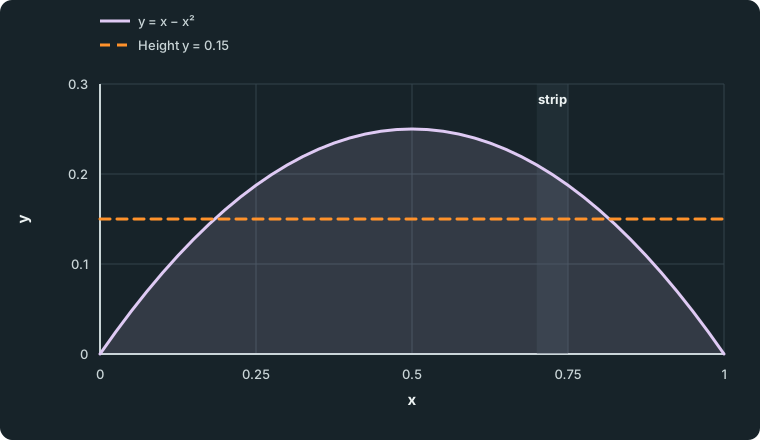
Figure data
This table is included in print while it is open.
| Series | x | y |
|---|---|---|
| y = x − x² | 0.000 | 0.000000 |
| y = x − x² | 0.025 | 0.024375 |
| y = x − x² | 0.050 | 0.047500 |
| y = x − x² | 0.075 | 0.069375 |
| y = x − x² | 0.100 | 0.090000 |
| y = x − x² | 0.125 | 0.109375 |
| y = x − x² | 0.150 | 0.127500 |
| y = x − x² | 0.175 | 0.144375 |
| y = x − x² | 0.200 | 0.160000 |
| y = x − x² | 0.225 | 0.174375 |
| y = x − x² | 0.250 | 0.187500 |
| y = x − x² | 0.275 | 0.199375 |
| y = x − x² | 0.300 | 0.210000 |
| y = x − x² | 0.325 | 0.219375 |
| y = x − x² | 0.350 | 0.227500 |
| y = x − x² | 0.375 | 0.234375 |
| y = x − x² | 0.400 | 0.240000 |
| y = x − x² | 0.425 | 0.244375 |
| y = x − x² | 0.450 | 0.247500 |
| y = x − x² | 0.475 | 0.249375 |
| y = x − x² | 0.500 | 0.250000 |
| y = x − x² | 0.525 | 0.249375 |
| y = x − x² | 0.550 | 0.247500 |
| y = x − x² | 0.575 | 0.244375 |
| y = x − x² | 0.600 | 0.240000 |
| y = x − x² | 0.625 | 0.234375 |
| y = x − x² | 0.650 | 0.227500 |
| y = x − x² | 0.675 | 0.219375 |
| y = x − x² | 0.700 | 0.210000 |
| y = x − x² | 0.725 | 0.199375 |
| y = x − x² | 0.750 | 0.187500 |
| y = x − x² | 0.775 | 0.174375 |
| y = x − x² | 0.800 | 0.160000 |
| y = x − x² | 0.825 | 0.144375 |
| y = x − x² | 0.850 | 0.127500 |
| y = x − x² | 0.875 | 0.109375 |
| y = x − x² | 0.900 | 0.090000 |
| y = x − x² | 0.925 | 0.069375 |
| y = x − x² | 0.950 | 0.047500 |
| y = x − x² | 0.975 | 0.024375 |
| y = x − x² | 1.000 | 0.000000 |
| Height y = 0.15 | 0.000 | 0.150000 |
| Height y = 0.15 | 1.000 | 0.150000 |
Check your understanding 1
Rotating about the y-axis
Check your understanding 1
Rotating about the y-axis
The region between y = x-x² and the x-axis is rotated through 2π about the y-axis. Find the volume, and explain why shells are easier than discs here.
Show answerHide answer
Discs about the y-axis need x in terms of y, and a horizontal line meets the curve twice, so there are two branches x = (1/2)(1± square root of (1-4y)). Shells use the curve as given:
Washers between those two branches, from y = 0 to y = 1/4, give the same π/6.
Surface area of revolution
Rotating a short piece of curve of length δ s at height y ≥ 0 about the x-axis sweeps a thin band of radius y and slant width δ s, with area about 2π y δ s. Adding the bands:
About the y-axis, the radius is x instead, so S = 2π∫ₐ^b x square root of (1 + (dy/(dx))²) dx for x ≥ 0. The band’s width is the slant length δ s, not δ x: a sloping band is wider than its shadow on the axis.
Common mistakes
- Writing 1 + dy/(dx) or 1 + (dy/(dx)) without the square, or forgetting the square root.
- Using 2π∫ y dx for surface area, which leaves out the slant factor.
- Taking the shell height as the y-value on the curve when the region lies between the curve and another line.
- Using x-limits in an integral with respect to y, or the reverse.
- Splitting a region into awkward branches when the other slicing would use the curve directly.
Before you move on
Try it yourself 1
A curved surface, checked on a sphere
Try it yourself 1
A curved surface, checked on a sphere
The arc y = square root of x, 0 ≤ x ≤ 2, is rotated through 2π about the x-axis. Find the exact curved surface area. Then use the same formula to show that a sphere of radius r has surface area 4π r².
Write your answer, then compare it with the solution
Hint 1
Put y inside the root
y square root of (1 + (y')²) = square root of (y² + y²(y')²). For y = square root of x, this becomes square root of (x + 1/4).
Show full solutionHide solution
Simplify and integrate
Method
y' = 1/(2 square root of x), so y square root of (1 + (y')²) = square root of x square root of (1 + 1/(4x)) = square root of (x + 1/4).Reason
The root of a linear expression integrates directly.Working
Answer
S = 2π∫₀² square root of (x + 1/4) dx; = 2π · (2/3)[(9/4)^(3/2)-(1/4)^(3/2)]; = 2π · 2/3 · 26/8 = 13π/3.Check on a sphere
Method
Rotate y = square root of (r²-x²), -r ≤ x ≤ r.Reason
A known answer tests the formula and the algebra.Working
Answer
y' = -x/y, so y square root of (1 + x²/y²) = square root of (y² + x²) = r. Then S = 2π∫₋ᵣ^rr dx = 4π r².
Quick check
Using 2π∫ y dx, without the arc-length factor, would undercount every sloping band; for the sphere it gives π²r² ≈ 9.87r² instead of 4π r² ≈ 12.57r². The sphere is a useful check on any surface-area formula you set up.
Loading reading progress…
Lesson done
- Monday
- Tuesday
- Wednesday
- Thursday
- Friday
- Saturday
- Sunday
Checking learning on this device…
Change goal
Progress options
Loading questions…