On this page
Loading guide controls…
Continue lessonNew guided lessons are not available yet.
Guided lesson options
You stopped at:
ContinueRevision Mode is on. Questions and activities are hidden.
The linked question or activity is hidden by Revision Mode.
A matrix is a compact record of a transformation: its columns say where the basis vectors go, and everything else follows by linearity. This lesson reads a transformation from its matrix, finds what it flattens (its kernel) and what it can reach (its range), connects their dimensions through the rank–nullity relationship, decides whether a set of vectors or polynomials forms a subspace, and composes transformations in the right order.
A matrix records where the basis vectors go
A transformation T:Rⁿ → R^m is linear when T(u + v) = T(u) + T(v) and T(λu) = λ T(u) for all vectors and scalars. Then every vector’s image is fixed by the images of the standard basis vectors, and T(x) = Mx where the columns of the m × n matrix M are T(e₁),…,T(eₙ).
For example, T(x,y) = (x + y, 2y, x-y) maps R² → R³ with T(e₁) = (1,0,1) and T(e₂) = (1,2,-1), so
A translation such as T(x) = x + (1,0) is not linear: it sends 0 to (1,0), but every linear map sends 0 to 0.
Doing A first and then B is the single transformation BA: the matrix nearest the vector acts first.
Worked example 1
What a transformation flattens
Worked example 1
What a transformation flattens
T:R³ → R² is given by T(x,y,z) = (x + z, y + z). Find its matrix, its null space and its range, and check rank + nullity.
Show full solutionHide solution
Matrix and null space
Method
M = (1, 0, 1; 0, 1, 1).Reason
The null space is everything sent to 0.Working
Answer
x + z = 0 and y + z = 0 give (x,y,z) = t(-1,-1,1): a line through the origin, so the nullity is 1.
Range
Method
The first two columns (1,0) and (0,1) already span R².Reason
The range is the column space.Working
Answer
The range is all of R², so the rank is 2, and 2 + 1 = 3 is the dimension of R³.
Quick check
T(-1,-1,1) = (0,0) confirms the null space. Each point of R² is the image of a whole line of points, parallel to (-1,-1,1): the transformation flattens one dimension.
Linear spaces, subspaces and bases
A linear space (vector space) over R is a set with addition and scalar multiplication satisfying the usual axioms: addition is commutative and associative, there is a zero vector and every vector has a negative, and scalar multiplication distributes over both additions, with 1v = v and (λμ)v = λ(μv). Examples include Rⁿ and the polynomials of degree at most 2.
A non-empty subset of a linear space is a subspace exactly when it contains 0 and is closed under addition and scalar multiplication.
- Vectors are linearly independent if the only combination giving 0 has all coefficients 0; otherwise one is a combination of the others. (1,2,3), (4,5,6), (7,8,9) are dependent: the middle one is their average.
- The span of a set is all of its linear combinations.
- A basis is an independent spanning set; the number of vectors in any basis is the dimension.
Check your understanding 1
Subspace or not?
Check your understanding 1
Subspace or not?
Decide whether each set is a subspace. For each subspace, give a basis and its dimension.
- {(x,y,z):x + y + z = 0} in R³.
- {(x,y,z):x + y + z = 1} in R³.
- The polynomials p of degree at most 2 with p(1) = 0.
Show answerHide answer
- Yes: it contains 0, and sums and multiples of solutions are solutions. Basis {(1,-1,0),(1,0,-1)}; dimension 2, a plane through the origin.
- No: 0 is not in it (0 ≠ 1).
- Yes: (p + q)(1) = 0 and (λ p)(1) = 0. Every such p is a(x-1) + b(x²-1), and these two are independent, so the dimension is 2.
Spot the mistake 1
Rotate, then stretch
Spot the mistake 1
Rotate, then stretch
R = (0, -1; 1, 0) rotates the plane 90° anticlockwise and S = (2, 0; 0, 1) stretches by 2 in the x-direction. A student says “rotate, then stretch” has matrix RS. Explain the error and give the correct matrix.
Write your answer, then compare it with the solution
Show full solutionHide solution
Order the product
Method
R acts first, so it must be next to the vector: S(Rx) = (SR)x.Reason
Matrix products are generally not commutative.Working
Answer
SR = (0, -2; 1, 0), RS = (0, -1; 2, 0).
Common mistake
Check with e₁: rotating gives (0,1), and stretching the x-direction leaves (0,1). SRe₁ = (0,1) agrees; RSe₁ = (0,2) does not.
Two orders give different rectangles
The solid rectangle has corners (0, 0), (0, 1), (−2, 1), (−2, 0). The dashed rectangle has corners (0, 0), (0, 2), (−1, 2), (−1, 0). The dotted original is the unit square in the first quadrant.
Scroll across to read every label.
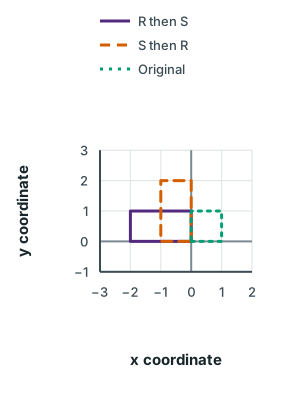
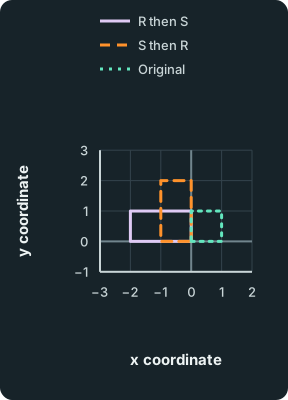
Figure data
This table is included in print while it is open.
| Series | x coordinate | y coordinate |
|---|---|---|
| R then S | 0 | 0 |
| R then S | 0 | 1 |
| R then S | -2 | 1 |
| R then S | -2 | 0 |
| R then S | 0 | 0 |
| S then R | 0 | 0 |
| S then R | 0 | 2 |
| S then R | -1 | 2 |
| S then R | -1 | 0 |
| S then R | 0 | 0 |
| Original | 0 | 0 |
| Original | 1 | 0 |
| Original | 1 | 1 |
| Original | 0 | 1 |
| Original | 0 | 0 |
Common mistakes
- Writing the images of the basis vectors as the rows of the matrix instead of its columns.
- Applying a composite SR in the order written; the matrix next to the vector acts first.
- Claiming a set is a subspace without checking that it contains the zero vector and is closed under addition and scalar multiplication.
- Giving the dimension of the kernel or range without giving a basis, when the question asks for one.
- Forgetting that dim(kernel) + dim(range) equals the number of columns.
Before you move on
Check your understanding 2
What does this matrix flatten?
Check your understanding 2
What does this matrix flatten?
The transformation T:R² → R² has matrix M = (2, 1; 4, 2). Find the dimension of its kernel and of its range, and describe both geometrically.
Show answerHide answer
M (x; y) = 0 gives 2x + y = 0, so the kernel is the line spanned by (1; -2), of dimension 1. The columns (2; 4) and (1; 2) are parallel, so the range is the line spanned by (1; 2), also of dimension 1. As a check, 1 + 1 = 2, the number of columns. T flattens the whole plane onto the line y = 2x.
Loading reading progress…
Lesson done
- Monday
- Tuesday
- Wednesday
- Thursday
- Friday
- Saturday
- Sunday
Checking learning on this device…
Change goal
Progress options
Loading questions…