Signed regions and volumes of revolution
Build signed sums, region areas and rotated cross-sections from their boundaries, then verify exact or numerical integrals.
More
Offline pages
Saved on this device only. Connect at least once every 30 days to confirm Premium. Sign-out or a change of account removes saved copies.
Find this activity in your course
On this page
You stopped at:
ContinueRevision Mode is on. Questions and activities are hidden.
A definite integral is the limit of signed sums
A definite integral accumulates a function over an interval. If f is continuous on [a,b] with a < b, divide the interval into n equal strips of width Δ x = (b-a)/n. Using the right endpoint of each strip gives the sum
As n → ∞, these sums tend to ∫ₐ^b f(x) dx. Each contribution includes its width; adding sampled heights alone is not an area or an accumulated quantity. Values below the axis contribute negatively.
For f(x) = x² on [0,1], the right-endpoint sum is
Here we used ∑ᵢ₌₁ⁿi² = n(n + 1)(2n + 1)/6. Therefore
With ten strips the sum is 0.385, an overestimate because x² increases on this interval. The finite sum is an approximation; its limit is the exact integral. Direct antiderivative evaluation, [x³/3]₀¹ = 1/3, gives an independent check.
Check your understanding 1 Keep the strip width in the sum
For f(x) = 1-x on [0,1], write the right-endpoint sum for n equal strips and find its limit. You may use ∑ᵢ₌₁ⁿi = n(n + 1)/2. Is the finite right-endpoint sum above or below the integral? Explain using the function’s behaviour.
Show answer
The width is 1/n, so Sₙ = (1/n)∑ᵢ₌₁ⁿ(1-i/n) = 1-(n + 1)/(2n) = (n-1)/(2n). Its limit is 1/2, agreeing with [x-x²/2]₀¹. The function decreases, so each right-endpoint height is the smallest on its strip and the finite sum underestimates the integral.
Cancellation changes the integral, not geometric area
For continuous f with antiderivative F,
A definite integral is a number: an arbitrary constant cancels in the subtraction. Reversing the bounds negates that number. A geometric area, however, is nonnegative and does not reverse sign when a boundary is described in a different order.
For f(x) = x-1 on [0,2], the signed integral is zero: the negative contribution on [0,1] cancels the positive contribution on [1,2]. The two triangles each have area 1/2, so their total geometric area is one square unit.
To find area between a curve and the x-axis, locate its zeros and split where the sign changes. Integrate f above the axis and -f below it. Equivalently the area is ∫ₐ^b|f(x)| dx, but the absolute value must be handled before cancellation, not applied to the final signed total.
Check your understanding 2 Two quantities from the same graph
For y = x-1 on 0 ≤ x ≤ 3, find the signed integral and total area between the graph and x-axis. A claim gives the absolute value of the signed integral as the area: identify the missing contribution.
Show answer
The zero is x = 1. The signed contributions are -1/2 on [0,1] and 2 on [1,3], so the signed integral is 3/2. The geometric area is 1/2 + 2 = 5/2 square units. Taking |3/2| preserves the cancellation instead of restoring the area below the axis; it is short of the total by one square unit.
For a region between two curves, use the nonnegative vertical gap upper minus lower, not each curve’s distance from the axis separately. For y = 2x and y = x², intersections satisfy x(x-2) = 0, so the enclosed region runs from 0 to 2. Since 2x-x² ≥ 0 there,
If two boundaries exchange order inside a requested interval, split at that crossing. A curve below the x-axis can still be the upper boundary of a region; relative height, rather than either boundary’s sign alone, selects the gap.
A rotated slice gives a disc or a washer
Volume is also an accumulation, but the quantity accumulated is a cross-sectional area. For rotation about the x-axis, take thin vertical strips. A strip at x sweeps out a circular cross-section perpendicular to that axis.
Write its outer and inner radii as R(x) ≥ r(x) ≥ 0. Then
A disc is the special case r = 0. Radii are distances from the rotation axis, not signed coordinates. If all lengths are in centimetres, the squared radii give cm² and multiplication by a strip width in cm gives cm³. The expression π(R-r)² is not the area of a washer.
For the region 0 ≤ y ≤ x², 0 ≤ x ≤ 1, a vertical slice reaches from the x-axis to y = x². Its rotation has radius R = x² and no hole. Hence
Squaring the radius gives x⁴, not x². Integrating x² alone would calculate a planar area and would have different units.
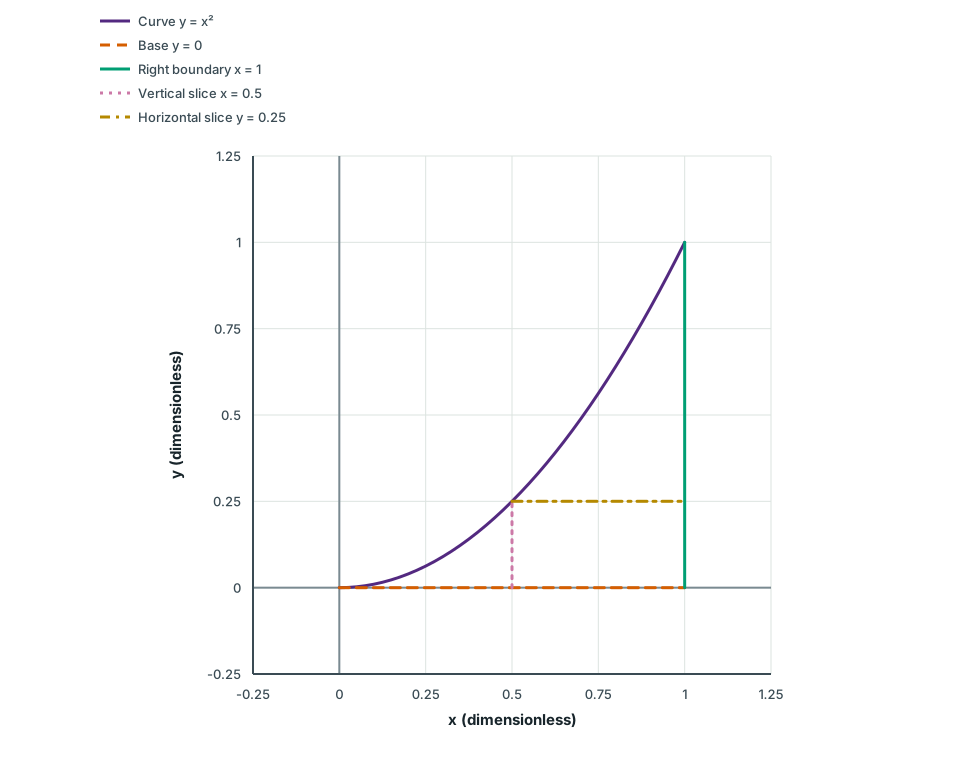
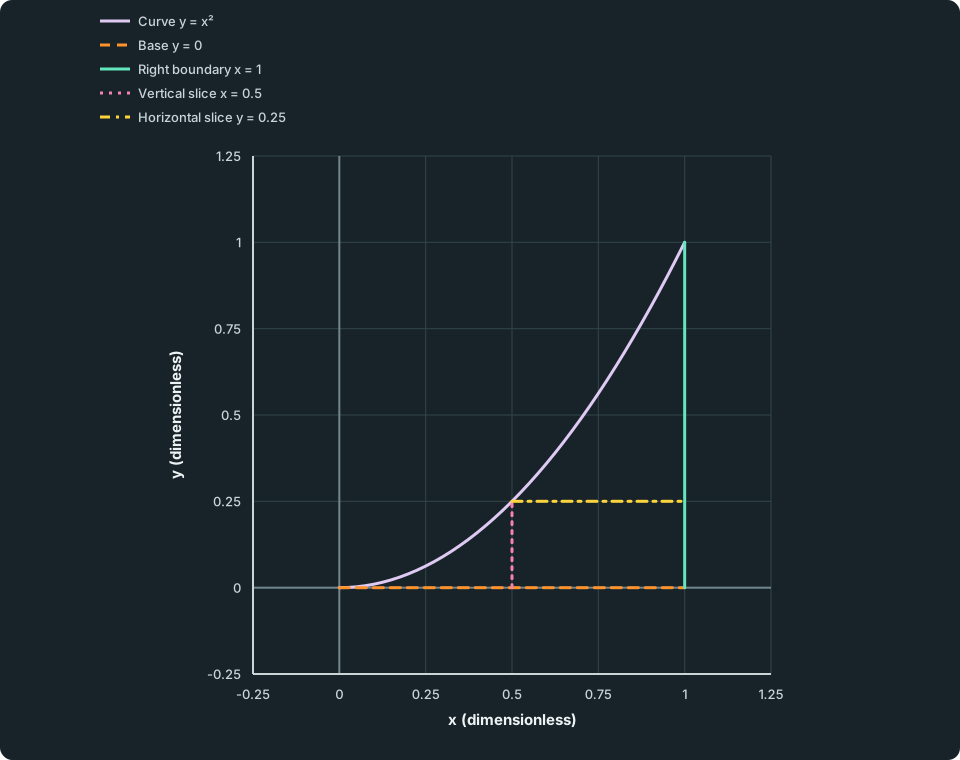
One region with vertical and horizontal slices
The curve runs from (0, 0) to (1, 1). A right boundary at x = 1 joins (1, 0) to (1, 1), and a base joins (0, 0) to (1, 0). The vertical slice runs from (0.5, 0) to (0.5, 0.25); the horizontal slice runs from (0.5, 0.25) to (1, 0.25), leaving a gap to the y-axis.
Scroll across the figure to read all labels.
View figure data
| Series | x (dimensionless) | y (dimensionless) |
|---|---|---|
| Curve y = x² | 0.000 | 0.000000 |
| Curve y = x² | 0.025 | 0.000625 |
| Curve y = x² | 0.050 | 0.002500 |
| Curve y = x² | 0.075 | 0.005625 |
| Curve y = x² | 0.100 | 0.010000 |
| Curve y = x² | 0.125 | 0.015625 |
| Curve y = x² | 0.150 | 0.022500 |
| Curve y = x² | 0.175 | 0.030625 |
| Curve y = x² | 0.200 | 0.040000 |
| Curve y = x² | 0.225 | 0.050625 |
| Curve y = x² | 0.250 | 0.062500 |
| Curve y = x² | 0.275 | 0.075625 |
| Curve y = x² | 0.300 | 0.090000 |
| Curve y = x² | 0.325 | 0.105625 |
| Curve y = x² | 0.350 | 0.122500 |
| Curve y = x² | 0.375 | 0.140625 |
| Curve y = x² | 0.400 | 0.160000 |
| Curve y = x² | 0.425 | 0.180625 |
| Curve y = x² | 0.450 | 0.202500 |
| Curve y = x² | 0.475 | 0.225625 |
| Curve y = x² | 0.500 | 0.250000 |
| Curve y = x² | 0.525 | 0.275625 |
| Curve y = x² | 0.550 | 0.302500 |
| Curve y = x² | 0.575 | 0.330625 |
| Curve y = x² | 0.600 | 0.360000 |
| Curve y = x² | 0.625 | 0.390625 |
| Curve y = x² | 0.650 | 0.422500 |
| Curve y = x² | 0.675 | 0.455625 |
| Curve y = x² | 0.700 | 0.490000 |
| Curve y = x² | 0.725 | 0.525625 |
| Curve y = x² | 0.750 | 0.562500 |
| Curve y = x² | 0.775 | 0.600625 |
| Curve y = x² | 0.800 | 0.640000 |
| Curve y = x² | 0.825 | 0.680625 |
| Curve y = x² | 0.850 | 0.722500 |
| Curve y = x² | 0.875 | 0.765625 |
| Curve y = x² | 0.900 | 0.810000 |
| Curve y = x² | 0.925 | 0.855625 |
| Curve y = x² | 0.950 | 0.902500 |
| Curve y = x² | 0.975 | 0.950625 |
| Curve y = x² | 1.000 | 1.000000 |
| Base y = 0 | 0.000 | 0.000000 |
| Base y = 0 | 1.000 | 0.000000 |
| Right boundary x = 1 | 1.000 | 0.000000 |
| Right boundary x = 1 | 1.000 | 1.000000 |
| Vertical slice x = 0.5 | 0.500 | 0.000000 |
| Vertical slice x = 0.5 | 0.500 | 0.250000 |
| Horizontal slice y = 0.25 | 0.500 | 0.250000 |
| Horizontal slice y = 0.25 | 1.000 | 0.250000 |
The graph shows this same region with one vertical and one horizontal slice. The curve, the x-axis and the right boundary x = 1 enclose the region. The horizontal slice does not start at the y-axis: that distinction matters when the axis of rotation changes.
Check your understanding 3 Check against an independent solid formula
The region 0 ≤ y ≤ x, 0 ≤ x ≤ 3 is rotated about the x-axis. Find its volume and compare it with a cone, identifying the cone’s height and base radius.
Show answer
Each slice gives a disc of radius x, so V = π∫₀³x² dx = 9π cubic units. The solid is a cone of height 3 and base radius 3, whose volume is (1/3)π(3²)(3) = 9π. Both methods describe the same solid, not merely the same curve.
Changing the axis changes the cross-sections
For rotation about the y-axis, use horizontal cross-sections and integrate with respect to y. The radii now come from horizontal distances. Describe the same region in terms of y before writing the integral; swapping the differential alone does not change the geometry correctly.
Return to 0 ≤ y ≤ x², 0 ≤ x ≤ 1. The y-range is 0 ≤ y ≤ 1. At a fixed y in this range, the inequalities require
The nonnegative square-root branch follows from x ≥ 0. Rotating that horizontal segment about the y-axis gives an outer radius 1 and inner radius square root of y. Thus
This solid has a hole in its cross-sections for 0 < y < 1. Using π∫₀¹y dy would rotate the excluded segment 0 ≤ x ≤ square root of y instead of the requested region. Changing the axis produces a different solid, even though the planar region has not changed.
Crossing the axis can remove the hole
Consider x-1 ≤ y ≤ x + 1 for 0 ≤ x ≤ 2, rotated about the x-axis. The two boundary curves alone do not justify subtracting their squares over the whole interval.
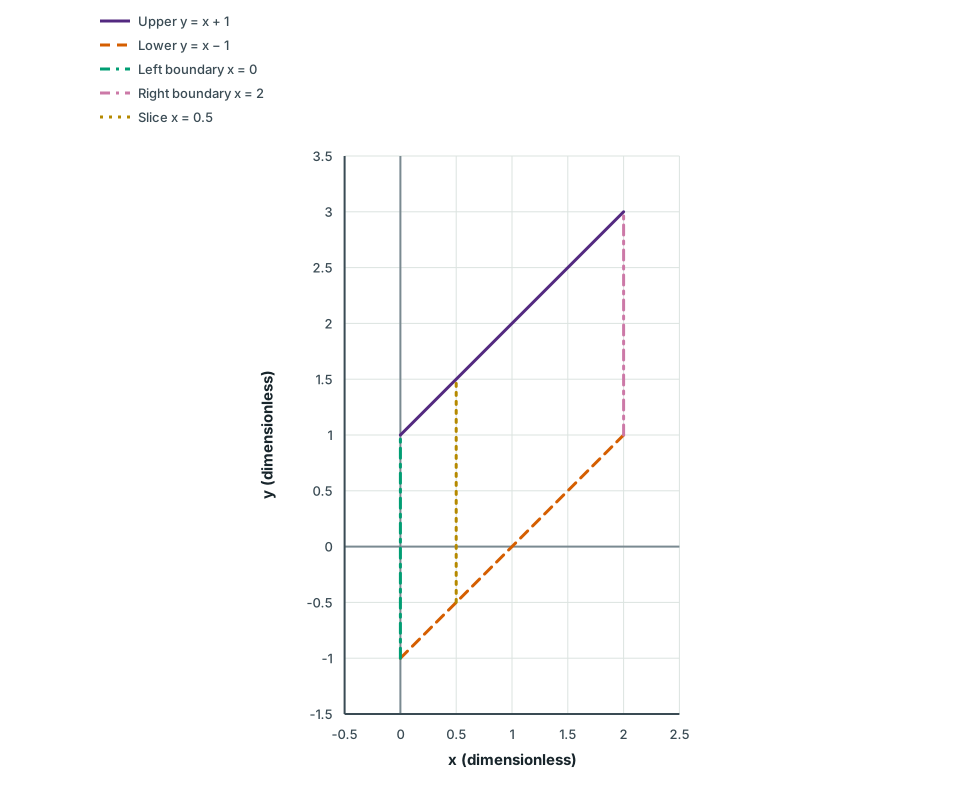
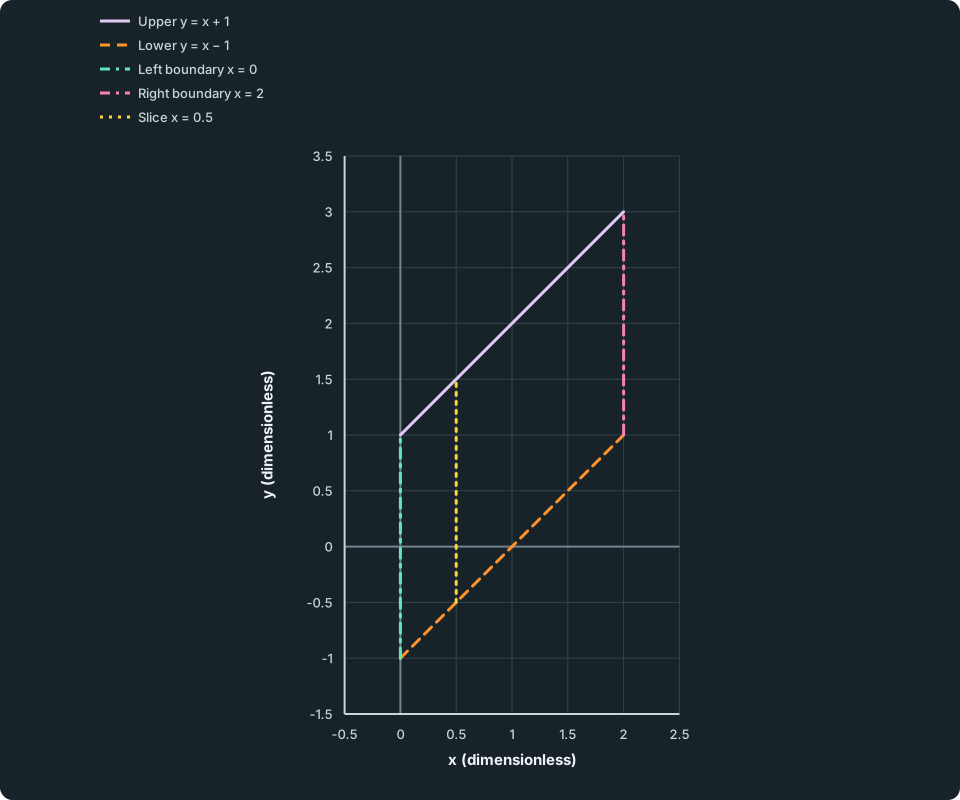
A bounded region crosses the rotation axis
The upper line runs from (0, 1) to (2, 3), while the lower line runs from (0, −1) through (1, 0) to (2, 1). Vertical boundaries close both ends. At x = 0.5 the slice runs from y = −0.5 to y = 1.5 and contains the x-axis. The lower boundary is above that axis only for x greater than 1.
Scroll across the figure to read all labels.
View figure data
| Series | x (dimensionless) | y (dimensionless) |
|---|---|---|
| Upper y = x + 1 | 0.0 | 1.0 |
| Upper y = x + 1 | 2.0 | 3.0 |
| Lower y = x − 1 | 0.0 | -1.0 |
| Lower y = x − 1 | 2.0 | 1.0 |
| Left boundary x = 0 | 0.0 | -1.0 |
| Left boundary x = 0 | 0.0 | 1.0 |
| Right boundary x = 2 | 2.0 | 1.0 |
| Right boundary x = 2 | 2.0 | 3.0 |
| Slice x = 0.5 | 0.5 | -0.5 |
| Slice x = 0.5 | 0.5 | 1.5 |
For 0 ≤ x ≤ 1, the vertical segment includes the axis. Its lower part rotates into a disc already covered by the upper part. There is no hole: the outer radius is x + 1, since x + 1 ≥ |x-1|, and the inner radius is zero.
For 1 ≤ x ≤ 2, the segment is on or above the axis, with outer radius x + 1 and inner radius x-1. The volume is therefore
Subtracting (x-1)² on [0,1] would invent an empty central hole and give 8π instead. The missing volume would be π∫₀¹(1-x)² dx = π/3. Check the swept cross-section first; taking an absolute value after a wrong subtraction would not restore it.
Try it yourself 1
Compare the region with its rotated solid
Problem
A region is defined by 0 ≤ x ≤ 2 and -1 ≤ y ≤ x. Find its planar area and the volume when it is rotated about the x-axis. State the cross-sectional radii and justify every interval split. Compare its area and volume with the preceding region between y = x-1 and y = x + 1 on the same x-interval. Does equal planar area force equal volume?
Write your answer, then compare it with the solution
Hints
Hint 1
Check what each vertical segment sweeps out
Decide whether the segment contains the rotation axis. Compare the two boundary distances from that axis and find where the larger distance changes owner.
Show full solution
Describe the planar gap
Method
Integrate the upper boundary minus the lower boundary.Reason
Planar area uses a vertical length; volume will instead use the area swept by that length.Working
Answer
The gap is x-(-1) = x + 1, so A = ∫₀²(x + 1) dx = 4 square units. The preceding region also has area ∫₀²[(x + 1)-(x-1)] dx = 4.Find the swept radii
Method
Compare distances 1 and x from the x-axis.Reason
The segment contains the axis throughout; its farthest endpoint sets the disc radius.Working
Answer
The inner radius is zero throughout. For 0 ≤ x ≤ 1, the lower boundary at y = -1 is at least as far from the axis as the upper boundary, so R = 1. For 1 ≤ x ≤ 2, R = x. The split at x = 1 marks a change of outer boundary, not the appearance of a hole.Accumulate the cross-sectional areas
Method
Integrate the two disc areas and compare volumes.Reason
Equal planar areas do not require equal distributions of distance from the rotation axis.Working
Answer
V = π∫₀¹ 1 dx + π∫₁²x² dx = π + 7π/3 = 10π/3 cubic units. This differs from 25π/3 for the preceding region, despite their equal planar areas. Subtracting the squared lower boundary would create a hole that the rotation does not have.
Quick check
Compare the planar gap and the swept cross-section separately. Every radius is nonnegative, the inner radius is zero where the segment contains the axis, and the outer radius follows whichever boundary is farther away. The final units distinguish area from volume.
Numerical integration still needs a correct model
A graphing calculator or software can approximate a definite integral without a convenient elementary antiderivative. For example, choose its numerical-integral operation, enter e^(-x²) as the integrand, and set lower bound 0 and upper bound 1. It gives
The integral denotes an exact number; the displayed decimal is an approximation. To four decimal places it is 0.7468. Record the integrand, variable, bounds and requested precision so the numerical result can be checked. A plotting window or a graph’s apparent shaded area is not a substitute for those inputs.
Check your understanding 4 Give the numerical tool the cross-sectional area
The region below y = e^(-x²) and above the x-axis, from x = 0 to x = 1, is rotated about the x-axis. Write the volume integral and use a numerical-integral operation to approximate it to four decimal places. Explain why multiplying the preceding area result by π would not calculate this volume.
Show answer
The radius is e^(-x²), so V = π∫₀¹e^(-2x²) dx ≈ 1.8791 cubic units. Enter e^(-2x²) with bounds 0,1 and multiply the result by π, or include π in the numerical integrand. Multiplying the original area integral by π would omit the required radius square. Keep guard digits until the final rounding.
Identify the region before integrating. Locate sign changes for geometric area; for volume, identify the axis, perpendicular slices and distance radii. Split wherever the relevant boundary or cross-section changes, then use exact or numerical evaluation on that model.
Keep track of this lesson
Mark the lesson done when you have worked through it.
Lesson progress is optional and kept on this device.
Loading lesson controls…
Your lesson mark records your own study. Checks are kept separately in My Learning.