Recurrence and convergence
Generate valid terms, prove affine limits through their errors, and distinguish sequence, series and numerical stopping claims.
More
Offline pages
Saved on this device only. Connect at least once every 30 days to confirm Premium. Sign-out or a change of account removes saved copies.
Find this activity in your course
On this page
You stopped at:
ContinueRevision Mode is on. Questions and activities are hidden.
A recurrence needs a starting value and a valid next step
A rule uₙ₊₁ = f(uₙ) generates the next term from the current term. It needs an initial value as well as the rule; the same rule with another start can give a different sequence. Each output must also be an allowed input for the following step if the real sequence is to continue.
For u₁ = 2 and uₙ₊₁ = uₙ/2 + 3, repeated substitution gives
| Position n | 1 | 2 | 3 | 4 | 5 |
|---|---|---|---|---|---|
| uₙ | 2 | 4 | 5 | 5.5 | 5.75 |
On a calculator using the previous answer, initialise it with 2, then repeatedly apply Ans ÷ 2 + 3. Record the initial value as term 1: reaching term m takes m-1 updates. In a software table, store the new result before applying the rule again. Keep internal precision rather than feeding a rounded displayed value back into the next calculation.
The values suggest a limit near 6, but a finite table alone cannot prove convergence or equality with a limit.
Check your understanding 1 A finite start may not continue indefinitely
Let w₁ = 2 and wₙ₊₁ = square root of (wₙ-1), using real square roots. Find the first three terms and decide whether a fourth real term exists. Which earlier output causes the next-step failure?
Show answer
w₁ = 2, w₂ = 1 and w₃ = 0. But w₄ would require square root of (-1), so there is no fourth real term. The value 0 is a valid output at term 3 but lies outside the next-step input domain wₙ ≥ 1. Three real terms do not establish an infinite real sequence.
A fixed-point equation gives a candidate, then needs a proof
For the affine rule uₙ₊₁ = quₙ + c, suppose a finite limit L exists. Passing to the limit in this continuous rule gives
For q ≠ 1, the candidate is L = c/(1-q). Subtract it from the original recurrence:
The error from L therefore follows a geometric progression. Repeated substitution gives
with u₁ set separately. In particular, if q = 0, every term after the initial one is L = c.
For the starting example, q = 1/2 and c = 3, so L = 6 and
The geometric error tends to zero, proving convergence to 6. Every finite term is below 6, and the positive gap halves each time. The sequence approaches its limit without ever needing to equal it.
Check your understanding 2 Explain why the candidate is a limit
Let u₁ = 10 and uₙ₊₁ = 0.2uₙ + 4. Find an explicit expression and its limit. From which side does it approach, and can any finite term equal the limit?
Show answer
The candidate is L = 5. Subtracting it gives uₙ₊₁-5 = (uₙ-5)/5, so uₙ = 5 + 5(1/5)ⁿ⁻¹. This also gives the stated initial term at n = 1.
Since |1/5| < 1, the error tends to zero. Every finite error is positive, so the sequence decreases towards 5 from above without attaining 5 at a finite position.
The multiplier and the initial error decide the behaviour
For q ≠ 1, the exact expression above separates two facts: the multiplier q and the initial error u₁-L.
| Multiplier | Behaviour when u₁ ≠ L |
|---|---|
| |q| < 1 | The error tends to zero. For negative q, successive errors alternate in sign. |
| q = -1 | The two values u₁ and c-u₁ alternate, with no limit. |
| |q| > 1 | The error magnitude grows without bound. A negative q also reverses its sign each step. |
If the initial error is zero, the sequence remains exactly at L, including when nearby starts would move away. For q = 1, use the original recurrence instead: uₙ = u₁ + (n-1)c. It is constant if c = 0; otherwise it has no finite limit.
For example, v₁ = 2 and vₙ₊₁ = 2vₙ-6 have the same candidate fixed point 6 as the first example, but terms 2,-2,-10,-26,…. Here vₙ = 6-4 · 2ⁿ⁻¹, which diverges downward. Solving the candidate equation did not establish its existence as a limit.
Check your understanding 3 The exact starting value matters
Keep vₙ₊₁ = 2vₙ-6. Compare starts v₁ = 6 and v₁ = 7. Does a multiplier with magnitude greater than one rule out convergence for every start?
Show answer
Starting at 6 gives 6,6,6,…, so its limit is 6. Starting at 7 gives vₙ = 6 + 2ⁿ⁻¹, which grows without bound. A multiplier with magnitude greater than one amplifies a nonzero initial error; it does not create an error when the initial value is exactly the fixed point.
A series converges when its partial sums converge
A convergent sequence and a convergent sum are different claims. For an infinite series u₁ + u₂ + …, examine the sequence of partial sums Sₙ. If Sₙ → S for a finite S, then
Thus terms tending to zero are necessary for a convergent series. A sequence approaching 6 gives a divergent series of its terms, even though that sequence itself converges.
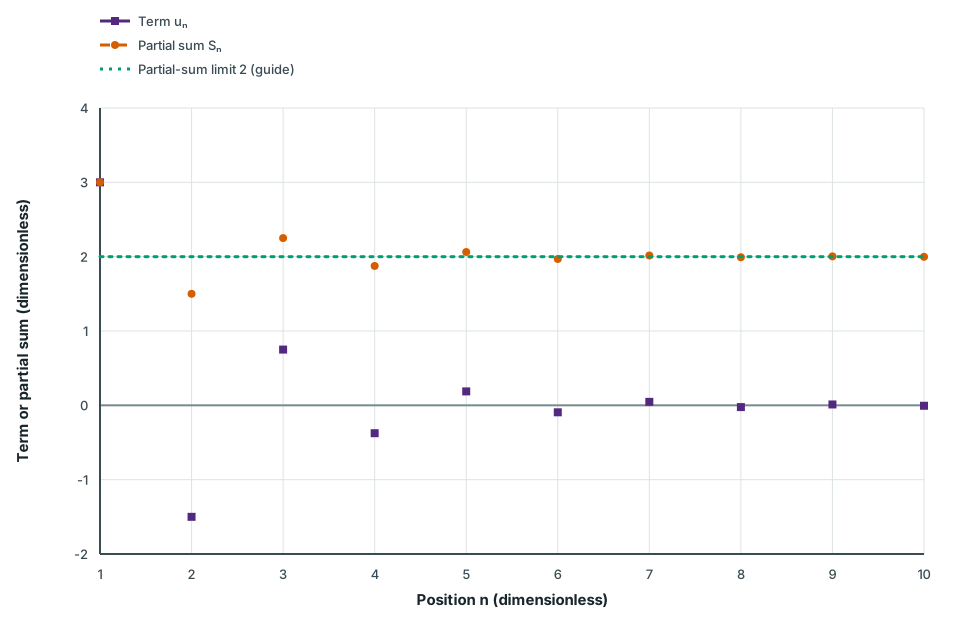
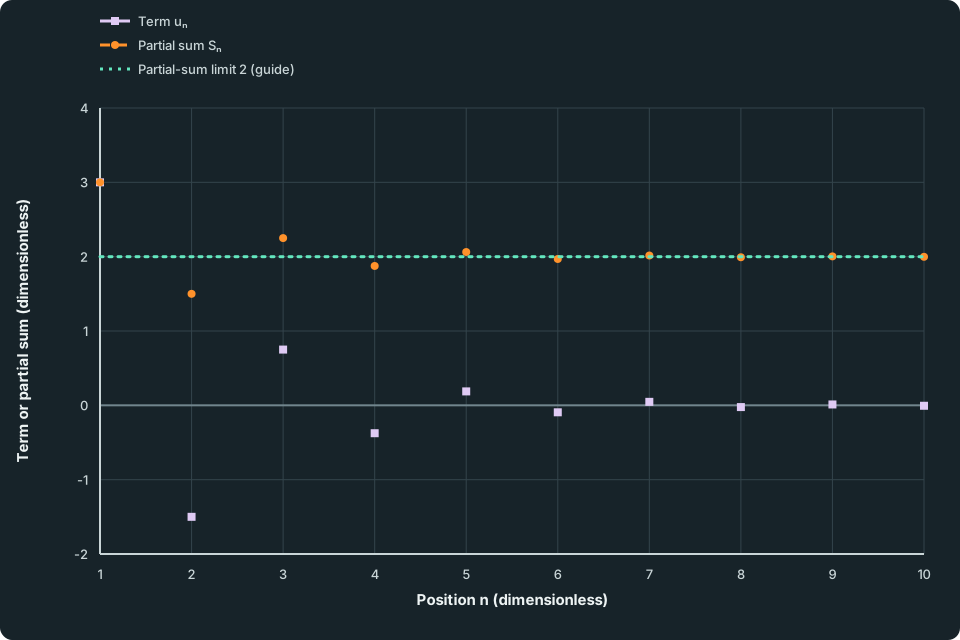
For uₙ = 3(-1/2)ⁿ⁻¹, however, the terms approach zero while their partial sums approach 2:
Terms and their partial sums
Alternating terms approach zero, while alternating partial sums approach two. The first ten integer positions are shown as separate points, without lines suggesting non-integer terms.
Scroll across the figure to read all labels.
View figure data
| Series | Position n (dimensionless) | Term or partial sum (dimensionless) |
|---|---|---|
| Term uₙ | 1 | 3.000000 |
| Term uₙ | 2 | -1.500000 |
| Term uₙ | 3 | 0.750000 |
| Term uₙ | 4 | -0.375000 |
| Term uₙ | 5 | 0.187500 |
| Term uₙ | 6 | -0.093750 |
| Term uₙ | 7 | 0.046875 |
| Term uₙ | 8 | -0.023438 |
| Term uₙ | 9 | 0.011719 |
| Term uₙ | 10 | -0.005859 |
| Partial sum Sₙ | 1 | 3.000000 |
| Partial sum Sₙ | 2 | 1.500000 |
| Partial sum Sₙ | 3 | 2.250000 |
| Partial sum Sₙ | 4 | 1.875000 |
| Partial sum Sₙ | 5 | 2.062500 |
| Partial sum Sₙ | 6 | 1.968750 |
| Partial sum Sₙ | 7 | 2.015625 |
| Partial sum Sₙ | 8 | 1.992188 |
| Partial sum Sₙ | 9 | 2.003906 |
| Partial sum Sₙ | 10 | 1.998047 |
| Partial-sum limit 2 (guide) | 1 | 2.000000 |
| Partial-sum limit 2 (guide) | 10 | 2.000000 |
The plot shows only integer positions and a finite sample. The power formula proves the limits; the points help distinguish which quantity is approaching which value.
Terms tending to zero are not sufficient. The harmonic terms 1/n tend to zero, but their partial sums grow without bound. Group them after the initial 1:
A block from 1/(2^k + 1) through 1/2^(k + 1) has 2^k terms, each at least 1/2^(k + 1). Every block therefore adds at least 1/2. Arbitrarily many such blocks force the partial sums beyond any finite bound, despite individual terms becoming small.
A stopping tolerance needs the right error bound
Stopping when consecutive terms differ by less than a tolerance checks a numerical rule, not exact equality with a limit. For the affine model, the geometric error gives a more precise relationship:
For q ≠ 1, the error in the newly computed term is
For example, uₙ₊₁ = 0.99uₙ + 1 has L = 100. If the current term is 90, the next is 90.1: the step is only 0.1, but the new term is still 9.9 from the limit. Here the error factor is 99. To guarantee new-term error less than 0.01, the step must be less than 1/9900, rather than merely less than 0.01.
This bound comes from the specified affine rule. A different recurrence needs its own justification; a long table or a small last change is not a universal convergence proof.
Try it yourself 1
Track the tank after each cycle
Problem
An ideal tank starts with 10 litres. Each cycle removes 20% of the volume present and then adds 3 litres. Assume no other losses and enough tank capacity. Let Vₙ be its volume after n completed cycles, with V₀ = 10. Form the recurrence and an explicit expression, justify its limit, and find the first cycle with at least 14.9 litres. A second proposal adds the 3 litres before removing 20%: would it have the same limit or ever reach that target? Explain.
Write your answer, then compare it with the solution
Hints
Hint 1
Follow one complete cycle in the stated order
Write what remains immediately after each operation. The index counts completed cycles, so the starting volume has index zero. Check the cycle just before any claimed first target.
Show full solution
Model removal followed by addition
Method
Apply the retained fraction to the current volume, then add the new amount.Reason
Removing 20% leaves 80%; the added 3 litres are not removed in this version of the cycle.Working
Answer
Vₙ₊₁ = (4/5)Vₙ + 3. Its fixed point is 15. The initial error is V₀-15 = -5, so Vₙ = 15-5(4/5)ⁿ. The error tends to zero because |4/5| < 1, proving limit 15 litres. Alternatively, for n ≥ 1, sum the retained initial volume and additions: Vₙ = 10(4/5)ⁿ + 3∑ₖ₌₀ⁿ⁻¹(4/5)^k = 15-5(4/5)ⁿ. Each addition has survived a different number of removals.Find the first completed cycle
Method
Translate the target into a power inequality and keep n an integer.Reason
The initial value has index zero, and the target comparison allows equality.Working
Answer
Vₙ ≥ 14.9 is equivalent to (4/5)ⁿ ≤ 0.02, so n ≥ log(0.02)/log(0.8) ≈ 17.531. The first cycle is 18. Direct checks give V₁₇ ≈ 14.8874 < 14.9 and V₁₈ ≈ 14.9099 ≥ 14.9 litres.Check the reversed operations
Method
Apply removal to both the old volume and the amount just added.Reason
Changing operation order changes the constant added per completed cycle.Working
Answer
With W₀ = 10, Wₙ₊₁ = (4/5)(Wₙ + 3) = (4/5)Wₙ + 12/5. The limit is 12, and Wₙ = 12-2(4/5)ⁿ < 12 for every finite n. It never reaches 14.9 litres.
Quick check
The first model approaches 15 from below; the second approaches 12 from below. Neither a candidate limit without the error formula nor a rounded calculator display establishes attainment. Compare the operation order, initial index, convergence proof and neighbouring-cycle check separately.
State the starting value, the index convention and every input restriction before iterating. For an affine recurrence, track the error from its fixed point to justify the behaviour. For an infinite series, examine its partial sums; neither small terms nor small successive changes alone prove the required conclusion.
Keep track of this lesson
Mark the lesson done when you have worked through it.
Lesson progress is optional and kept on this device.
Loading lesson controls…
Your lesson mark records your own study. Checks are kept separately in My Learning.