Simultaneous linear equations
Construct two linear graphs, solve for their common pair and check graphical readings with algebra.
More
Offline pages
Saved on this device only. Connect at least once every 30 days to confirm Premium. Sign-out or a change of account removes saved copies.
Find this activity in your course
On this page
You stopped at:
ContinueRevision Mode is on. Questions and activities are hidden.
Both equations must hold at once
Solve x + y = 7 and 2x-y = 5. Adding the equations eliminates y: 3x = 12, so x = 4. Substitute into the first equation to get y = 3. Check both: 4 + 3 = 7 and 8-3 = 5.
A pair satisfying only one equation is not a simultaneous solution. You can view each equation as a line; the required pair is a common point.
Construct both lines on one coordinate grid
An equation such as x + y = 7 has many solutions: (3,4), (5,2) and (6,1) all satisfy it. Its graph contains all the ordered pairs satisfying the equation. A simultaneous solution must also lie on the other equation’s graph.
To draw the lines for x + y = 7 and 2x-y = 5, first write y = 7-x and y = 2x-5. Choose some x-values, then calculate a separate y-value for each equation.
| x | y = 7 − x | y = 2x − 5 |
|---|---|---|
| 3 | 4 | 1 |
| 5 | 2 | 5 |
| 6 | 1 | 7 |
Use one labelled coordinate grid for both lines. For the first line, plot (3,4), (5,2) and (6,1); for the second, plot (3,1), (5,5) and (6,7). In each pair, move across to x before moving vertically to y. Two distinct points determine a straight line; the third checks your substitution and plotting. Draw each straight line through its points and extend it across the useful part of the grid.
One point satisfies both linear equations
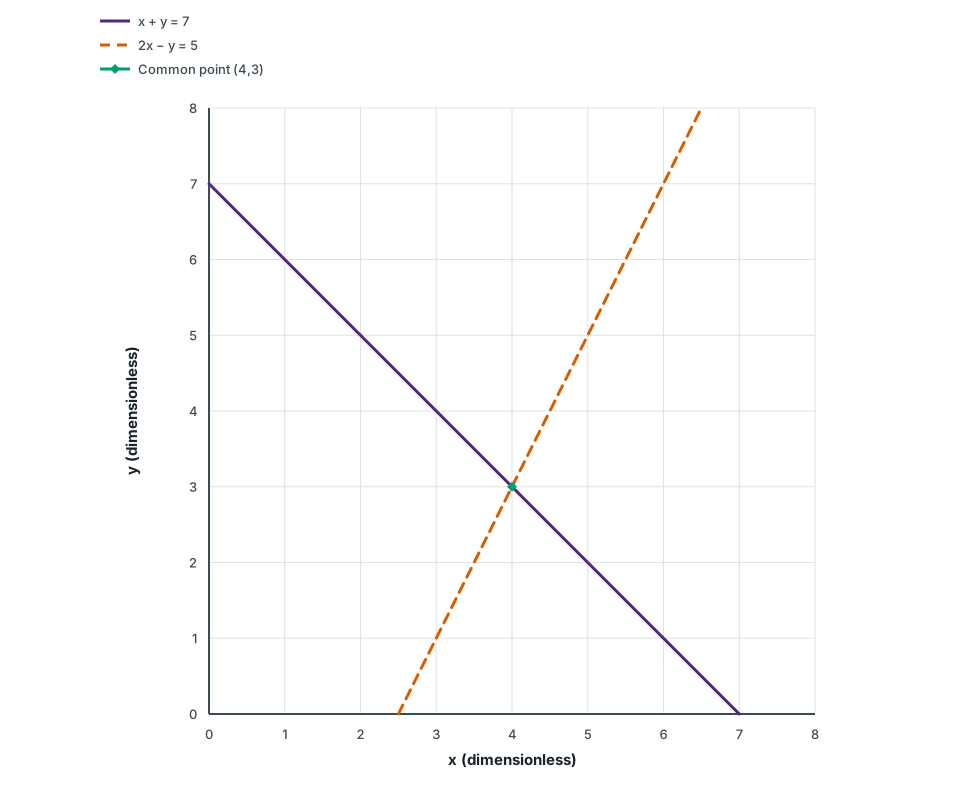
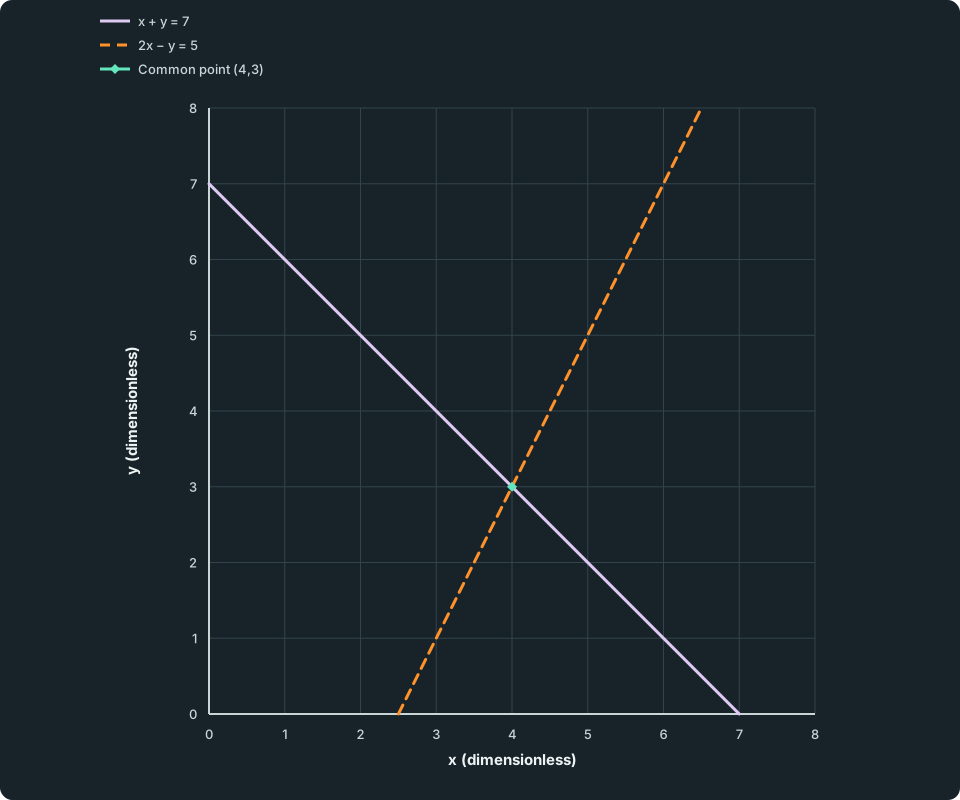
On a coordinate grid from 0 to 8 on both axes, the solid line falls from (0,7) to (7,0). The dashed line rises from (2.5,0) to (6.5,8). They cross at (4,3), inside the plotting window.
Scroll across the figure to read all labels.
View figure data
| Series | x (dimensionless) | y (dimensionless) |
|---|---|---|
| x + y = 7 | 0.0 | 7 |
| x + y = 7 | 3.0 | 4 |
| x + y = 7 | 5.0 | 2 |
| x + y = 7 | 6.0 | 1 |
| x + y = 7 | 7.0 | 0 |
| 2x − y = 5 | 2.5 | 0 |
| 2x − y = 5 | 3.0 | 1 |
| 2x − y = 5 | 5.0 | 5 |
| 2x − y = 5 | 6.0 | 7 |
| 2x − y = 5 | 6.5 | 8 |
| Common point (4,3) | 4.0 | 3 |
The solid line falls as x increases; the dashed line rises. Read the crossing by tracing to both axes: x is about 4 and y is about 3. The pair (4,3) satisfies both original equations exactly, as the substitution above confirms. Reading only x = 4 would leave the second unknown unanswered. A graph drawn by hand normally gives an estimate; exact substitution or algebra establishes whether the apparent coordinates are exact.
More generally, ax + by = c can be written y = (c-ax)/b when b ≠ 0. Do not divide by a zero coefficient: 2x = 6 is the vertical line x = 3, while 3y = 6 is the horizontal line y = 2. Their common point is (3,2). For a straight-line equation, a and b cannot both be zero.
Check your understanding 1 Make a graph, then test the crossing
Use a coordinate grid to solve x + y = 8 and y = x-2 graphically. Choose and record points for each line, draw both lines, then read both coordinates of their intersection. Check your pair in both original equations. Work on paper if that is easier.
Show answer
For y = 8-x, you could plot (0,8) and (8,0), checking with (4,4). For y = x-2, you could plot (2,0) and (6,4), checking with (4,2). Other correctly calculated point choices work too. Draw each straight line on the same grid with consistent labelled scales.
The intersection is near (5,3). Check: 5 + 3 = 8 and 3 = 5-2. These checks show that (5,3) is an exact solution, even if your drawing gives slightly different readings. If the lines miss that point, recheck the calculated pairs, their x–y order and the axis scales before changing the equations.
Substitution uses one complete expression
From x + y = 7, write y = 7-x. Substitute that expression in the other equation: 2x-(7-x) = 5. The bracket gives 3x-7 = 5, so x = 4 and y = 3 again. Subtracting only the 7 would lose the negative of -x.
If coefficients do not already match, multiply an entire equation first. For 2x + 3y = 13 and 3x + 2y = 12, multiply the first by 3 and the second by 2. Subtract to get 5y = 15, so y = 3 and x = 2.
Check the geometry of an exceptional result
The equations x + y = 4 and 2x + 2y = 9 have no common solution: doubling the first would require 8, not 9. Their lines are parallel and distinct. For x + y = 4 and 2x + 2y = 8, the second repeats the same condition, so infinitely many real pairs fit. A cancellation to 0 = 0 does not choose one pair.
Check your understanding 2 Define both unknowns
Adult tickets cost $8 and child tickets $5. Ten tickets cost $65. Form and solve a pair of equations for their numbers.
Show answer
Let a and c be the adult and child ticket counts. a + c = 10 and 8a + 5c = 65. Subtract five times the first from the second: 3a = 15, so a = 5 and c = 5. Both are non-negative integers and satisfy the count and cost.
Read a graphical answer honestly
Two lines appear to cross at approximately (2.1, 3.8) on a hand-drawn grid. Is that automatically an exact algebraic solution?
Show answer
No. Graph resolution makes it an estimate. Substitute to test it, or solve the stated equations algebraically for exact values. Graphical and algebraic methods can check each other’s scale and location.
Keep track of this lesson
Mark the lesson done when you have worked through it.
Lesson progress is optional and kept on this device.
Loading lesson controls…
Your lesson mark records your own study. Checks are kept separately in My Learning.