Exponentials, logarithms and domains
Use inverse graphs, valid bases and original argument conditions to solve exponential equations and interpret a decay model with a fixed background.
More
Offline pages
Saved on this device only. Connect at least once every 30 days to confirm Premium. Sign-out or a change of account removes saved copies.
Find this activity in your course
On this page
You stopped at:
ContinueRevision Mode is on. Questions and activities are hidden.
A logarithm asks for an exponent
For a > 0 and a ≠ 1, y = a^x is equivalent to x = log ₐ y, with y > 0. Thus log₂8 = 3 because 2³ = 8. The exponential accepts any real input and has positive outputs. Its inverse logarithm accepts positive inputs and can have any real output.
Both base conditions matter. Base 1 always gives 1 under exponentiation, so it cannot provide an inverse logarithm. Negative bases do not define a real exponential for every real input. If the base is unknown, retain its conditions too: logₓ16 = 2 gives x² = 16, but only x = 4 is a valid base.
For a > 1, both aˣ and logₐx increase. For 0 < a < 1, both decrease. Their coordinates interchange under reflection in y = x. The exponential passes through (0,1) and has horizontal asymptote y = 0. The logarithm passes through (1,0) and has vertical asymptote x = 0, approached from positive x.
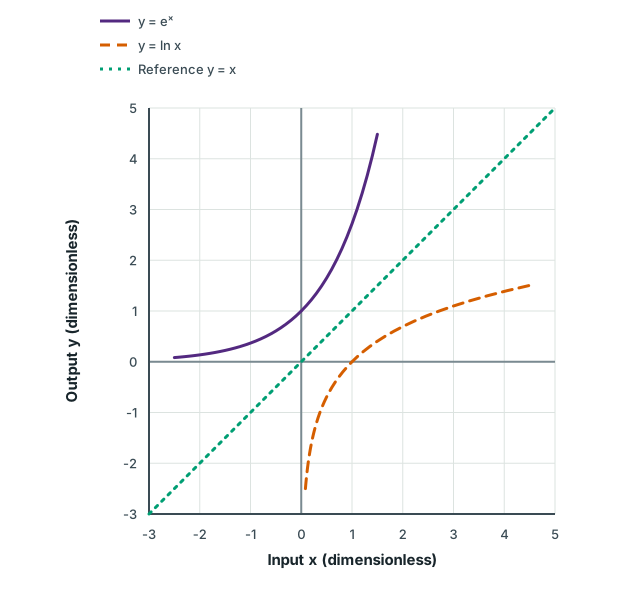
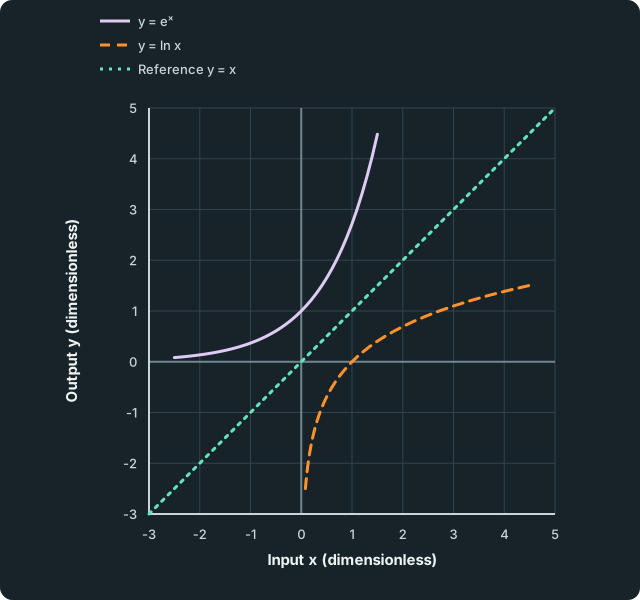
The natural base e gives eˣ and its inverse ln x. This figure shows that particular base, with equal coordinate scales:
Exponential and natural-logarithm coordinates interchange
Both curves increase. The exponential becomes steeper to the right; the natural logarithm becomes less steep. The exponential approaches the horizontal axis to the left. The logarithm approaches the vertical axis from its positive-input side.
Scroll across the figure to read all labels.
View figure data
| Series | Input x (dimensionless) | Output y (dimensionless) |
|---|---|---|
| y = eˣ | -2.50000 | 0.08208 |
| y = eˣ | -2.40000 | 0.09072 |
| y = eˣ | -2.30000 | 0.10026 |
| y = eˣ | -2.20000 | 0.11080 |
| y = eˣ | -2.10000 | 0.12246 |
| y = eˣ | -2.00000 | 0.13534 |
| y = eˣ | -1.90000 | 0.14957 |
| y = eˣ | -1.80000 | 0.16530 |
| y = eˣ | -1.70000 | 0.18268 |
| y = eˣ | -1.60000 | 0.20190 |
| y = eˣ | -1.50000 | 0.22313 |
| y = eˣ | -1.40000 | 0.24660 |
| y = eˣ | -1.30000 | 0.27253 |
| y = eˣ | -1.20000 | 0.30119 |
| y = eˣ | -1.10000 | 0.33287 |
| y = eˣ | -1.00000 | 0.36788 |
| y = eˣ | -0.90000 | 0.40657 |
| y = eˣ | -0.80000 | 0.44933 |
| y = eˣ | -0.70000 | 0.49659 |
| y = eˣ | -0.60000 | 0.54881 |
| y = eˣ | -0.50000 | 0.60653 |
| y = eˣ | -0.40000 | 0.67032 |
| y = eˣ | -0.30000 | 0.74082 |
| y = eˣ | -0.20000 | 0.81873 |
| y = eˣ | -0.10000 | 0.90484 |
| y = eˣ | 0.00000 | 1.00000 |
| y = eˣ | 0.10000 | 1.10517 |
| y = eˣ | 0.20000 | 1.22140 |
| y = eˣ | 0.30000 | 1.34986 |
| y = eˣ | 0.40000 | 1.49182 |
| y = eˣ | 0.50000 | 1.64872 |
| y = eˣ | 0.60000 | 1.82212 |
| y = eˣ | 0.70000 | 2.01375 |
| y = eˣ | 0.80000 | 2.22554 |
| y = eˣ | 0.90000 | 2.45960 |
| y = eˣ | 1.00000 | 2.71828 |
| y = eˣ | 1.10000 | 3.00417 |
| y = eˣ | 1.20000 | 3.32012 |
| y = eˣ | 1.30000 | 3.66930 |
| y = eˣ | 1.40000 | 4.05520 |
| y = eˣ | 1.50000 | 4.48169 |
| y = ln x | 0.08208 | -2.50000 |
| y = ln x | 0.09072 | -2.40000 |
| y = ln x | 0.10026 | -2.30000 |
| y = ln x | 0.11080 | -2.20000 |
| y = ln x | 0.12246 | -2.10000 |
| y = ln x | 0.13534 | -2.00000 |
| y = ln x | 0.14957 | -1.90000 |
| y = ln x | 0.16530 | -1.80000 |
| y = ln x | 0.18268 | -1.70000 |
| y = ln x | 0.20190 | -1.60000 |
| y = ln x | 0.22313 | -1.50000 |
| y = ln x | 0.24660 | -1.40000 |
| y = ln x | 0.27253 | -1.30000 |
| y = ln x | 0.30119 | -1.20000 |
| y = ln x | 0.33287 | -1.10000 |
| y = ln x | 0.36788 | -1.00000 |
| y = ln x | 0.40657 | -0.90000 |
| y = ln x | 0.44933 | -0.80000 |
| y = ln x | 0.49659 | -0.70000 |
| y = ln x | 0.54881 | -0.60000 |
| y = ln x | 0.60653 | -0.50000 |
| y = ln x | 0.67032 | -0.40000 |
| y = ln x | 0.74082 | -0.30000 |
| y = ln x | 0.81873 | -0.20000 |
| y = ln x | 0.90484 | -0.10000 |
| y = ln x | 1.00000 | 0.00000 |
| y = ln x | 1.10517 | 0.10000 |
| y = ln x | 1.22140 | 0.20000 |
| y = ln x | 1.34986 | 0.30000 |
| y = ln x | 1.49182 | 0.40000 |
| y = ln x | 1.64872 | 0.50000 |
| y = ln x | 1.82212 | 0.60000 |
| y = ln x | 2.01375 | 0.70000 |
| y = ln x | 2.22554 | 0.80000 |
| y = ln x | 2.45960 | 0.90000 |
| y = ln x | 2.71828 | 1.00000 |
| y = ln x | 3.00417 | 1.10000 |
| y = ln x | 3.32012 | 1.20000 |
| y = ln x | 3.66930 | 1.30000 |
| y = ln x | 4.05520 | 1.40000 |
| y = ln x | 4.48169 | 1.50000 |
| Reference y = x | -3.00000 | -3.00000 |
| Reference y = x | 5.00000 | 5.00000 |
For example, (1,e) on the exponential corresponds to (e,1) on the logarithm. The graph’s cropped endpoints are not domain boundaries. A negative logarithm output is possible: ln x < 0 for 0 < x < 1. For a base between zero and one, the sign pattern reverses; for example, log _(1/2)4 = -2 because (1/2)⁻² = 4.
Check your understanding 1 A different base changes direction, not the input condition
Sketch or describe y = (1/2)^x and y = log _(1/2)x. State their intercepts, asymptotes, domains and ranges, and use the exponential point (−2,4) to locate a point on its inverse. A proposal rejects the inverse point because its output is negative. Assess the claim.
Show answer
Both graphs decrease. The exponential has domain all real x, range y > 0, intercept (0,1) and horizontal asymptote y = 0. It never reaches the x-axis. The logarithm has domain x > 0, range all real y, intercept (1,0) and vertical asymptote x = 0. It has no y-intercept.
Interchanging coordinates gives (4,−2) on the logarithm. Its input 4 is positive, so the negative output −2 is valid. The proposal confuses the logarithm’s input restriction with its output range. The increasing natural-base figure above illustrates the same inverse-coordinate rule, while these two graphs have decreasing direction.
Logarithm laws follow exponent multiplication
For positive u and v and a valid base a,
The real-power form here uses u > 0. There is no law turning log(u + v) into log u + log v. For example, log₂(2 + 6) = 3, while log₂2 + log₂6 = log₂12, which is not 3. Adding logarithms combines a product, rather than a sum of arguments.
Change of base gives log ₐ u = ln u/ln a. The denominator is nonzero because a ≠ 1. For example, log₄8 = ln 8/ln 4 = 3/2, which is confirmed by 4^(3/2) = 8. A calculator approximation is not needed for that exact result.
Solve while retaining the original domains
For ln(x − 1) + ln(x + 1) = ln 8, each original argument must be positive, so x > 1. Combining gives ln(x² − 1) = ln 8, hence x² = 9. The algebraic candidates are x = 3 and −3, but only 3 satisfies the original domain. At x = −3, the positive combined product hides two negative original arguments.
Check your understanding 2 A combined expression can hide original exclusions
Solve log ₂(x-2) + log ₂x = 3. Check the original arguments at every candidate rather than keeping a root merely because their product is positive.
Show answer
The original domain is x > 2. Combining gives x(x − 2) = 8, so x = 4 or −2. At x = 4, the arguments are 2 and 4, giving 1 + 2 = 3. At x = −2, the arguments are −4 and −2, so neither original logarithm is real. Only x = 4 is allowed. A positive product alone does not retain the positivity of each argument.
Recover the exponential input after a substitution
When the bases match, equate exponents: 2^(x + 1) = 8 = 2³ gives x = 2. For 3^(2x-1) = 7, taking logarithms gives (2x − 1)ln 3 = ln 7, so
Keep this exact form, or round only at the end. Substituting it gives 2x − 1 = log₃7, so the original exponential is 7.
An equation involving both aˣ and a²ˣ may be quadratic in a positive quantity. For 4^x-5(2^x) + 4 = 0, put u = 2ˣ > 0. Then u² − 5u + 4 = 0, giving u = 1 or 4. Both are positive, but the original unknown is x: 2ˣ = 1 gives x = 0, while 2ˣ = 4 gives x = 2. Reporting u = 1 or 4 alone would stop before answering the question.
Check your understanding 3 A quadratic root need not be an exponential value
Solve 9^x + 2(3^x)-3 = 0 over the real numbers, explaining how the substitution’s range affects the quadratic candidates. Check the final answer in the original equation.
Show answer
Put u = 3ˣ > 0, so u² + 2u − 3 = (u − 1)(u + 3) = 0. The candidate u = −3 is impossible for a real exponential with base 3. From u = 1, 3ˣ = 1 gives x = 0. The original check is 1 + 2(1) − 3 = 0. The negative quadratic root is not an extra real x-value.
Build a rule from the context
An idealised tank starts with 150 litres of water and loses 10% of the water present during each hour. Model its volume after whole numbers of hours. The fixed percentage is an assumption, not something established by the starting volume alone.
Let n be the number of hours and V(n) the volume in litres. Losing 10% leaves 90% of the current volume, so each one-hour step multiplies by 0.9. Starting from V(0) = 150 gives V(1) = 135 and V(2) = 121.5. Repeating that multiplier n times gives
The initial volume supplies the coefficient; the remaining fraction supplies the base; n counts the one-hour steps. The losses are 15 litres in the first hour and 13.5 litres in the second. A fixed percentage does not mean a fixed number of litres lost.
Check your understanding 4 A different loss rule needs a different model
Another tank starts with 150 litres but loses a fixed 10 litres per hour over its first ten hours. Define a volume model for whole numbers of hours in that interval and predict its volume after two hours. Explain why copying 150(0.9)ⁿ would describe the wrong rule.
Show answer
With n the number of hours and V(n) the volume in litres, use V(n) = 150-10n for whole n from 0 to 10. Thus V(2) = 130 litres. Each step subtracts the same amount, so this is a linear model.
The exponential rule would give 121.5 litres after two hours and would lose 15 litres in its first hour. It describes a constant percentage, not this tank’s constant loss of 10 litres. Check both the initial value and what one step does; matching the starting volume alone does not select a model.
Compare exponential growth and decay
In the model N(t) = 80e^(-0.2t), let t be the numerical elapsed time in hours and N the quantity in units, for t ≥ 0. The coefficient 0.2 is therefore per hour. N(0) = 80 and the quantity stays positive while decreasing.
Its one-hour multiplier is e^(-0.2) ≈ 0.818731, a decrease of about 18.1%, rather than exactly 20%. To find when N = 40, first divide by 80, giving e^(-0.2t) = 1/2. Then −0.2t = −ln 2, so t = ln 2/0.2 ≈ 3.47 hours. The negative exponential parameter produces decay; it does not make the quantity negative.
An observed ratio applies over its stated time step. If Q(t) = 200bᵗ with t in days and Q(2) = 128, then b² = 128/200 = 0.64. A positive real-time exponential base gives b = 0.8. Thus the daily multiplier is 0.8, while the two-day multiplier is 0.64. Neither equals a constant additive decrease in quantity.
Try it yourself 1
Separate a fixed background from the decaying part
Problem
A model is N(t) = 20 + Abᵗ, where t is the numerical time in hours, N is measured in units, A > 0 and 0 < b < 1. Its observations are N(0) = 100 and N(2) = 65. Find A and b, then the time when the model predicts N = 40, to three significant figures. Decide whether N can equal 20 at a finite time t ≥ 0.
A proposal takes logarithms as ln N = ln 20 + ln A + t ln b. Test this transformation against the original model. State whether the 40-unit prediction is within the observed time range.
Write your answer, then compare it with the solution
Hints
Hint 1
Identify which part of the quantity has a constant multiplier
The fixed background is added to the exponential part. Use each observation in the original model before choosing a logarithm transformation. Check the exponential’s positive range when considering the 20-unit target.
Show full solution
Recover the decaying part and its base
Method
Use the zero-time observation, then the two-hour observation.Reason
The exponential applies to N − 20, rather than to the whole measured quantity.Working
Answer
At zero, 100 = 20 + A gives A = 80. At two hours, 65 − 20 = 80b², so b² = 45/80 = 9/16. The base condition gives b = 3/4, rather than −3/4. The recovered model is N(t) = 20 + 80(3/4)ᵗ, which reproduces both observations.Solve the target equation before rounding
Method
Subtract the background and divide by the recovered multiplier.Reason
Logarithms can now isolate the exponent of one positive exponential term.Working
Answer
For N = 40, (3/4)ᵗ = (40 − 20)/80 = 1/4. Hence t = ln(1/4)/ln(3/4) ≈ 4.82 hours to three significant figures. Both logarithms are negative, so the elapsed time is positive. This is beyond the observed interval 0 ≤ t ≤ 2, so it is an extrapolation that assumes the stated model continues to apply.Test the finite-time background target
Method
Use the positive range of the exponential term.Reason
A decaying positive term approaches zero without attaining it at a finite real input.Working
Answer
For every finite t ≥ 0, 80(3/4)ᵗ > 0, so N(t) > 20. The quantity approaches 20 as time increases but never equals it in this model. Setting (3/4)ᵗ = 0 and then attempting ln 0 would not give a valid finite-time solution.Reject the proposed logarithm transformation
Method
Check whether the logarithm law applies to the original sum.Reason
A logarithm of a sum is not the sum of logarithms.Working
Answer
The proposed right side would be ln(20Abᵗ), describing multiplication instead of addition. At t = 0 and A = 80, it gives ln 1600, whereas the original quantity gives ln 100. The valid transformation after subtracting the background is ln(N − 20) = ln A + t ln b, with N − 20 > 0.
Quick check
Compare the original observations, base and argument conditions, elapsed-time unit and prediction range. A different valid method is welcome when it preserves the added background and checks the original model. These are self-review criteria; a fitted formula does not establish that a real process follows it indefinitely.
Keep track of this lesson
Mark the lesson done when you have worked through it.
Lesson progress is optional and kept on this device.
Loading lesson controls…
Your lesson mark records your own study. Checks are kept separately in My Learning.