Function rules and natural logarithms
Connect function rules, exponential/logarithm graphs and valid log algebra to growth, decay and fitted model parameters.
More
Offline pages
Saved on this device only. Connect at least once every 30 days to confirm Premium. Sign-out or a change of account removes saved copies.
Find this activity in your course
On this page
You stopped at:
ContinueRevision Mode is on. Questions and activities are hidden.
One allowed input gives one output
A function assigns exactly one output to each allowed input. For y = x², choosing x = 3 gives y = 9. Choosing x = −3 also gives 9, but that does not violate the rule: each chosen input still has only one output. Different inputs may share an output.
By contrast, the complete relation y² = x gives y = 3 and y = −3 when x = 9. It is not one y-function of x unless a branch is selected. The rule y = square root of x selects the non-negative output, giving 3 at x = 9.
Check your understanding 1 One output is different from one input
A claim says that y = x² is not a function because x = 2 and x = −2 both give 4. Another claim treats the two outputs of y² = 4 as a single function value at x = 4 for the relation y² = x. Assess both claims and explain what choosing the non-negative square-root branch changes.
Show answer
The first claim confuses different inputs with multiple outputs for one input. Both 2 and −2 have the single output 4 under y = x², so the rule is a function.
At x = 4, the full relation y² = x gives two outputs, 2 and −2. A list of both is not one output of a single y-function. Selecting y = square root of x keeps only the non-negative output, which is 2 at this input.
Exponential and logarithmic rules undo one another
The statements y = e^x and x = ln y express the same relationship. For example, e² has natural logarithm 2, and e^(ln 5) = 5. The number e is the exponential base used by the natural logarithm ln.
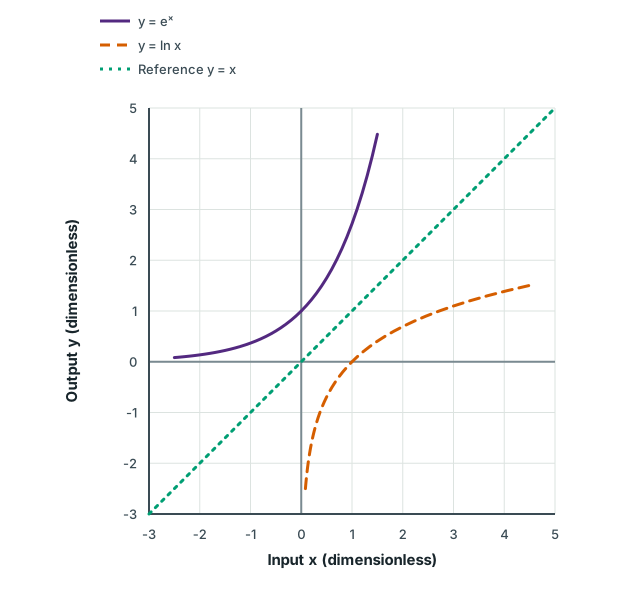
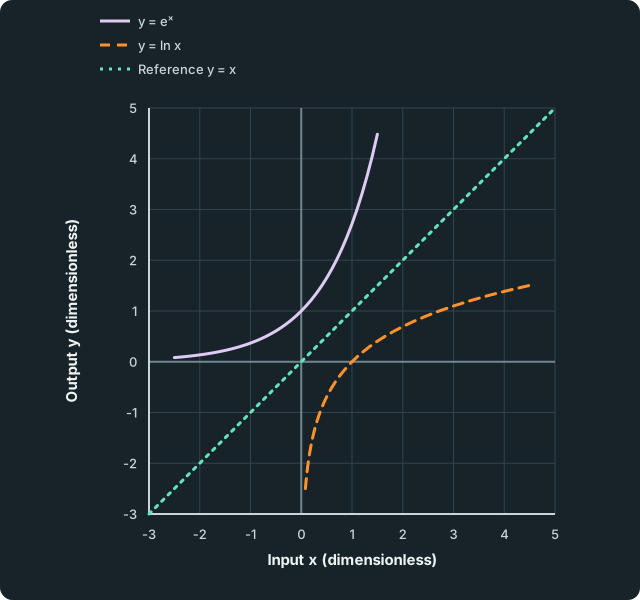
The exponential graph passes through (0,1), has positive outputs and approaches the horizontal line y = 0 as x becomes very negative. The natural-logarithm graph passes through (1,0), uses positive inputs and approaches the vertical line x = 0 from the right. It has no y-intercept because ln 0 is not defined.
Exponential and natural-logarithm coordinates interchange
Both curves increase. The exponential becomes steeper to the right; the natural logarithm becomes less steep. The exponential approaches the horizontal axis to the left. The logarithm approaches the vertical axis from its positive-input side.
Scroll across the figure to read all labels.
View figure data
| Series | Input x (dimensionless) | Output y (dimensionless) |
|---|---|---|
| y = eˣ | -2.50000 | 0.08208 |
| y = eˣ | -2.40000 | 0.09072 |
| y = eˣ | -2.30000 | 0.10026 |
| y = eˣ | -2.20000 | 0.11080 |
| y = eˣ | -2.10000 | 0.12246 |
| y = eˣ | -2.00000 | 0.13534 |
| y = eˣ | -1.90000 | 0.14957 |
| y = eˣ | -1.80000 | 0.16530 |
| y = eˣ | -1.70000 | 0.18268 |
| y = eˣ | -1.60000 | 0.20190 |
| y = eˣ | -1.50000 | 0.22313 |
| y = eˣ | -1.40000 | 0.24660 |
| y = eˣ | -1.30000 | 0.27253 |
| y = eˣ | -1.20000 | 0.30119 |
| y = eˣ | -1.10000 | 0.33287 |
| y = eˣ | -1.00000 | 0.36788 |
| y = eˣ | -0.90000 | 0.40657 |
| y = eˣ | -0.80000 | 0.44933 |
| y = eˣ | -0.70000 | 0.49659 |
| y = eˣ | -0.60000 | 0.54881 |
| y = eˣ | -0.50000 | 0.60653 |
| y = eˣ | -0.40000 | 0.67032 |
| y = eˣ | -0.30000 | 0.74082 |
| y = eˣ | -0.20000 | 0.81873 |
| y = eˣ | -0.10000 | 0.90484 |
| y = eˣ | 0.00000 | 1.00000 |
| y = eˣ | 0.10000 | 1.10517 |
| y = eˣ | 0.20000 | 1.22140 |
| y = eˣ | 0.30000 | 1.34986 |
| y = eˣ | 0.40000 | 1.49182 |
| y = eˣ | 0.50000 | 1.64872 |
| y = eˣ | 0.60000 | 1.82212 |
| y = eˣ | 0.70000 | 2.01375 |
| y = eˣ | 0.80000 | 2.22554 |
| y = eˣ | 0.90000 | 2.45960 |
| y = eˣ | 1.00000 | 2.71828 |
| y = eˣ | 1.10000 | 3.00417 |
| y = eˣ | 1.20000 | 3.32012 |
| y = eˣ | 1.30000 | 3.66930 |
| y = eˣ | 1.40000 | 4.05520 |
| y = eˣ | 1.50000 | 4.48169 |
| y = ln x | 0.08208 | -2.50000 |
| y = ln x | 0.09072 | -2.40000 |
| y = ln x | 0.10026 | -2.30000 |
| y = ln x | 0.11080 | -2.20000 |
| y = ln x | 0.12246 | -2.10000 |
| y = ln x | 0.13534 | -2.00000 |
| y = ln x | 0.14957 | -1.90000 |
| y = ln x | 0.16530 | -1.80000 |
| y = ln x | 0.18268 | -1.70000 |
| y = ln x | 0.20190 | -1.60000 |
| y = ln x | 0.22313 | -1.50000 |
| y = ln x | 0.24660 | -1.40000 |
| y = ln x | 0.27253 | -1.30000 |
| y = ln x | 0.30119 | -1.20000 |
| y = ln x | 0.33287 | -1.10000 |
| y = ln x | 0.36788 | -1.00000 |
| y = ln x | 0.40657 | -0.90000 |
| y = ln x | 0.44933 | -0.80000 |
| y = ln x | 0.49659 | -0.70000 |
| y = ln x | 0.54881 | -0.60000 |
| y = ln x | 0.60653 | -0.50000 |
| y = ln x | 0.67032 | -0.40000 |
| y = ln x | 0.74082 | -0.30000 |
| y = ln x | 0.81873 | -0.20000 |
| y = ln x | 0.90484 | -0.10000 |
| y = ln x | 1.00000 | 0.00000 |
| y = ln x | 1.10517 | 0.10000 |
| y = ln x | 1.22140 | 0.20000 |
| y = ln x | 1.34986 | 0.30000 |
| y = ln x | 1.49182 | 0.40000 |
| y = ln x | 1.64872 | 0.50000 |
| y = ln x | 1.82212 | 0.60000 |
| y = ln x | 2.01375 | 0.70000 |
| y = ln x | 2.22554 | 0.80000 |
| y = ln x | 2.45960 | 0.90000 |
| y = ln x | 2.71828 | 1.00000 |
| y = ln x | 3.00417 | 1.10000 |
| y = ln x | 3.32012 | 1.20000 |
| y = ln x | 3.66930 | 1.30000 |
| y = ln x | 4.05520 | 1.40000 |
| y = ln x | 4.48169 | 1.50000 |
| Reference y = x | -3.00000 | -3.00000 |
| Reference y = x | 5.00000 | 5.00000 |
Interchanging the coordinates on one graph gives the other: (0,1) becomes (1,0), and (1,e) becomes (e,1). The reference line y = x makes this interchange visible. Neither curve has a turning point: both increase, although the exponential gets steeper and the logarithm increases more slowly.
A negative logarithm output is possible even though its input is positive. For example, ln(e⁻¹) = -1. Rejecting a logarithm just because its result is negative confuses the input condition with the output.
Logarithm laws require positive arguments
For u > 0, v > 0 and a real constant r,
There is no matching sum law for ln(u + v). For example, ln 5 + ln 2 = ln 10, not ln 7. The multiplication happens inside the combined logarithm because adding logarithms combines a product.
Keep the original argument conditions when solving equations. For
both original arguments must be positive, so x > 1. Combining the logs gives ln(x²-1) = ln 8, hence x² = 9. The algebraic candidates are 3 and −3, but only x = 3 satisfies the original equation’s conditions. The positive combined product at −3 does not make its two negative original arguments valid.
Check your understanding 2 Check the argument, not just the transformed equation
Solve ln(x + 2) = ln 5 + ln 2. Explain why combining the right side as ln 7 would solve a different equation, and check the original argument at your answer.
Show answer
The right side is ln 10, so x + 2 = 10 and x = 8. Its original argument is 10, which is positive. Adding logarithms combines the product 5 × 2, not the sum 5 + 2. Using ln 7 would give x = 5, which does not satisfy the stated equation.
Check your understanding 3 Repair an extra candidate from a combined product
A solution of ln(x-1) + ln(x + 1) = ln 15 reaches x² = 16 and accepts both x = 4 and x = −4 because x² − 1 is positive at each. Explain the error and give the valid solution. Would replacing the original arguments by their absolute values preserve the original equation?
Show answer
The separate arguments require x − 1 > 0 and x + 1 > 0, hence x > 1. At x = −4 they are −5 and −3, so the original logarithms are not defined. At x = 4 the arguments are 3 and 5, giving ln 15. The valid solution is x = 4 only.
Inserting absolute values changes the equation: it would allow negative arguments of the original expressions to contribute logs of different, positive numbers. It cannot be used to justify the rejected candidate in the stated problem.
Use a stated growth model
A model for a measured quantity is
where t is the numerical elapsed time in hours and N is measured in units. At t = 0, N = 120. Increasing t by one hour multiplies N by e^(0.15) ≈ 1.161834, an increase of about 16.2%. The continuous parameter 0.15 per hour is not itself a 15% discrete hourly increase.
The doubling time solves 120e^(0.15t) = 240. Divide by 120 before taking the natural logarithm:
For the decay model D(t) = 120e^(-0.15t), the one-hour multiplier is e^(-0.15) ≈ 0.860708. Its half-value time is also ln 2/0.15 hours. The negative exponent produces decay; it does not make the modelled quantity negative.
Logarithmic growth has decreasing increments
Consider L(t) = 10 + 4 ln(1 + t), with t the numerical elapsed time in hours and t ≥ 0. It starts at 10, gives approximately 12.7726 at t = 1 and 14.3944 at t = 2. The successive one-hour increases are about 2.7726 and 1.6219, rather than a constant additive step or the exponential model’s constant multiplicative factor.
The logarithm keeps increasing more slowly as its positive input grows. A graph that appears to flatten in one window does not establish a finite ceiling. A mathematical growth rule also needs a stated setting and interval before being applied to a real quantity indefinitely.
Try it yourself 1
Recover a model from two observations
Problem
A proposed model is Q(t) = Ae^kt, with A > 0, t the numerical time in hours and Q measured in units. The observations are Q(2) = 90 and Q(6) = 150. Use this model to find A and k, then the time at which its predicted quantity reaches 200 units. Give the time to three significant figures.
Show how the two observations determine the parameters. State the meaning of A and distinguish that fitted initial value from an observation actually taken at t = 0. Is the 200-unit prediction an interpolation between the two observations?
Write your answer, then compare it with the solution
Hints
Hint 1
Use the change between the two observed times
Write an equation for each observation. Combining the equations can remove the unknown initial multiplier before you solve for the growth parameter. Then return to either original observation to recover it.
Show full solution
Use the ratio of the observations
Method
Write Ae^2k = 90 and Ae^6k = 150.Reason
The same initial multiplier occurs in both equations, while the elapsed-time difference is four hours.Working
Answer
Dividing the second equation by the first gives e^4k = 150/90 = 5/3. Thus k = ln(5/3)/4 ≈ 0.127706406 per hour. This is positive, agreeing with the observed increase.Recover the initial multiplier
Method
Substitute k into an original observation equation.Reason
The ratio determined the growth parameter but cancelled A.Working
Answer
A = 90e^(-2k) = 90 square root of (3/5) ≈ 69.7137002 units. Substituting the unrounded A and k returns 90 at two hours and 150 at six hours. A is the model’s Q(0), not a measured zero-hour observation supplied by the problem.Solve the target equation and interpret the time
Method
Set the fitted quantity equal to 200 and use a natural logarithm.Reason
The unknown time occurs in an exponent; the original positive target and multiplier permit the logarithm.Working
Answer
Ae^kt = 200 gives t = ln(200/A)/k ≈ 8.25268318 hours, or 8.25 hours to three significant figures. This lies beyond the observed interval from two to six hours, so it is extrapolation under the proposed model. The two observations alone do not establish that the same growth rule remains valid there.
Quick check
Compare your equations, elapsed-time difference, growth parameter, initial value and target time separately. Keep unrounded parameters in the final calculation, and distinguish model predictions from measurements actually available.
Keep track of this lesson
Mark the lesson done when you have worked through it.
Lesson progress is optional and kept on this device.
Loading lesson controls…
Your lesson mark records your own study. Checks are kept separately in My Learning.