On this page
Loading guide controls…
Continue lessonNew guided lessons are not available yet.
Guided lesson options
You stopped at:
ContinueRevision Mode is on. Questions and activities are hidden.
The linked question or activity is hidden by Revision Mode.
Row reduction is the systematic way to solve a system of linear equations, and it reveals far more than one solution: whether a solution exists at all, how many free parameters it has, and the rank of the matrix. This lesson reduces matrices with row operations that keep the solutions, interprets a zero row, finds rank, null space and column space, computes 3 × 3 determinants and inverses, and decides how a parameter in a system changes the type of solution.
Row operations keep the solutions
A system of linear equations Ax = b is recorded in the augmented matrix (A ∣ b). Three row operations never change the solution set, because each can be undone:
- swap two rows;
- multiply a row by a nonzero number;
- add a multiple of one row to another.
Row reduction uses them to reach echelon form: each row’s first nonzero entry (its leading entry) is to the right of the one above, and any zero rows are at the bottom. Then the last equation involves the fewest unknowns, and you substitute back upwards.
Worked example 1
Three planes through one point
Worked example 1
Three planes through one point
Solve x + y + z = 6, x + 2y + 3z = 14, 2x + 3y + 5z = 23 by row reduction, and interpret the answer geometrically.
Show full solutionHide solution
Clear the first column
Method
Subtract row 1 from row 2, and twice row 1 from row 3.Reason
The leading 1 in row 1 removes x from every later equation.Working
Answer
(1116; 12314; 23523) → (1116; 0128; 01311)Clear the second column and substitute back
Method
Subtract the new row 2 from row 3.Reason
Echelon form leaves one unknown in the last row.Working
Answer
(1116; 0128; 0013)So z = 3, then y = 8-2z = 2, then x = 6-y-z = 1.
Quick check
Substitute (1,2,3) into all three original equations: 6, 1 + 4 + 9 = 14 and 2 + 6 + 15 = 23. Each equation is a plane, and the three planes meet at the single point (1,2,3).
When elimination produces a zero row
Worked example 2
A line of solutions, or none
Worked example 2
A line of solutions, or none
Solve x + y + z = 6, x + 2y + 3z = 14, 2x + 3y + 4z = c for (a) c = 20 and (b) c = 21. Interpret each case geometrically.
Show full solutionHide solution
Reduce with c kept general
Method
Use the same operations as before.Reason
Only the last entry depends on c, so one reduction covers both cases.Working
Answer
(1116; 0128; 012c-12) → (1116; 0128; 000c-20)Case (a): c = 20
Method
The last row says 0 = 0, so only two equations constrain three unknowns.Reason
One unknown is free; give it a parameter.Working
Answer
Let z = t. Then y = 8-2t and x = 6-y-z = t-2:
r = (-2; 8; 0) + t (1; -2; 1), t∈R.The three planes share this line.
Case (b): c = 21
Method
The last row says 0 = 1.Reason
No values of x, y, z can satisfy it.Working
Answer
There is no solution. No two of the normals (1,1,1), (1,2,3), (2,3,4) are parallel, so each pair of planes meets in a line, and the three lines are parallel: the planes form a triangular prism.
Quick check
Check case (a) at t = 0: (-2,8,0) gives 6, 14 and -4 + 24 = 20. A zero row is not by itself “no solution”: read its right-hand entry.
Rank, null space and column space
For the coefficient matrix A = (1, 1, 1; 1, 2, 3; 2, 3, 4):
- The rank is the number of nonzero rows in an echelon form: here 2.
- The null space is the set of x with Ax = 0. From the reduction with zero right-hand side, it is {t(1,-2,1)^T}, a line through the origin with basis {(1,-2,1)^T}. Its dimension, the nullity, is 1.
- The column space (or range space) is the set of all Ax, the combinations of the columns. The third column is 2 × the second minus the first, so the first two columns are a basis, and the column space is the plane z = x + y through the origin.
For an n × n matrix, rank + nullity = n: here 2 + 1 = 3. The row space, spanned by the rows, has the same dimension as the column space.
The null space is a subspace: it contains 0, and if Au = Av = 0 then A(λu + μv) = 0. The column space explains the earlier cases: Ax = b has a solution exactly when b is in the column space, that is when b₃ = b₁ + b₂. That holds for (6,14,20) and fails for (6,14,21).
A null-space direction also runs along the solution line
The solid projected solution line is y = 4 − 2x, with z = x + 2. The dashed projected null-space line is y = −2x, with z = x. Only the latter passes through the three-dimensional origin.
Scroll across to read every label.
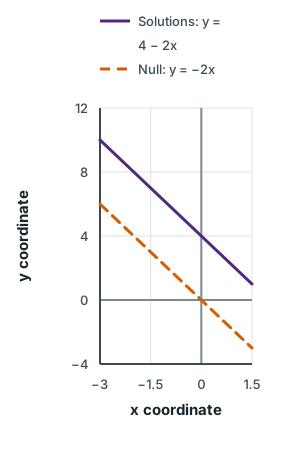
Figure data
This table is included in print while it is open.
| x coordinate | Solutions: y = 4 − 2x | Null: y = −2x |
|---|---|---|
| -3.00 | 10.0 | 6.0 |
| -2.95 | 9.9 | 5.9 |
| -2.90 | 9.8 | 5.8 |
| -2.85 | 9.7 | 5.7 |
| -2.80 | 9.6 | 5.6 |
| -2.75 | 9.5 | 5.5 |
| -2.70 | 9.4 | 5.4 |
| -2.65 | 9.3 | 5.3 |
| -2.60 | 9.2 | 5.2 |
| -2.55 | 9.1 | 5.1 |
| -2.50 | 9.0 | 5.0 |
| -2.45 | 8.9 | 4.9 |
| -2.40 | 8.8 | 4.8 |
| -2.35 | 8.7 | 4.7 |
| -2.30 | 8.6 | 4.6 |
| -2.25 | 8.5 | 4.5 |
| -2.20 | 8.4 | 4.4 |
| -2.15 | 8.3 | 4.3 |
| -2.10 | 8.2 | 4.2 |
| -2.05 | 8.1 | 4.1 |
| -2.00 | 8.0 | 4.0 |
| -1.95 | 7.9 | 3.9 |
| -1.90 | 7.8 | 3.8 |
| -1.85 | 7.7 | 3.7 |
| -1.80 | 7.6 | 3.6 |
| -1.75 | 7.5 | 3.5 |
| -1.70 | 7.4 | 3.4 |
| -1.65 | 7.3 | 3.3 |
| -1.60 | 7.2 | 3.2 |
| -1.55 | 7.1 | 3.1 |
| -1.50 | 7.0 | 3.0 |
| -1.45 | 6.9 | 2.9 |
| -1.40 | 6.8 | 2.8 |
| -1.35 | 6.7 | 2.7 |
| -1.30 | 6.6 | 2.6 |
| -1.25 | 6.5 | 2.5 |
| -1.20 | 6.4 | 2.4 |
| -1.15 | 6.3 | 2.3 |
| -1.10 | 6.2 | 2.2 |
| -1.05 | 6.1 | 2.1 |
| -1.00 | 6.0 | 2.0 |
| -0.95 | 5.9 | 1.9 |
| -0.90 | 5.8 | 1.8 |
| -0.85 | 5.7 | 1.7 |
| -0.80 | 5.6 | 1.6 |
| -0.75 | 5.5 | 1.5 |
| -0.70 | 5.4 | 1.4 |
| -0.65 | 5.3 | 1.3 |
| -0.60 | 5.2 | 1.2 |
| -0.55 | 5.1 | 1.1 |
| -0.50 | 5.0 | 1.0 |
| -0.45 | 4.9 | 0.9 |
| -0.40 | 4.8 | 0.8 |
| -0.35 | 4.7 | 0.7 |
| -0.30 | 4.6 | 0.6 |
| -0.25 | 4.5 | 0.5 |
| -0.20 | 4.4 | 0.4 |
| -0.15 | 4.3 | 0.3 |
| -0.10 | 4.2 | 0.2 |
| -0.05 | 4.1 | 0.1 |
| 0.00 | 4.0 | 0.0 |
| 0.05 | 3.9 | -0.1 |
| 0.10 | 3.8 | -0.2 |
| 0.15 | 3.7 | -0.3 |
| 0.20 | 3.6 | -0.4 |
| 0.25 | 3.5 | -0.5 |
| 0.30 | 3.4 | -0.6 |
| 0.35 | 3.3 | -0.7 |
| 0.40 | 3.2 | -0.8 |
| 0.45 | 3.1 | -0.9 |
| 0.50 | 3.0 | -1.0 |
| 0.55 | 2.9 | -1.1 |
| 0.60 | 2.8 | -1.2 |
| 0.65 | 2.7 | -1.3 |
| 0.70 | 2.6 | -1.4 |
| 0.75 | 2.5 | -1.5 |
| 0.80 | 2.4 | -1.6 |
| 0.85 | 2.3 | -1.7 |
| 0.90 | 2.2 | -1.8 |
| 0.95 | 2.1 | -1.9 |
| 1.00 | 2.0 | -2.0 |
| 1.05 | 1.9 | -2.1 |
| 1.10 | 1.8 | -2.2 |
| 1.15 | 1.7 | -2.3 |
| 1.20 | 1.6 | -2.4 |
| 1.25 | 1.5 | -2.5 |
| 1.30 | 1.4 | -2.6 |
| 1.35 | 1.3 | -2.7 |
| 1.40 | 1.2 | -2.8 |
| 1.45 | 1.1 | -2.9 |
| 1.50 | 1.0 | -3.0 |
Check your understanding 1
A 2 × 2 example
Check your understanding 1
A 2 × 2 example
For B = (1, 2; 2, 4), find the rank, a basis for the null space and a basis for the column space. Check rank + nullity, and decide whether Bx = (3; 5) has a solution.
Show answerHide answer
Subtracting twice row 1 from row 2 leaves one nonzero row, so the rank is 1. The null space is x + 2y = 0, with basis {(2,-1)^T}, so the nullity is 1 and 1 + 1 = 2. Both columns are multiples of (1,2)^T, which is a basis for the column space. (3,5)^T is not a multiple of (1,2)^T, so the system has no solution.
Determinants and inverses of 3 × 3 matrices
A square system has exactly one solution when its coefficient matrix has an inverse, and a matrix has an inverse exactly when its determinant is not zero. For a 3 × 3 matrix, expand along the first row. Each entry is multiplied by its cofactor: the 2 × 2 determinant left when you delete that entry’s row and column, with the signs + - + along the row.
For A = (2, 1, 0; 1, 3, 1; 0, 1, 2),
You may expand along any row or column, using the sign pattern +, -, +; -, +, -; +, -, +; a row or column with zeros saves work. Swapping two rows changes the sign of the determinant, and adding a multiple of one row to another leaves it unchanged, so row reduction is another way to find it.
To find the inverse, replace every entry by its cofactor, transpose the result to get the adjugate, and divide by the determinant:
Check by multiplying: AA⁻¹ = I. Row reducing (A ∣ I) until the left-hand block is I gives the same inverse in the right-hand block.
Check your understanding 2
Determinant and inverse
Check your understanding 2
Determinant and inverse
For B = (1, 2, 0; 0, 1, 3; 2, 0, 1), find det B and B⁻¹. Then check one entry of BB⁻¹.
Show answerHide answer
Along the first row, det B = 1(1-0)-2(0-6) + 0 = 13. The adjugate is (1, -2, 6; 6, 1, -3; -2, 4, 1), so B⁻¹ = 1/13 (1, -2, 6; 6, 1, -3; -2, 4, 1). Check: row 1 of B times column 1 of B⁻¹ is (1/13)(1 + 12 + 0) = 1.
A parameter decides the case
Common mistakes
- Using an operation that changes the solutions, such as multiplying a row by 0 or adding a multiple of a row to itself.
- Reading a zero row 0 = 0 as “no solution”; it signals a free parameter. A row 0 = c with c ≠ 0 signals inconsistency.
- Giving the null space as a single vector without the parameter, or forgetting that it always contains 0.
- Taking the rank as the number of non-zero entries instead of the number of non-zero rows after reduction.
- Dividing by a parameter in elimination without treating the case where it is zero separately.
Before you move on
Try it yourself 1
For which k and c?
Try it yourself 1
For which k and c?
Consider x + y + z = 6, x + 2y + 3z = 14, 2x + 3y + kz = c. Find the values of k for which the system has a unique solution. For the remaining value of k, find the condition on c for the system to have any solutions, and describe the solution set.
Write your answer, then compare it with the solution
Hint 1
Start with the determinant
A square system has a unique solution exactly when its coefficient matrix is non-singular.
Show full solutionHide solution
Find when the matrix is singular
Method
Expand the determinant along the first row.Reason
A nonzero determinant gives an inverse, and so exactly one solution.Working
Answer
det(1, 1, 1; 1, 2, 3; 2, 3, k) = (2k-9)-(k-6) + (3-4) = k-4.The solution is unique for every k ≠ 4, for every c.
Reduce the case k = 4
Method
With k = 4 this is the system of the previous example.Reason
The final row reduced to 0 = c-20.Working
Answer
If c = 20, there are infinitely many solutions on the line (-2,8,0) + t(1,-2,1). If c ≠ 20, there are none.
Quick check
At k = 5, c = 23 you should recover the unique solution (1,2,3) from the first example. Rank explains the cases: rank 3 when k ≠ 4; rank 2 when k = 4, with solutions only when b lies in the column space. Compare your explanation with the solution yourself; it is not marked.
Linear transformations and the axioms of a linear space are taught in Linear transformations and linear spaces.
Loading reading progress…
Lesson done
- Monday
- Tuesday
- Wednesday
- Thursday
- Friday
- Saturday
- Sunday
Checking learning on this device…
Change goal
Progress options
Loading questions…