Inverse and composite functions
Choose inverse branches, exchange domain and range, and check the full intermediate set in a composition.
More
Offline pages
Saved on this device only. Connect at least once every 30 days to confirm Premium. Sign-out or a change of account removes saved copies.
Find this activity in your course
On this page
You stopped at:
ContinueRevision Mode is on. Questions and activities are hidden.
Reversing a rule must recover one input
A function includes its domain. To reverse it as a function on its range, each output must identify exactly one original input: the original function must be one-to-one. A graph passes the horizontal-line test when every horizontal line meets it at most once.
The rule f(x) = (x-2)² on all real inputs fails this test. For example, f(1) = f(3) = 1. An inverse could not choose between those two inputs from the output alone. This differs from the vertical-line test, which checks whether the original graph is a function at all.
Restrict the original domain to x ≥ 2. Now x-2 ≥ 0, and each output identifies one input. Solve
The inverse is f⁻¹(x) = 2 + square root of x. Its domain is the original range [0,∞), and its range is the original domain [2,∞). Choosing the positive square root follows from the original restriction; it is not a universal rule for quadratic inverses.
If the original domain were instead x ≥ 3, its range would be [1,∞). The inverse would use the same expression, but only for x ≥ 1, with range [3,∞). Do not replace a stated inverse domain by every input its formula can accept.
Check your understanding 1 The domain chooses the square-root sign
For f(x) = (x + 1)² restricted to x ≤ -1, find its inverse and state the inverse’s domain and range. Explain why the other square-root branch fails.
Show answer
The range of f is [0,∞). Solving with x + 1 ≤ 0 gives x = -1- square root of y. Thus f⁻¹(x) = -1- square root of x, with domain [0,∞) and range (-∞,-1]. The plus branch would usually return inputs greater than -1, outside f’s original domain. At output zero the branches meet, but an inverse must work throughout the full range.
Reflect points and exchange the two sets
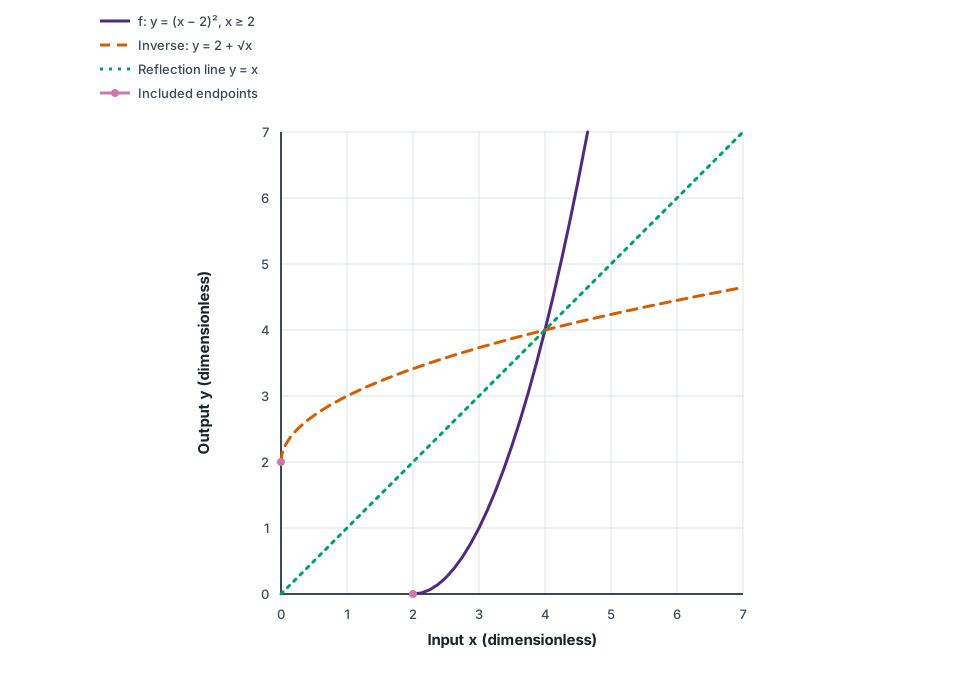
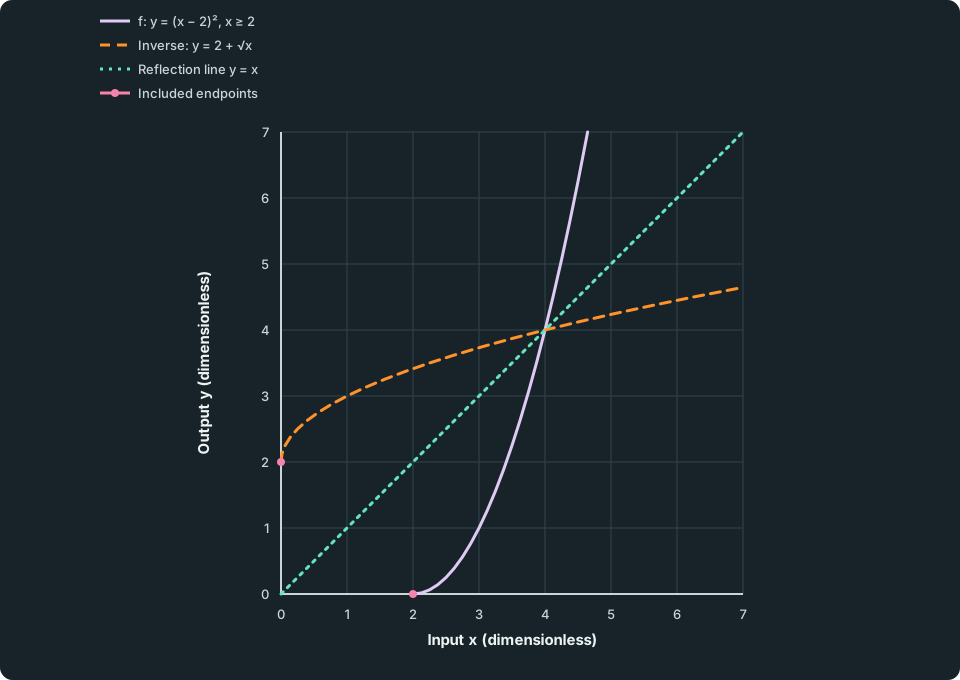
If (a,b) is on a one-to-one function’s graph, then (b,a) is on its inverse’s graph. This exchange reflects the graph in y = x, provided the axes use equal coordinate scales. The domain and range exchange at the same time.
A function and its inverse
Equal coordinate scales show y = (x − 2)² for x ≥ 2 and its inverse y = 2 + √x. Filled circles mark their included endpoints. The dotted diagonal is y = x.
Scroll across the figure to read all labels.
View figure data
| Series | Input x (dimensionless) | Output y (dimensionless) |
|---|---|---|
| f: y = (x − 2)², x ≥ 2 | 2.00000 | 0.00000 |
| f: y = (x − 2)², x ≥ 2 | 2.12500 | 0.01563 |
| f: y = (x − 2)², x ≥ 2 | 2.25000 | 0.06250 |
| f: y = (x − 2)², x ≥ 2 | 2.37500 | 0.14063 |
| f: y = (x − 2)², x ≥ 2 | 2.50000 | 0.25000 |
| f: y = (x − 2)², x ≥ 2 | 2.62500 | 0.39063 |
| f: y = (x − 2)², x ≥ 2 | 2.75000 | 0.56250 |
| f: y = (x − 2)², x ≥ 2 | 2.87500 | 0.76563 |
| f: y = (x − 2)², x ≥ 2 | 3.00000 | 1.00000 |
| f: y = (x − 2)², x ≥ 2 | 3.12500 | 1.26563 |
| f: y = (x − 2)², x ≥ 2 | 3.25000 | 1.56250 |
| f: y = (x − 2)², x ≥ 2 | 3.37500 | 1.89063 |
| f: y = (x − 2)², x ≥ 2 | 3.50000 | 2.25000 |
| f: y = (x − 2)², x ≥ 2 | 3.62500 | 2.64063 |
| f: y = (x − 2)², x ≥ 2 | 3.75000 | 3.06250 |
| f: y = (x − 2)², x ≥ 2 | 3.87500 | 3.51563 |
| f: y = (x − 2)², x ≥ 2 | 4.00000 | 4.00000 |
| f: y = (x − 2)², x ≥ 2 | 4.12500 | 4.51563 |
| f: y = (x − 2)², x ≥ 2 | 4.25000 | 5.06250 |
| f: y = (x − 2)², x ≥ 2 | 4.37500 | 5.64063 |
| f: y = (x − 2)², x ≥ 2 | 4.50000 | 6.25000 |
| f: y = (x − 2)², x ≥ 2 | 4.64575 | 7.00000 |
| Inverse: y = 2 + √x | 0.00000 | 2.00000 |
| Inverse: y = 2 + √x | 0.01563 | 2.12500 |
| Inverse: y = 2 + √x | 0.06250 | 2.25000 |
| Inverse: y = 2 + √x | 0.14063 | 2.37500 |
| Inverse: y = 2 + √x | 0.25000 | 2.50000 |
| Inverse: y = 2 + √x | 0.39063 | 2.62500 |
| Inverse: y = 2 + √x | 0.56250 | 2.75000 |
| Inverse: y = 2 + √x | 0.76563 | 2.87500 |
| Inverse: y = 2 + √x | 1.00000 | 3.00000 |
| Inverse: y = 2 + √x | 1.26563 | 3.12500 |
| Inverse: y = 2 + √x | 1.56250 | 3.25000 |
| Inverse: y = 2 + √x | 1.89063 | 3.37500 |
| Inverse: y = 2 + √x | 2.25000 | 3.50000 |
| Inverse: y = 2 + √x | 2.64063 | 3.62500 |
| Inverse: y = 2 + √x | 3.06250 | 3.75000 |
| Inverse: y = 2 + √x | 3.51563 | 3.87500 |
| Inverse: y = 2 + √x | 4.00000 | 4.00000 |
| Inverse: y = 2 + √x | 4.51563 | 4.12500 |
| Inverse: y = 2 + √x | 5.06250 | 4.25000 |
| Inverse: y = 2 + √x | 5.64063 | 4.37500 |
| Inverse: y = 2 + √x | 6.25000 | 4.50000 |
| Inverse: y = 2 + √x | 7.00000 | 4.64575 |
| Reflection line y = x | 0.00000 | 0.00000 |
| Reflection line y = x | 7.00000 | 7.00000 |
| Included endpoints | 2.00000 | 0.00000 |
| Included endpoints | 0.00000 | 2.00000 |
The displayed curves are parts of the functions, not their full domains. For example, the original rule at input 5 gives output 9, so the inverse contains (9,5), even though that point lies outside this plotting window.
The notation f⁻¹ means an inverse function, whereas 1/f means the reciprocal of the output. With f(x) = (x-2)² on x ≥ 2, f⁻¹(4) = 4 but 1/f(4) = 1/4. The reciprocal is also undefined at the original input 2, where f is zero. Exchanging coordinates and reciprocating y-values are different operations.
Check an inverse on the original sets
For the branch x ≥ 2,
The last equality uses x-2 ≥ 0. On the unrestricted real line, square root of ((x-2)²) is |x-2|, not always x-2. Substituting x = 1 into the unrestricted expression would give 3, exposing why this branch cannot invert inputs below 2.
In the other direction, for every y ≥ 0,
Both checks matter: the inverse must return allowed original inputs and must recover every output in the original range. State the sets on which each identity holds.
Composition follows the inside function first
Define (f° g)(x) = f(g(x)): apply g, then feed its output into f. For f(x) = x² + 1 and g(x) = 3x-2, both with domain R,
At input 1, the first order follows 1 → 1 → 2, whereas the second follows 1 → 2 → 4. Order generally changes both the rule and the result. Read from the innermost operation outward before simplifying.
For f° g to exist on the whole stated domain of g, every output of g must be an allowed input of f:
Testing one input is insufficient. If f(x) = square root of x for x ≥ 0 and g(x) = x-1 for all real x, g also produces negative outputs. Thus f° g does not exist on g’s entire stated domain. Although square root of (x-1) is readable for x ≥ 1, silently replacing g’s declared domain would change the question.
Use ranges to decide which order exists
Let f(x) = (x-2)² for x ≥ 2 and g(x) = 2-x for x ≤ 0. The range of g is [2,∞), exactly the domain of f. Therefore f° g exists on (-∞,0] and
Its domain is still x ≤ 0, with range [0,∞). Simplifying to x² does not grant it all real inputs.
The reverse order does not exist on f’s whole domain: f’s range [0,∞) is not contained in g’s domain (-∞,0]. The shared endpoint zero lets one particular calculation work, but does not make every output admissible.
Check your understanding 2 Keep a strict endpoint strict
Let f(x) = square root of (x-1) for x ≥ 1 and g(x) = 2-x for x < 1. Decide whether f° g exists on g’s whole domain. If it does, give its rule, domain and range. Decide whether the reverse order exists on f’s whole domain.
Show answer
The range of g is (1,∞), contained in f’s domain [1,∞). Thus f° g exists, with rule square root of (1-x) on x < 1 and range (0,∞). Zero is approached as x tends to 1 from below, but is not attained because x = 1 is excluded.
The reverse order fails: f’s range is [0,∞), which is not contained in g’s domain (-∞,1). For example, f(5) = 2, and g does not admit input 2.
Try it yourself 1
Interpret the device’s display
Problem
A device accepts a number x with 2 ≤ x ≤ 5. It first calculates y = (x-2)² + 1, then displays D = 2y-3. Express D in terms of x and find its range. Recover the accepted input when the display is 7. Could the device display 18 under the same input restriction? Explain.
Write your answer, then compare it with the solution
Hints
Hint 1
Follow the two operations and the allowed interval
Work through the stages in their stated order. When reversing a reading, check which algebraic solutions belong to the accepted input interval.
Show full solution
Combine the two stages
Method
Substitute the first output into the display rule.Reason
The display receives y, not the original input x.Working
Answer
D = 2((x-2)² + 1)-3 = 2(x-2)²-1. As x-2 runs through [0,3], its square takes every value in [0,9]. Hence D takes every value in [-1,17].Recover an allowed input
Method
Set the display expression equal to 7.Reason
Solving an equation may give candidates outside the device’s original domain.Working
Answer
2(x-2)²-1 = 7 gives (x-2)² = 4, so x = 0 or x = 4. Only x = 4 is accepted. It gives y = 5 and then D = 7.
Quick check
Both range endpoints are included because the device accepts inputs 2 and 5. A display of 18 is above the maximum 17, so it has no accepted input under this model. Compare the rule, attainable set and branch choice separately; a readable square root alone does not establish an allowed original input.
Before simplifying, record the original domain and the set passed from one function to the next. For inversion, use one-to-one behaviour and exchange domain with range. For composition, test the whole intermediate range and retain the declared domain after simplification.
Keep track of this lesson
Mark the lesson done when you have worked through it.
Lesson progress is optional and kept on this device.
Loading lesson controls…
Your lesson mark records your own study. Checks are kept separately in My Learning.