Conics and rational graph features
Derive coordinate restrictions, distinguish holes from asymptotes, and use equations to verify graph features.
More
Offline pages
Saved on this device only. Connect at least once every 30 days to confirm Premium. Sign-out or a change of account removes saved copies.
Find this activity in your course
On this page
You stopped at:
ContinueRevision Mode is on. Questions and activities are hidden.
Let the equation decide the allowed coordinates
A graph is the set of coordinate pairs satisfying its equation. It need not be a single-valued function of x. Before choosing a graphing window, identify restrictions from squares, denominators and the stated domain. These restrictions can reveal a missing branch or an impossible point before you plot anything.
For y² = ax with a > 0, the left side is nonnegative, so x ≥ 0. The vertex is (0,0) and the parabola opens right. Every positive x gives two y-values, y = ± square root of ax, while every real y gives an allowed x. The whole curve has range R and is symmetric about y = 0; it is not one function y = f(x).
With a < 0, the allowed inputs instead satisfy x ≤ 0, and the parabola opens left. The parameter’s sign changes the opening, not the nonnegativity of a square.
For x² = by with b > 0, the restriction is y ≥ 0. This parabola opens upward, has vertex (0,0) and symmetry axis x = 0, and is a function y = x²/b on all real x. A negative b reverses the opening and gives y ≤ 0. The cases a = 0 or b = 0 reduce to straight lines; they are not parabolas.
Check your understanding 1 A sideways curve has two branches
For y² = -4x, state the possible x- and y-values, opening direction and symmetry axis. Find all points on the curve with x = -1. Is the whole curve one function of x?
Show answer
Require -4x ≥ 0, so x ≤ 0; every real y is possible because x = -y²/4. The parabola opens left and is symmetric about y = 0. At x = -1, y² = 4, giving both (-1,2) and (-1,-2). A vertical line through x = -1 meets it twice, so the whole relation is not a single-valued function of x.
An ellipse is bounded in both coordinates
For positive a and b,
Both terms are nonnegative and sum to one. Therefore |x| ≤ a and |y| ≤ b. Setting one coordinate to zero gives intercepts (± a,0) and (0,± b). Changing the sign of x or y leaves the equation unchanged, so both coordinate axes are symmetry axes. The ellipse is closed and has no asymptotes.
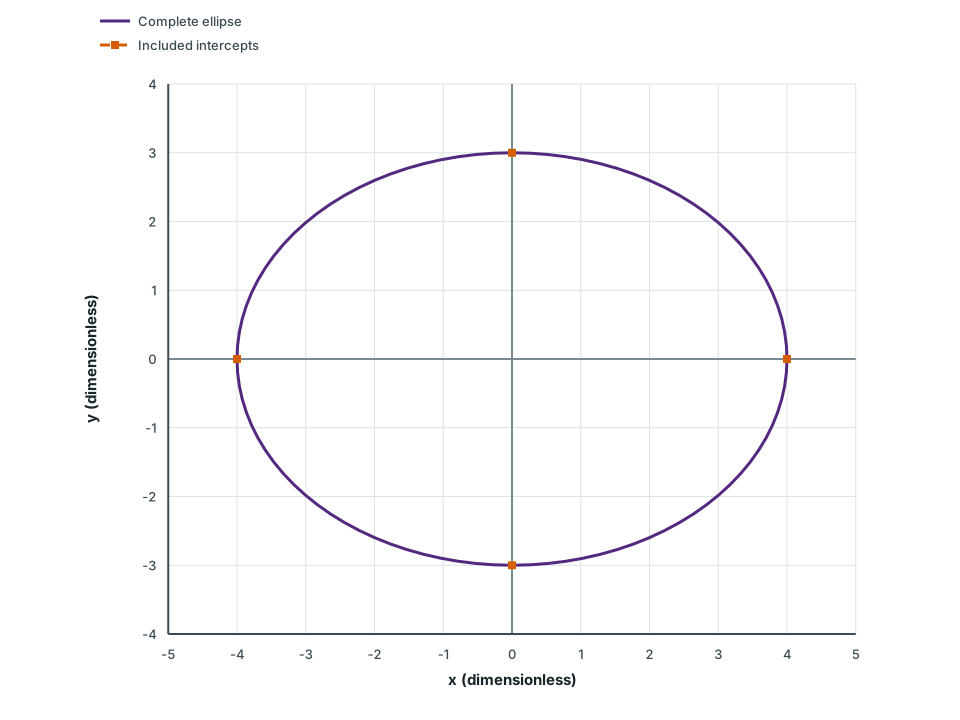
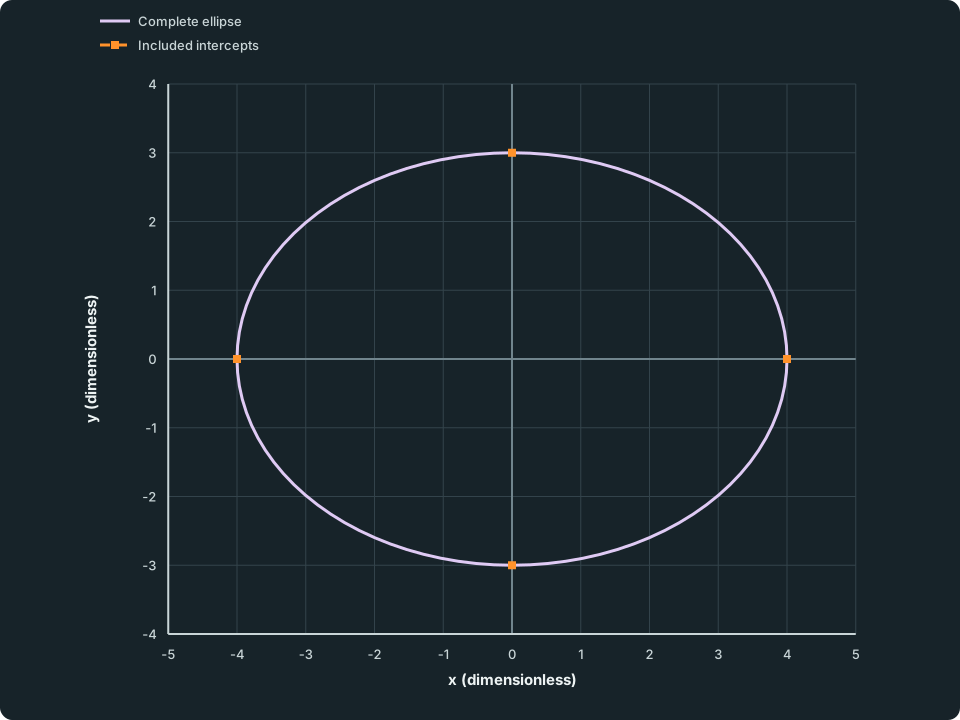
For example, x²/16 + y²/9 = 1 extends from -4 to 4 horizontally and from -3 to 3 vertically. At x = 0 it contains both (0,3) and (0,-3). The upper half alone is the function y = 3 square root of (1-x²/16) on [-4,4]; its range is [0,3]. Selecting that branch changes the relation you are describing.
The complete ellipse x²/16 + y²/9 = 1
A closed ellipse, wider horizontally than vertically, meets the axes at (−4, 0), (4, 0), (0, −3) and (0, 3). Both coordinate axes are symmetry axes. Equal coordinate scales preserve its shape.
Scroll across the figure to read all labels.
View figure data
| Series | x (dimensionless) | y (dimensionless) |
|---|---|---|
| Complete ellipse | 4.0000 | 0.0000 |
| Complete ellipse | 3.9914 | 0.1962 |
| Complete ellipse | 3.9658 | 0.3916 |
| Complete ellipse | 3.9231 | 0.5853 |
| Complete ellipse | 3.8637 | 0.7765 |
| Complete ellipse | 3.7877 | 0.9643 |
| Complete ellipse | 3.6955 | 1.1481 |
| Complete ellipse | 3.5875 | 1.3269 |
| Complete ellipse | 3.4641 | 1.5000 |
| Complete ellipse | 3.3259 | 1.6667 |
| Complete ellipse | 3.1734 | 1.8263 |
| Complete ellipse | 3.0074 | 1.9780 |
| Complete ellipse | 2.8284 | 2.1213 |
| Complete ellipse | 2.6374 | 2.2555 |
| Complete ellipse | 2.4350 | 2.3801 |
| Complete ellipse | 2.2223 | 2.4944 |
| Complete ellipse | 2.0000 | 2.5981 |
| Complete ellipse | 1.7692 | 2.6906 |
| Complete ellipse | 1.5307 | 2.7716 |
| Complete ellipse | 1.2858 | 2.8408 |
| Complete ellipse | 1.0353 | 2.8978 |
| Complete ellipse | 0.7804 | 2.9424 |
| Complete ellipse | 0.5221 | 2.9743 |
| Complete ellipse | 0.2616 | 2.9936 |
| Complete ellipse | 0.0000 | 3.0000 |
| Complete ellipse | -0.2616 | 2.9936 |
| Complete ellipse | -0.5221 | 2.9743 |
| Complete ellipse | -0.7804 | 2.9424 |
| Complete ellipse | -1.0353 | 2.8978 |
| Complete ellipse | -1.2858 | 2.8408 |
| Complete ellipse | -1.5307 | 2.7716 |
| Complete ellipse | -1.7692 | 2.6906 |
| Complete ellipse | -2.0000 | 2.5981 |
| Complete ellipse | -2.2223 | 2.4944 |
| Complete ellipse | -2.4350 | 2.3801 |
| Complete ellipse | -2.6374 | 2.2555 |
| Complete ellipse | -2.8284 | 2.1213 |
| Complete ellipse | -3.0074 | 1.9780 |
| Complete ellipse | -3.1734 | 1.8263 |
| Complete ellipse | -3.3259 | 1.6667 |
| Complete ellipse | -3.4641 | 1.5000 |
| Complete ellipse | -3.5875 | 1.3269 |
| Complete ellipse | -3.6955 | 1.1481 |
| Complete ellipse | -3.7877 | 0.9643 |
| Complete ellipse | -3.8637 | 0.7765 |
| Complete ellipse | -3.9231 | 0.5853 |
| Complete ellipse | -3.9658 | 0.3916 |
| Complete ellipse | -3.9914 | 0.1962 |
| Complete ellipse | -4.0000 | 0.0000 |
| Complete ellipse | -3.9914 | -0.1962 |
| Complete ellipse | -3.9658 | -0.3916 |
| Complete ellipse | -3.9231 | -0.5853 |
| Complete ellipse | -3.8637 | -0.7765 |
| Complete ellipse | -3.7877 | -0.9643 |
| Complete ellipse | -3.6955 | -1.1481 |
| Complete ellipse | -3.5875 | -1.3269 |
| Complete ellipse | -3.4641 | -1.5000 |
| Complete ellipse | -3.3259 | -1.6667 |
| Complete ellipse | -3.1734 | -1.8263 |
| Complete ellipse | -3.0074 | -1.9780 |
| Complete ellipse | -2.8284 | -2.1213 |
| Complete ellipse | -2.6374 | -2.2555 |
| Complete ellipse | -2.4350 | -2.3801 |
| Complete ellipse | -2.2223 | -2.4944 |
| Complete ellipse | -2.0000 | -2.5981 |
| Complete ellipse | -1.7692 | -2.6906 |
| Complete ellipse | -1.5307 | -2.7716 |
| Complete ellipse | -1.2858 | -2.8408 |
| Complete ellipse | -1.0353 | -2.8978 |
| Complete ellipse | -0.7804 | -2.9424 |
| Complete ellipse | -0.5221 | -2.9743 |
| Complete ellipse | -0.2616 | -2.9936 |
| Complete ellipse | 0.0000 | -3.0000 |
| Complete ellipse | 0.2616 | -2.9936 |
| Complete ellipse | 0.5221 | -2.9743 |
| Complete ellipse | 0.7804 | -2.9424 |
| Complete ellipse | 1.0353 | -2.8978 |
| Complete ellipse | 1.2858 | -2.8408 |
| Complete ellipse | 1.5307 | -2.7716 |
| Complete ellipse | 1.7692 | -2.6906 |
| Complete ellipse | 2.0000 | -2.5981 |
| Complete ellipse | 2.2223 | -2.4944 |
| Complete ellipse | 2.4350 | -2.3801 |
| Complete ellipse | 2.6374 | -2.2555 |
| Complete ellipse | 2.8284 | -2.1213 |
| Complete ellipse | 3.0074 | -1.9780 |
| Complete ellipse | 3.1734 | -1.8263 |
| Complete ellipse | 3.3259 | -1.6667 |
| Complete ellipse | 3.4641 | -1.5000 |
| Complete ellipse | 3.5875 | -1.3269 |
| Complete ellipse | 3.6955 | -1.1481 |
| Complete ellipse | 3.7877 | -0.9643 |
| Complete ellipse | 3.8637 | -0.7765 |
| Complete ellipse | 3.9231 | -0.5853 |
| Complete ellipse | 3.9658 | -0.3916 |
| Complete ellipse | 3.9914 | -0.1962 |
| Complete ellipse | 4.0000 | 0.0000 |
| Included intercepts | -4.0000 | 0.0000 |
| Included intercepts | 4.0000 | 0.0000 |
| Included intercepts | 0.0000 | -3.0000 |
| Included intercepts | 0.0000 | 3.0000 |
On a calculator that accepts only y as a function of x, enter both Y₁ = 3 square root of (1-X²/16) and Y₂ = -3 square root of (1-X²/16). Their real inputs stop at X = ±4. A window such as -5 ≤ X ≤ 5, -4 ≤ Y ≤ 4 contains the whole ellipse; software supporting implicit equations can instead plot the original relation directly.
The denominators are squared intercept lengths. Reading 16 as the horizontal intercept or drawing only the positive square-root branch would give a different graph.
The positive squared term locates hyperbola branches
For the hyperbola
rearrange to x²/a² = 1 + y²/b² ≥ 1. Thus x ≤ -a or x ≥ a. Its branches open left and right, with vertices (± a,0). Every real y is possible. Both coordinate axes are symmetry axes, but neither branch enters the strip -a < x < a.
For
instead y²/b² = 1 + x²/a² ≥ 1. The branches open up and down, with vertices (0,± b), all real x allowed, and y ≤ -b or y ≥ b. The positive squared term identifies the opening direction.
For either orientation, the asymptotes are y = ±(b/a)x. Far from the origin, the constant one is small relative to the squared terms, suggesting y²/b² ≈ x²/a². These lines describe limiting behaviour; they are not parts of the hyperbola. Substituting either line into its equation gives zero on the left, not one.
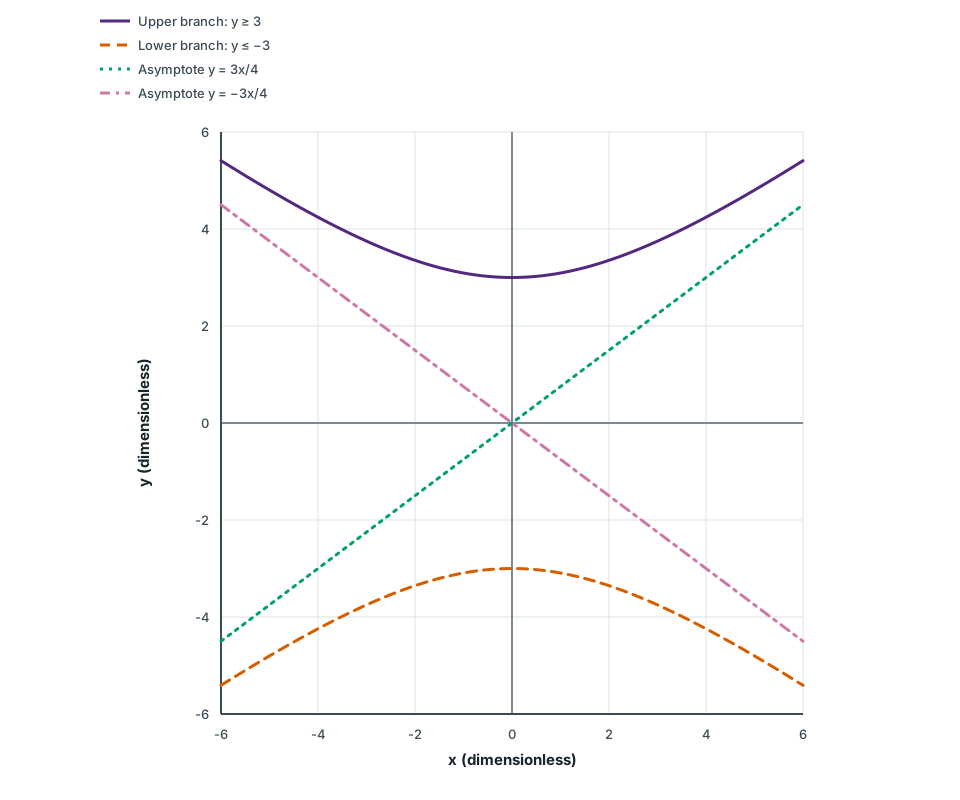
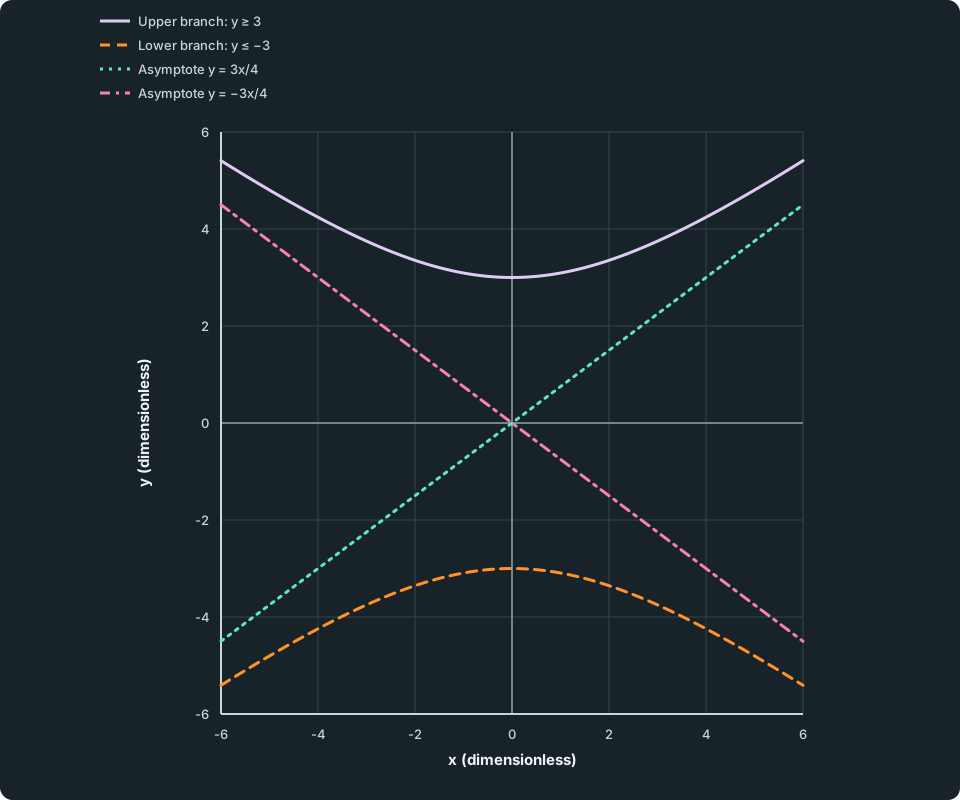
A hyperbola opening up and down
The two branches have vertices (0, 3) and (0, −3), with no curve in −3 < y < 3. Every real x is allowed. Both coordinate axes are symmetry axes. Asymptotes y = ±3x/4 approach the branches far from the origin.
Scroll across the figure to read all labels.
View figure data
| Series | x (dimensionless) | y (dimensionless) |
|---|---|---|
| Upper branch: y ≥ 3 | -6.00 | 5.408 |
| Upper branch: y ≥ 3 | -5.85 | 5.315 |
| Upper branch: y ≥ 3 | -5.70 | 5.223 |
| Upper branch: y ≥ 3 | -5.55 | 5.131 |
| Upper branch: y ≥ 3 | -5.40 | 5.040 |
| Upper branch: y ≥ 3 | -5.25 | 4.950 |
| Upper branch: y ≥ 3 | -5.10 | 4.861 |
| Upper branch: y ≥ 3 | -4.95 | 4.773 |
| Upper branch: y ≥ 3 | -4.80 | 4.686 |
| Upper branch: y ≥ 3 | -4.65 | 4.600 |
| Upper branch: y ≥ 3 | -4.50 | 4.516 |
| Upper branch: y ≥ 3 | -4.35 | 4.432 |
| Upper branch: y ≥ 3 | -4.20 | 4.350 |
| Upper branch: y ≥ 3 | -4.05 | 4.269 |
| Upper branch: y ≥ 3 | -3.90 | 4.190 |
| Upper branch: y ≥ 3 | -3.75 | 4.112 |
| Upper branch: y ≥ 3 | -3.60 | 4.036 |
| Upper branch: y ≥ 3 | -3.45 | 3.962 |
| Upper branch: y ≥ 3 | -3.30 | 3.889 |
| Upper branch: y ≥ 3 | -3.15 | 3.819 |
| Upper branch: y ≥ 3 | -3.00 | 3.750 |
| Upper branch: y ≥ 3 | -2.85 | 3.684 |
| Upper branch: y ≥ 3 | -2.70 | 3.619 |
| Upper branch: y ≥ 3 | -2.55 | 3.558 |
| Upper branch: y ≥ 3 | -2.40 | 3.499 |
| Upper branch: y ≥ 3 | -2.25 | 3.442 |
| Upper branch: y ≥ 3 | -2.10 | 3.388 |
| Upper branch: y ≥ 3 | -1.95 | 3.338 |
| Upper branch: y ≥ 3 | -1.80 | 3.290 |
| Upper branch: y ≥ 3 | -1.65 | 3.245 |
| Upper branch: y ≥ 3 | -1.50 | 3.204 |
| Upper branch: y ≥ 3 | -1.35 | 3.166 |
| Upper branch: y ≥ 3 | -1.20 | 3.132 |
| Upper branch: y ≥ 3 | -1.05 | 3.102 |
| Upper branch: y ≥ 3 | -0.90 | 3.075 |
| Upper branch: y ≥ 3 | -0.75 | 3.052 |
| Upper branch: y ≥ 3 | -0.60 | 3.034 |
| Upper branch: y ≥ 3 | -0.45 | 3.019 |
| Upper branch: y ≥ 3 | -0.30 | 3.008 |
| Upper branch: y ≥ 3 | -0.15 | 3.002 |
| Upper branch: y ≥ 3 | 0.00 | 3.000 |
| Upper branch: y ≥ 3 | 0.15 | 3.002 |
| Upper branch: y ≥ 3 | 0.30 | 3.008 |
| Upper branch: y ≥ 3 | 0.45 | 3.019 |
| Upper branch: y ≥ 3 | 0.60 | 3.034 |
| Upper branch: y ≥ 3 | 0.75 | 3.052 |
| Upper branch: y ≥ 3 | 0.90 | 3.075 |
| Upper branch: y ≥ 3 | 1.05 | 3.102 |
| Upper branch: y ≥ 3 | 1.20 | 3.132 |
| Upper branch: y ≥ 3 | 1.35 | 3.166 |
| Upper branch: y ≥ 3 | 1.50 | 3.204 |
| Upper branch: y ≥ 3 | 1.65 | 3.245 |
| Upper branch: y ≥ 3 | 1.80 | 3.290 |
| Upper branch: y ≥ 3 | 1.95 | 3.338 |
| Upper branch: y ≥ 3 | 2.10 | 3.388 |
| Upper branch: y ≥ 3 | 2.25 | 3.442 |
| Upper branch: y ≥ 3 | 2.40 | 3.499 |
| Upper branch: y ≥ 3 | 2.55 | 3.558 |
| Upper branch: y ≥ 3 | 2.70 | 3.619 |
| Upper branch: y ≥ 3 | 2.85 | 3.684 |
| Upper branch: y ≥ 3 | 3.00 | 3.750 |
| Upper branch: y ≥ 3 | 3.15 | 3.819 |
| Upper branch: y ≥ 3 | 3.30 | 3.889 |
| Upper branch: y ≥ 3 | 3.45 | 3.962 |
| Upper branch: y ≥ 3 | 3.60 | 4.036 |
| Upper branch: y ≥ 3 | 3.75 | 4.112 |
| Upper branch: y ≥ 3 | 3.90 | 4.190 |
| Upper branch: y ≥ 3 | 4.05 | 4.269 |
| Upper branch: y ≥ 3 | 4.20 | 4.350 |
| Upper branch: y ≥ 3 | 4.35 | 4.432 |
| Upper branch: y ≥ 3 | 4.50 | 4.516 |
| Upper branch: y ≥ 3 | 4.65 | 4.600 |
| Upper branch: y ≥ 3 | 4.80 | 4.686 |
| Upper branch: y ≥ 3 | 4.95 | 4.773 |
| Upper branch: y ≥ 3 | 5.10 | 4.861 |
| Upper branch: y ≥ 3 | 5.25 | 4.950 |
| Upper branch: y ≥ 3 | 5.40 | 5.040 |
| Upper branch: y ≥ 3 | 5.55 | 5.131 |
| Upper branch: y ≥ 3 | 5.70 | 5.223 |
| Upper branch: y ≥ 3 | 5.85 | 5.315 |
| Upper branch: y ≥ 3 | 6.00 | 5.408 |
| Lower branch: y ≤ −3 | -6.00 | -5.408 |
| Lower branch: y ≤ −3 | -5.85 | -5.315 |
| Lower branch: y ≤ −3 | -5.70 | -5.223 |
| Lower branch: y ≤ −3 | -5.55 | -5.131 |
| Lower branch: y ≤ −3 | -5.40 | -5.040 |
| Lower branch: y ≤ −3 | -5.25 | -4.950 |
| Lower branch: y ≤ −3 | -5.10 | -4.861 |
| Lower branch: y ≤ −3 | -4.95 | -4.773 |
| Lower branch: y ≤ −3 | -4.80 | -4.686 |
| Lower branch: y ≤ −3 | -4.65 | -4.600 |
| Lower branch: y ≤ −3 | -4.50 | -4.516 |
| Lower branch: y ≤ −3 | -4.35 | -4.432 |
| Lower branch: y ≤ −3 | -4.20 | -4.350 |
| Lower branch: y ≤ −3 | -4.05 | -4.269 |
| Lower branch: y ≤ −3 | -3.90 | -4.190 |
| Lower branch: y ≤ −3 | -3.75 | -4.112 |
| Lower branch: y ≤ −3 | -3.60 | -4.036 |
| Lower branch: y ≤ −3 | -3.45 | -3.962 |
| Lower branch: y ≤ −3 | -3.30 | -3.889 |
| Lower branch: y ≤ −3 | -3.15 | -3.819 |
| Lower branch: y ≤ −3 | -3.00 | -3.750 |
| Lower branch: y ≤ −3 | -2.85 | -3.684 |
| Lower branch: y ≤ −3 | -2.70 | -3.619 |
| Lower branch: y ≤ −3 | -2.55 | -3.558 |
| Lower branch: y ≤ −3 | -2.40 | -3.499 |
| Lower branch: y ≤ −3 | -2.25 | -3.442 |
| Lower branch: y ≤ −3 | -2.10 | -3.388 |
| Lower branch: y ≤ −3 | -1.95 | -3.338 |
| Lower branch: y ≤ −3 | -1.80 | -3.290 |
| Lower branch: y ≤ −3 | -1.65 | -3.245 |
| Lower branch: y ≤ −3 | -1.50 | -3.204 |
| Lower branch: y ≤ −3 | -1.35 | -3.166 |
| Lower branch: y ≤ −3 | -1.20 | -3.132 |
| Lower branch: y ≤ −3 | -1.05 | -3.102 |
| Lower branch: y ≤ −3 | -0.90 | -3.075 |
| Lower branch: y ≤ −3 | -0.75 | -3.052 |
| Lower branch: y ≤ −3 | -0.60 | -3.034 |
| Lower branch: y ≤ −3 | -0.45 | -3.019 |
| Lower branch: y ≤ −3 | -0.30 | -3.008 |
| Lower branch: y ≤ −3 | -0.15 | -3.002 |
| Lower branch: y ≤ −3 | 0.00 | -3.000 |
| Lower branch: y ≤ −3 | 0.15 | -3.002 |
| Lower branch: y ≤ −3 | 0.30 | -3.008 |
| Lower branch: y ≤ −3 | 0.45 | -3.019 |
| Lower branch: y ≤ −3 | 0.60 | -3.034 |
| Lower branch: y ≤ −3 | 0.75 | -3.052 |
| Lower branch: y ≤ −3 | 0.90 | -3.075 |
| Lower branch: y ≤ −3 | 1.05 | -3.102 |
| Lower branch: y ≤ −3 | 1.20 | -3.132 |
| Lower branch: y ≤ −3 | 1.35 | -3.166 |
| Lower branch: y ≤ −3 | 1.50 | -3.204 |
| Lower branch: y ≤ −3 | 1.65 | -3.245 |
| Lower branch: y ≤ −3 | 1.80 | -3.290 |
| Lower branch: y ≤ −3 | 1.95 | -3.338 |
| Lower branch: y ≤ −3 | 2.10 | -3.388 |
| Lower branch: y ≤ −3 | 2.25 | -3.442 |
| Lower branch: y ≤ −3 | 2.40 | -3.499 |
| Lower branch: y ≤ −3 | 2.55 | -3.558 |
| Lower branch: y ≤ −3 | 2.70 | -3.619 |
| Lower branch: y ≤ −3 | 2.85 | -3.684 |
| Lower branch: y ≤ −3 | 3.00 | -3.750 |
| Lower branch: y ≤ −3 | 3.15 | -3.819 |
| Lower branch: y ≤ −3 | 3.30 | -3.889 |
| Lower branch: y ≤ −3 | 3.45 | -3.962 |
| Lower branch: y ≤ −3 | 3.60 | -4.036 |
| Lower branch: y ≤ −3 | 3.75 | -4.112 |
| Lower branch: y ≤ −3 | 3.90 | -4.190 |
| Lower branch: y ≤ −3 | 4.05 | -4.269 |
| Lower branch: y ≤ −3 | 4.20 | -4.350 |
| Lower branch: y ≤ −3 | 4.35 | -4.432 |
| Lower branch: y ≤ −3 | 4.50 | -4.516 |
| Lower branch: y ≤ −3 | 4.65 | -4.600 |
| Lower branch: y ≤ −3 | 4.80 | -4.686 |
| Lower branch: y ≤ −3 | 4.95 | -4.773 |
| Lower branch: y ≤ −3 | 5.10 | -4.861 |
| Lower branch: y ≤ −3 | 5.25 | -4.950 |
| Lower branch: y ≤ −3 | 5.40 | -5.040 |
| Lower branch: y ≤ −3 | 5.55 | -5.131 |
| Lower branch: y ≤ −3 | 5.70 | -5.223 |
| Lower branch: y ≤ −3 | 5.85 | -5.315 |
| Lower branch: y ≤ −3 | 6.00 | -5.408 |
| Asymptote y = 3x/4 | -6.00 | -4.500 |
| Asymptote y = 3x/4 | 6.00 | 4.500 |
| Asymptote y = −3x/4 | -6.00 | 4.500 |
| Asymptote y = −3x/4 | 6.00 | -4.500 |
Check your understanding 2 Read the positive squared term
Give the vertices, coordinate restrictions, symmetry axes and asymptotes of y²/9-x²/16 = 1. Explain why x = ±4 are not its vertices.
Show answer
The branches open up and down, with vertices (0,3) and (0,-3). All real x are allowed, while y ≤ -3 or y ≥ 3. Its symmetry axes are x = 0 and y = 0, and the asymptotes are y = ±3x/4.
Setting y = 0 would require -x²/16 = 1, which has no real solution. Thus there are no x-intercepts; the number 4 determines the asymptote slopes together with 3, not an x-intercept of this orientation.
A rational graph’s exclusions survive rearrangement
For
the original denominator excludes x = 3. The final term is unbounded as x approaches 3, giving a vertical asymptote there. It tends to zero as |x| grows, giving horizontal asymptote y = 2. This graph never attains y = 2, since 7/(x-3) cannot equal zero. Its intercepts are (-1/2,0) and (0,-1/3).
Write u = x-3 and v = y-2. The equation becomes uv = 7. Replacing (u,v) by (-u,-v) preserves it, so the graph has centre of rotational symmetry (3,2). Swapping u and v also preserves it; its two reflection axes are y-2 = ±(x-3). The vertical and horizontal asymptotes are not those reflection axes. The centre itself is excluded from the curve.
A denominator zero does not always produce an asymptote. For
cancelling the common factor gives y = x + 1 only at allowed inputs. The graph is that line with a hole at (1,2). Nearby outputs tend to 2, rather than becoming unbounded. Its range excludes 2 because the only input producing that output on the line was removed.
Check your understanding 3 Decide what happens at the removed input
A plotter simplifies y = (x²-4)/(x-2) and draws a complete straight line. Give the original domain, the missing point and the range. Is x = 2 a vertical asymptote?
Show answer
The original domain is Rsetminus{2}. At allowed inputs, y = x + 2, so the graph has a hole at (2,4) and range Rsetminus{4}. As x approaches 2, y tends to 4; there is no vertical asymptote there. The simplified expression alone restores a point that the original equation excludes.
Division reveals a sloping asymptote and exact turning levels
For a quadratic numerator and linear denominator, divide before interpreting the graph:
The vertical asymptote is x = 1. The difference between the curve and the line y = x + 1 is 2/(x-1), which tends to zero as |x| grows. Therefore the line is the oblique asymptote. A ratio close to one or a line that merely looks close in a narrow window is not the defining check.
There is no x-intercept because x² + 1 is always positive; the y-intercept is (0,-1). To find which output levels occur without relying on a picture, put u = x-1. Then
For a real point at a given output y, this quadratic in u needs discriminant (y-2)²-8 ≥ 0. Its roots cannot be zero, since their product is 2. Hence the exact range is
At either boundary the quadratic has a repeated root, u = ± square root of 2. This gives turning points (1- square root of 2,2-2 square root of 2) and (1 + square root of 2,2 + 2 square root of 2): a maximum on the left branch and a minimum on the right. The range gap also confirms that an apparent x-axis crossing on a coarse plot is false. Later, differentiation gives another way to locate the same turning points.
Try it yourself 1
Check the width of an opening
Problem
An ideal opening has upper boundary x²/16 + y²/9 = 1 with y ≥ 0 and a level floor y = 0. The numerical coordinates x and y are measured in metres. Model an object as a rectangle centred at x = 0, standing on the floor, with height 2.4 m. Does width 5 m fit without crossing the boundary? Find the greatest width if contact with the boundary is allowed, then state how the answer changes when positive clearance is required. Explain which part of the rectangle you check and why.
Write your answer, then compare it with the solution
Hints
Hint 1
Compare the rectangle with the allowed upper branch
The boundary height changes with horizontal distance from the centre. Relate the rectangle’s width to the coordinates of its upper corners before testing whether it fits.
Show full solution
Locate the limiting corners
Method
Use the upper branch and the rectangle’s half-width.Reason
The height 3 square root of (1-x²/16) decreases as |x| increases within the opening. The upper corners therefore face the smallest boundary height above the rectangle.Working
Answer
For width 5, the upper corners have coordinates (±2.5,2.4). Their substitution gives 2.5²/16 + 2.4²/9 = 0.390625 + 0.64 = 1.030625 > 1. They lie outside the ellipse, so the modelled rectangle does not fit.Separate contact from positive clearance
Method
Replace the width by a nonnegative variable w and solve the boundary condition.Reason
Equality represents contact at the upper corners. Positive clearance requires a strict inequality.Working
Answer
Require (w/2)²/16 + 0.64 ≤ 1, so w² ≤ 23.04 and 0 ≤ w ≤ 4.8. The greatest width with contact allowed is 4.8 m. Positive clearance requires w < 4.8 m; 4.8 is then a limiting width, not an attained maximum.
Quick check
The centre height alone cannot decide the fit. This result uses the ideal ellipse, a level floor, exact stated dimensions and a centred rectangular object. A horizontal shift or a required clearance margin changes the condition. Compare the branch, limiting points and strictness of the boundary separately.
For a complete sketch, record the original domain, coordinate restrictions, intercepts, symmetry and asymptotes before accepting a software plot. Use separate function branches when a relation has two y-values, and check excluded inputs algebraically. An empty part of one display window does not prove that a branch or intercept does not exist.
Keep track of this lesson
Mark the lesson done when you have worked through it.
Lesson progress is optional and kept on this device.
Loading lesson controls…
Your lesson mark records your own study. Checks are kept separately in My Learning.