Graph transformations and reciprocals
Map coordinates and intervals, distinguish absolute-value and reciprocal graphs, and retain parametric branches.
More
Offline pages
Saved on this device only. Connect at least once every 30 days to confirm Premium. Sign-out or a change of account removes saved copies.
Find this activity in your course
On this page
You stopped at:
ContinueRevision Mode is on. Questions and activities are hidden.
Find the new coordinates of an old point
A graph transformation relates corresponding points. If (u,v) lies on y = f(x), then f(u) = v. For the transformed graph y = Af(B(x-h)) + k, with nonzero A and B, solve the inside relation B(x-h) = u and transform the output:
An outside factor multiplies output coordinates directly; an inside factor changes input coordinates inversely. A negative B also reverses the horizontal orientation. Solving for the new x avoids guessing the order of several transformations.
For example, y = -2f(3(x-1)) + 4 maps (u,v) to (1 + u/3,4-2v). This can be described as horizontal compression by factor 1/3, a shift right by 1, vertical stretch by 2, reflection in the horizontal axis and a shift up by 4.
The same mapping applies to endpoints and graph features. An original vertical asymptote u = a moves to x = 1 + a/3, while a horizontal asymptote v = b moves to y = 4-2b. Do not transform a vertical-asymptote coordinate with the output rule.
Check your understanding 1 Solve the inside relation
The graph y = f(x) contains (6,-2). Give the corresponding point on y = 3f(2x + 4)-1, explaining how you obtain each coordinate.
Show answer
Use 2x + 4 = 6, so x = 1. The new output is 3(-2)-1 = -7, giving (1,-7). Applying the inside transformation directly to the old coordinate would give the wrong input: the new input must make the inside expression equal to the old one.
Map the whole domain and range
If the original domain is a set D, the transformed input must satisfy B(x-h)∈ D. Its output set is obtained by applying v↦ k + Av to the original range. Endpoint inclusion follows the corresponding original point; a reflection can reverse their numerical order.
Check your understanding 2 A reflection reverses the interval order
Let f(u) = u² for 1 < u ≤ 5. Find the domain and range of g(x) = f(1-2x). Locate its included and excluded endpoints and explain whether it increases or decreases across its domain.
Show answer
Require 1 < 1-2x ≤ 5. This gives -2 ≤ x < 0. The included original input u = 5 maps to x = -2, giving endpoint (-2,25). The excluded input u = 1 maps to x = 0, so (0,1) is missing. The range remains (1,25].
As x increases from -2 towards 0, 1-2x decreases from 5 towards 1. Squaring positive inputs preserves that order, so g decreases. The larger output is at the included left endpoint, not the right one.
Absolute value on the output and input do different jobs
For y = |f(x)|, keep graph portions at or above the horizontal axis and reflect negative portions upward. The original domain stays unchanged; the outputs are nonnegative, but their complete range still depends on f.
For y = f(|x|), the function receives a nonnegative input. Keep the original right-hand graph and reflect it across the vertical axis. The new output need not be nonnegative. Its domain consists of x-values for which |x| belongs to the original domain; do not assume the right-hand part exists everywhere.
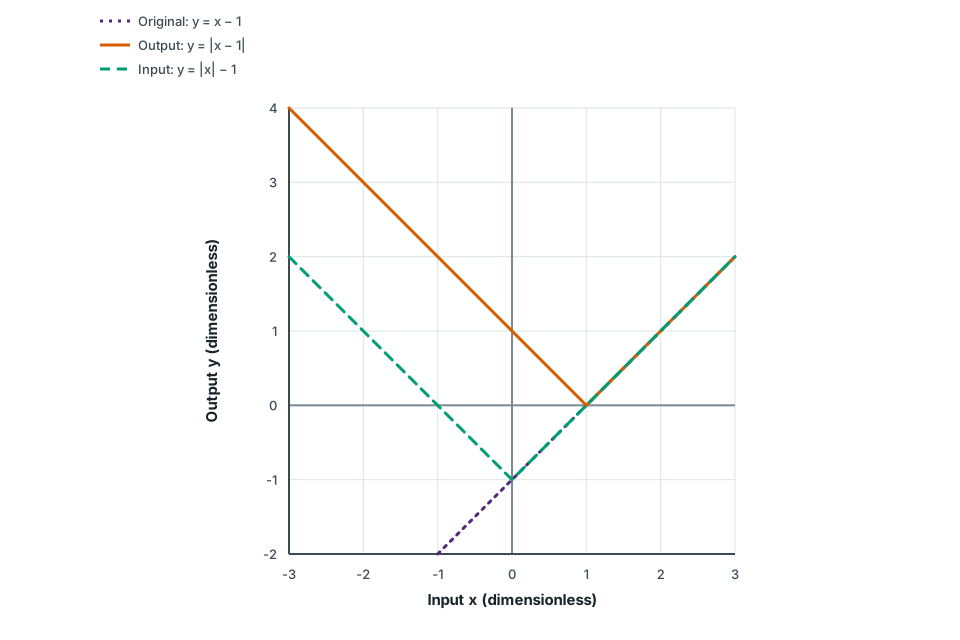
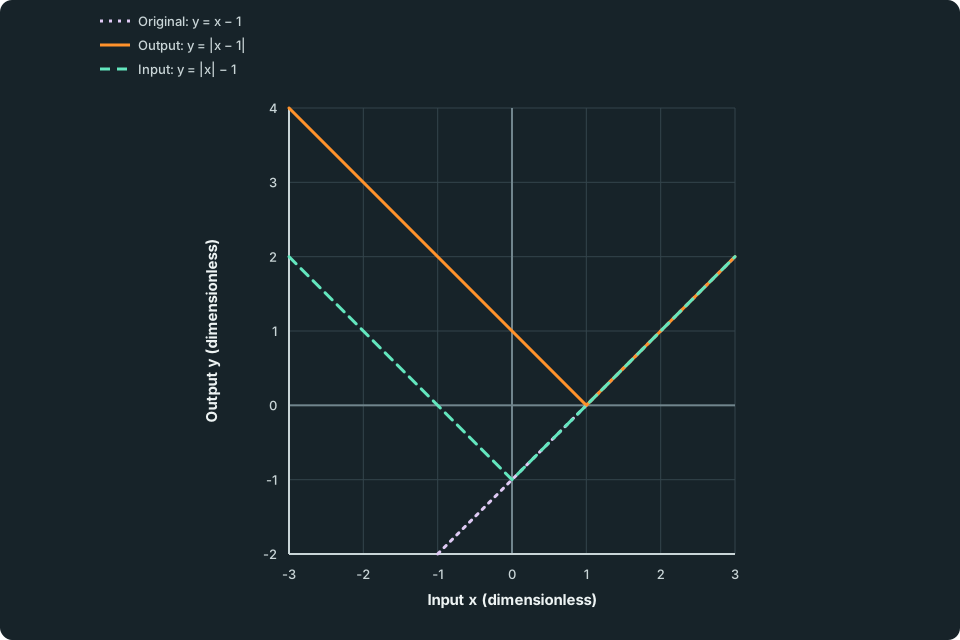
For f(x) = x-1 on R, |f(x)| = |x-1| has vertex (1,0) and range [0,∞). In contrast, f(|x|) = |x|-1 has vertex (0,-1) and range [-1,∞).
Absolute value on the input or output
The dotted original line is y = x − 1. The solid output-absolute-value graph is y = |x − 1|. The dashed input-absolute-value graph is y = |x| − 1. Equal coordinate scales preserve their slopes and vertices.
Scroll across the figure to read all labels.
View figure data
| Series | Input x (dimensionless) | Output y (dimensionless) |
|---|---|---|
| Original: y = x − 1 | -1 | -2 |
| Original: y = x − 1 | 3 | 2 |
| Output: y = |x − 1| | -3 | 4 |
| Output: y = |x − 1| | 1 | 0 |
| Output: y = |x − 1| | 3 | 2 |
| Input: y = |x| − 1 | -3 | 2 |
| Input: y = |x| − 1 | 0 | -1 |
| Input: y = |x| − 1 | 3 | 2 |
The bracket placement identifies which quantity is changed first. As a domain example, if the original function is defined only for u ≥ 1, then f(|x|) requires |x| ≥ 1. Its domain is (-∞,-1]∪[1,∞); reflecting the graph cannot fill the central gap.
A reciprocal retains every original exclusion
The reciprocal graph y = 1/f(x) is defined only where f is defined and nonzero. It is not the inverse-function graph: x stays the same, while each nonzero output becomes its reciprocal.
Positive outputs stay positive and negative outputs stay negative. Outputs 1 and -1 stay unchanged. When f tends to zero through nonzero values, its reciprocal becomes unbounded; when |f| tends to infinity, its reciprocal tends to zero. A finite nonzero limiting value L instead gives reciprocal limit 1/L.
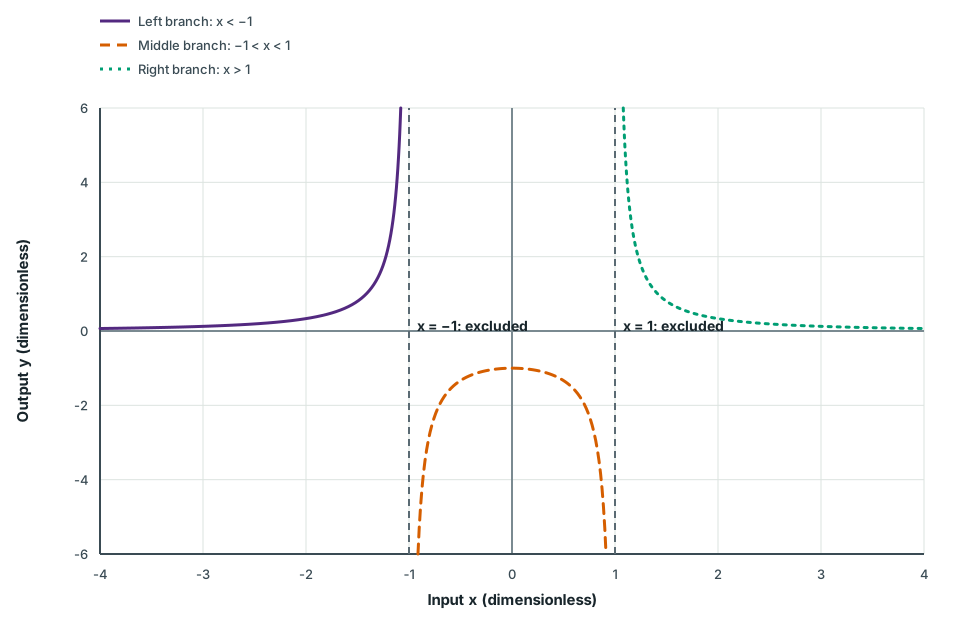
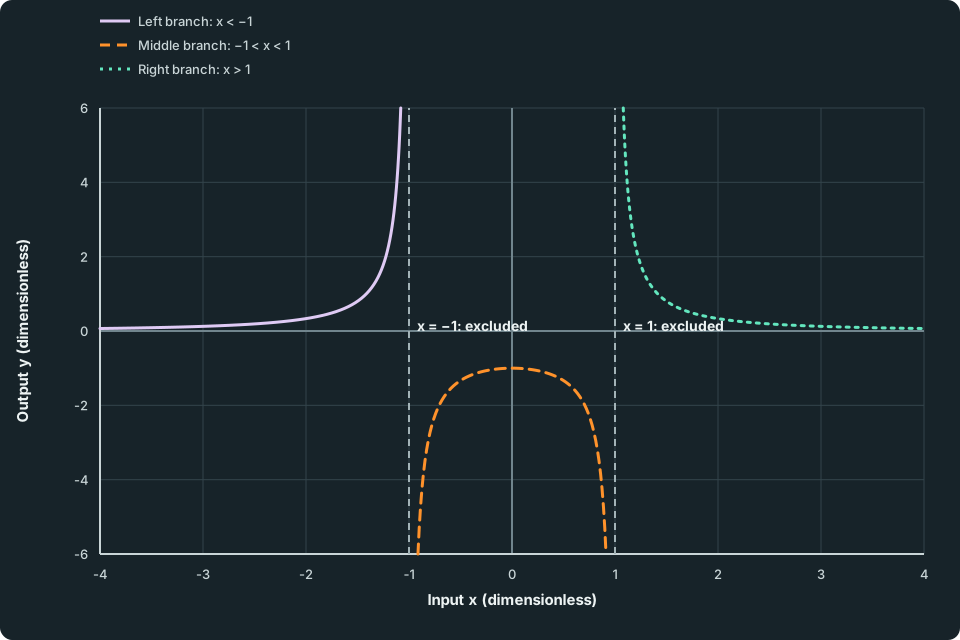
For f(x) = x²-1 on R, exclude x = -1 and x = 1. The reciprocal has vertical asymptotes there and horizontal asymptote y = 0. It is even, so its two outer branches reflect across the vertical axis.
The reciprocal of x² − 1
The reciprocal is positive for x < −1 and x > 1, and negative for −1 < x < 1. It passes through (0, −1). The graph approaches the excluded vertical guides and the horizontal axis without crossing the horizontal axis.
Scroll across the figure to read all labels.
View figure data
| Series | Input x (dimensionless) | Output y (dimensionless) |
|---|---|---|
| Left branch: x < −1 | -4.00000 | 0.06667 |
| Left branch: x < −1 | -3.82422 | 0.07340 |
| Left branch: x < −1 | -3.65874 | 0.08073 |
| Left branch: x < −1 | -3.50296 | 0.08873 |
| Left branch: x < −1 | -3.35630 | 0.09742 |
| Left branch: x < −1 | -3.21824 | 0.10687 |
| Left branch: x < −1 | -3.08826 | 0.11713 |
| Left branch: x < −1 | -2.96590 | 0.12826 |
| Left branch: x < −1 | -2.85072 | 0.14032 |
| Left branch: x < −1 | -2.74228 | 0.15337 |
| Left branch: x < −1 | -2.64019 | 0.16749 |
| Left branch: x < −1 | -2.54409 | 0.18274 |
| Left branch: x < −1 | -2.45361 | 0.19919 |
| Left branch: x < −1 | -2.36844 | 0.21694 |
| Left branch: x < −1 | -2.28826 | 0.23606 |
| Left branch: x < −1 | -2.21278 | 0.25665 |
| Left branch: x < −1 | -2.14172 | 0.27879 |
| Left branch: x < −1 | -2.07482 | 0.30258 |
| Left branch: x < −1 | -2.01184 | 0.32814 |
| Left branch: x < −1 | -1.95256 | 0.35556 |
| Left branch: x < −1 | -1.89674 | 0.38497 |
| Left branch: x < −1 | -1.84420 | 0.41648 |
| Left branch: x < −1 | -1.79473 | 0.45023 |
| Left branch: x < −1 | -1.74817 | 0.48636 |
| Left branch: x < −1 | -1.70433 | 0.52501 |
| Left branch: x < −1 | -1.66306 | 0.56632 |
| Left branch: x < −1 | -1.62421 | 0.61048 |
| Left branch: x < −1 | -1.58764 | 0.65764 |
| Left branch: x < −1 | -1.55320 | 0.70799 |
| Left branch: x < −1 | -1.52079 | 0.76173 |
| Left branch: x < −1 | -1.49028 | 0.81905 |
| Left branch: x < −1 | -1.46155 | 0.88018 |
| Left branch: x < −1 | -1.43451 | 0.94535 |
| Left branch: x < −1 | -1.40905 | 1.01480 |
| Left branch: x < −1 | -1.38508 | 1.08880 |
| Left branch: x < −1 | -1.36252 | 1.16761 |
| Left branch: x < −1 | -1.34127 | 1.25154 |
| Left branch: x < −1 | -1.32128 | 1.34088 |
| Left branch: x < −1 | -1.30245 | 1.43599 |
| Left branch: x < −1 | -1.28473 | 1.53719 |
| Left branch: x < −1 | -1.26805 | 1.64488 |
| Left branch: x < −1 | -1.25234 | 1.75944 |
| Left branch: x < −1 | -1.23756 | 1.88130 |
| Left branch: x < −1 | -1.22364 | 2.01090 |
| Left branch: x < −1 | -1.21053 | 2.14872 |
| Left branch: x < −1 | -1.19820 | 2.29527 |
| Left branch: x < −1 | -1.18659 | 2.45107 |
| Left branch: x < −1 | -1.17565 | 2.61671 |
| Left branch: x < −1 | -1.16536 | 2.79279 |
| Left branch: x < −1 | -1.15567 | 2.97994 |
| Left branch: x < −1 | -1.14655 | 3.17887 |
| Left branch: x < −1 | -1.13796 | 3.39028 |
| Left branch: x < −1 | -1.12988 | 3.61496 |
| Left branch: x < −1 | -1.12227 | 3.85373 |
| Left branch: x < −1 | -1.11511 | 4.10745 |
| Left branch: x < −1 | -1.10836 | 4.37705 |
| Left branch: x < −1 | -1.10201 | 4.66353 |
| Left branch: x < −1 | -1.09603 | 4.96791 |
| Left branch: x < −1 | -1.09041 | 5.29132 |
| Left branch: x < −1 | -1.08511 | 5.63493 |
| Left branch: x < −1 | -1.08012 | 6.00000 |
| Middle branch: −1 < x < 1 | -0.91287 | -6.00000 |
| Middle branch: −1 < x < 1 | -0.90076 | -5.30111 |
| Middle branch: −1 < x < 1 | -0.88789 | -4.72495 |
| Middle branch: −1 < x < 1 | -0.87430 | -4.24450 |
| Middle branch: −1 < x < 1 | -0.85998 | -3.83981 |
| Middle branch: −1 < x < 1 | -0.84495 | -3.49586 |
| Middle branch: −1 < x < 1 | -0.82923 | -3.20120 |
| Middle branch: −1 < x < 1 | -0.81281 | -2.94695 |
| Middle branch: −1 < x < 1 | -0.79573 | -2.72616 |
| Middle branch: −1 < x < 1 | -0.77799 | -2.53332 |
| Middle branch: −1 < x < 1 | -0.75960 | -2.36401 |
| Middle branch: −1 < x < 1 | -0.74058 | -2.21467 |
| Middle branch: −1 < x < 1 | -0.72096 | -2.08238 |
| Middle branch: −1 < x < 1 | -0.70073 | -1.96475 |
| Middle branch: −1 < x < 1 | -0.67993 | -1.85980 |
| Middle branch: −1 < x < 1 | -0.65857 | -1.76588 |
| Middle branch: −1 < x < 1 | -0.63666 | -1.68162 |
| Middle branch: −1 < x < 1 | -0.61422 | -1.60583 |
| Middle branch: −1 < x < 1 | -0.59128 | -1.53754 |
| Middle branch: −1 < x < 1 | -0.56785 | -1.47591 |
| Middle branch: −1 < x < 1 | -0.54394 | -1.42020 |
| Middle branch: −1 < x < 1 | -0.51959 | -1.36982 |
| Middle branch: −1 < x < 1 | -0.49481 | -1.32422 |
| Middle branch: −1 < x < 1 | -0.46962 | -1.28295 |
| Middle branch: −1 < x < 1 | -0.44404 | -1.24560 |
| Middle branch: −1 < x < 1 | -0.41810 | -1.21183 |
| Middle branch: −1 < x < 1 | -0.39180 | -1.18135 |
| Middle branch: −1 < x < 1 | -0.36519 | -1.15389 |
| Middle branch: −1 < x < 1 | -0.33827 | -1.12921 |
| Middle branch: −1 < x < 1 | -0.31107 | -1.10713 |
| Middle branch: −1 < x < 1 | -0.28362 | -1.08748 |
| Middle branch: −1 < x < 1 | -0.25593 | -1.07009 |
| Middle branch: −1 < x < 1 | -0.22803 | -1.05485 |
| Middle branch: −1 < x < 1 | -0.19994 | -1.04164 |
| Middle branch: −1 < x < 1 | -0.17168 | -1.03037 |
| Middle branch: −1 < x < 1 | -0.14329 | -1.02096 |
| Middle branch: −1 < x < 1 | -0.11477 | -1.01335 |
| Middle branch: −1 < x < 1 | -0.08616 | -1.00748 |
| Middle branch: −1 < x < 1 | -0.05748 | -1.00332 |
| Middle branch: −1 < x < 1 | -0.02875 | -1.00083 |
| Middle branch: −1 < x < 1 | 0.00000 | -1.00000 |
| Middle branch: −1 < x < 1 | 0.02875 | -1.00083 |
| Middle branch: −1 < x < 1 | 0.05748 | -1.00332 |
| Middle branch: −1 < x < 1 | 0.08616 | -1.00748 |
| Middle branch: −1 < x < 1 | 0.11477 | -1.01335 |
| Middle branch: −1 < x < 1 | 0.14329 | -1.02096 |
| Middle branch: −1 < x < 1 | 0.17168 | -1.03037 |
| Middle branch: −1 < x < 1 | 0.19994 | -1.04164 |
| Middle branch: −1 < x < 1 | 0.22803 | -1.05485 |
| Middle branch: −1 < x < 1 | 0.25593 | -1.07009 |
| Middle branch: −1 < x < 1 | 0.28362 | -1.08748 |
| Middle branch: −1 < x < 1 | 0.31107 | -1.10713 |
| Middle branch: −1 < x < 1 | 0.33827 | -1.12921 |
| Middle branch: −1 < x < 1 | 0.36519 | -1.15389 |
| Middle branch: −1 < x < 1 | 0.39180 | -1.18135 |
| Middle branch: −1 < x < 1 | 0.41810 | -1.21183 |
| Middle branch: −1 < x < 1 | 0.44404 | -1.24560 |
| Middle branch: −1 < x < 1 | 0.46962 | -1.28295 |
| Middle branch: −1 < x < 1 | 0.49481 | -1.32422 |
| Middle branch: −1 < x < 1 | 0.51959 | -1.36982 |
| Middle branch: −1 < x < 1 | 0.54394 | -1.42020 |
| Middle branch: −1 < x < 1 | 0.56785 | -1.47591 |
| Middle branch: −1 < x < 1 | 0.59128 | -1.53754 |
| Middle branch: −1 < x < 1 | 0.61422 | -1.60583 |
| Middle branch: −1 < x < 1 | 0.63666 | -1.68162 |
| Middle branch: −1 < x < 1 | 0.65857 | -1.76588 |
| Middle branch: −1 < x < 1 | 0.67993 | -1.85980 |
| Middle branch: −1 < x < 1 | 0.70073 | -1.96475 |
| Middle branch: −1 < x < 1 | 0.72096 | -2.08238 |
| Middle branch: −1 < x < 1 | 0.74058 | -2.21467 |
| Middle branch: −1 < x < 1 | 0.75960 | -2.36401 |
| Middle branch: −1 < x < 1 | 0.77799 | -2.53332 |
| Middle branch: −1 < x < 1 | 0.79573 | -2.72616 |
| Middle branch: −1 < x < 1 | 0.81281 | -2.94695 |
| Middle branch: −1 < x < 1 | 0.82923 | -3.20120 |
| Middle branch: −1 < x < 1 | 0.84495 | -3.49586 |
| Middle branch: −1 < x < 1 | 0.85998 | -3.83981 |
| Middle branch: −1 < x < 1 | 0.87430 | -4.24450 |
| Middle branch: −1 < x < 1 | 0.88789 | -4.72495 |
| Middle branch: −1 < x < 1 | 0.90076 | -5.30111 |
| Middle branch: −1 < x < 1 | 0.91287 | -6.00000 |
| Right branch: x > 1 | 1.08012 | 6.00000 |
| Right branch: x > 1 | 1.08511 | 5.63493 |
| Right branch: x > 1 | 1.09041 | 5.29132 |
| Right branch: x > 1 | 1.09603 | 4.96791 |
| Right branch: x > 1 | 1.10201 | 4.66353 |
| Right branch: x > 1 | 1.10836 | 4.37705 |
| Right branch: x > 1 | 1.11511 | 4.10745 |
| Right branch: x > 1 | 1.12227 | 3.85373 |
| Right branch: x > 1 | 1.12988 | 3.61496 |
| Right branch: x > 1 | 1.13796 | 3.39028 |
| Right branch: x > 1 | 1.14655 | 3.17887 |
| Right branch: x > 1 | 1.15567 | 2.97994 |
| Right branch: x > 1 | 1.16536 | 2.79279 |
| Right branch: x > 1 | 1.17565 | 2.61671 |
| Right branch: x > 1 | 1.18659 | 2.45107 |
| Right branch: x > 1 | 1.19820 | 2.29527 |
| Right branch: x > 1 | 1.21053 | 2.14872 |
| Right branch: x > 1 | 1.22364 | 2.01090 |
| Right branch: x > 1 | 1.23756 | 1.88130 |
| Right branch: x > 1 | 1.25234 | 1.75944 |
| Right branch: x > 1 | 1.26805 | 1.64488 |
| Right branch: x > 1 | 1.28473 | 1.53719 |
| Right branch: x > 1 | 1.30245 | 1.43599 |
| Right branch: x > 1 | 1.32128 | 1.34088 |
| Right branch: x > 1 | 1.34127 | 1.25154 |
| Right branch: x > 1 | 1.36252 | 1.16761 |
| Right branch: x > 1 | 1.38508 | 1.08880 |
| Right branch: x > 1 | 1.40905 | 1.01480 |
| Right branch: x > 1 | 1.43451 | 0.94535 |
| Right branch: x > 1 | 1.46155 | 0.88018 |
| Right branch: x > 1 | 1.49028 | 0.81905 |
| Right branch: x > 1 | 1.52079 | 0.76173 |
| Right branch: x > 1 | 1.55320 | 0.70799 |
| Right branch: x > 1 | 1.58764 | 0.65764 |
| Right branch: x > 1 | 1.62421 | 0.61048 |
| Right branch: x > 1 | 1.66306 | 0.56632 |
| Right branch: x > 1 | 1.70433 | 0.52501 |
| Right branch: x > 1 | 1.74817 | 0.48636 |
| Right branch: x > 1 | 1.79473 | 0.45023 |
| Right branch: x > 1 | 1.84420 | 0.41648 |
| Right branch: x > 1 | 1.89674 | 0.38497 |
| Right branch: x > 1 | 1.95256 | 0.35556 |
| Right branch: x > 1 | 2.01184 | 0.32814 |
| Right branch: x > 1 | 2.07482 | 0.30258 |
| Right branch: x > 1 | 2.14172 | 0.27879 |
| Right branch: x > 1 | 2.21278 | 0.25665 |
| Right branch: x > 1 | 2.28826 | 0.23606 |
| Right branch: x > 1 | 2.36844 | 0.21694 |
| Right branch: x > 1 | 2.45361 | 0.19919 |
| Right branch: x > 1 | 2.54409 | 0.18274 |
| Right branch: x > 1 | 2.64019 | 0.16749 |
| Right branch: x > 1 | 2.74228 | 0.15337 |
| Right branch: x > 1 | 2.85072 | 0.14032 |
| Right branch: x > 1 | 2.96590 | 0.12826 |
| Right branch: x > 1 | 3.08826 | 0.11713 |
| Right branch: x > 1 | 3.21824 | 0.10687 |
| Right branch: x > 1 | 3.35630 | 0.09742 |
| Right branch: x > 1 | 3.50296 | 0.08873 |
| Right branch: x > 1 | 3.65874 | 0.08073 |
| Right branch: x > 1 | 3.82422 | 0.07340 |
| Right branch: x > 1 | 4.00000 | 0.06667 |
For |x| > 1, the denominator is positive; for -1 < x < 1, it is negative. At x = 0, the output is -1. Inside that middle interval the denominator runs through [-1,0), so the reciprocal outputs form (-∞,-1]. Outside it, every positive denominator is possible, giving all positive outputs. The complete range is therefore
The reciprocal never equals zero. A plotted branch close to the horizontal axis has not reached it, and a vertical guide is not a collection of defined graph points.
Check your understanding 3 An exclusion need not be an asymptote
A function is defined by f(x) = (x²-1)/(x-1) for real x ≠ 1. Find the domain of its reciprocal. Identify the reciprocal’s vertical asymptote and any hole after simplifying, explaining why they are different.
Show answer
The original input 1 stays excluded, and f(-1) = 0 adds the exclusion -1. For allowed inputs, f simplifies to x + 1, so the reciprocal is 1/(x + 1) with domain Rsetminus{-1,1}.
At x = -1, the reciprocal is unbounded on approach, giving a vertical asymptote. At x = 1, the simplified expression approaches 1/2, but the original function was undefined there. The reciprocal has a hole at (1,1/2), not a vertical asymptote. Cancelling factors does not restore an original input.
A parameter interval selects the traced curve
For x = t², y = t + 1 with -2 ≤ t ≤ 2, eliminating t gives x = (y-1)². Retain -1 ≤ y ≤ 3: the full sideways parabola includes points outside the parameter interval.
Track the direction too. As t increases, the point moves from (4,-1) to (0,1) and then to (4,3). This whole relation is not one function y = f(x): for example, x = 1 occurs at t = -1 and t = 1, with two different y-values. Eliminating a parameter does not guarantee a single-valued function or preserve the traversal information by itself.
Try it yourself 1
Check a proposed graph
Problem
A moving point has x = t² and y = t + 1 for 0 ≤ t ≤ 2. A proposed graph uses y = 1± square root of x with 0 ≤ x ≤ 4. Correct this description, including any branch restriction, endpoints and direction of travel. Give a point included by the proposed description that the moving point never reaches.
Write your answer, then compare it with the solution
Hints
Hint 1
Carry the parameter restriction into the coordinates
Express t in terms of one coordinate, then use the given interval before choosing a square-root sign.
Show full solution
Retain the allowed branch
Method
Use t = y-1 and the restriction t ≥ 0.Reason
The parameter interval decides which part of the Cartesian relation is traced.Working
Answer
x = (y-1)² with 1 ≤ y ≤ 3. Equivalently, y = 1 + square root of x for 0 ≤ x ≤ 4. The minus branch contributes no further allowed points.Verify travel and reject an extra point
Method
Evaluate the original parametric rule at its endpoints and a proposed extra point.Reason
A Cartesian expression alone does not specify traversal or establish that every proposed point is reached.Working
Answer
The point travels from (0,1) at t = 0 to (4,3) at t = 2, with both coordinates increasing. The proposed point (1,0) would require t = -1, outside the interval.
Quick check
The original interval includes both endpoints. The two square-root branches share (0,1), but only the plus branch describes the rest of this motion. Compare the branch, allowed coordinates and direction separately; a correct eliminated equation can still describe too many points.
To transform a graph, start with corresponding points and preserve its declared sets. For absolute values and reciprocals, decide whether the input or output changes and retain exclusions. For parametric curves, carry the parameter interval and traversal into the Cartesian description.
Keep track of this lesson
Mark the lesson done when you have worked through it.
Lesson progress is optional and kept on this device.
Loading lesson controls…
Your lesson mark records your own study. Checks are kept separately in My Learning.