Rational, absolute and graphical inequalities
Track signs, exclusions and numerical boundaries, then check solutions against the original mathematical model.
More
Offline pages
Saved on this device only. Connect at least once every 30 days to confirm Premium. Sign-out or a change of account removes saved copies.
Find this activity in your course
On this page
You stopped at:
ContinueRevision Mode is on. Questions and activities are hidden.
Keep the original domain before comparing signs
An inequality asks for every allowed input that makes a comparison true. Zeros locate possible equality points; denominator zeros locate exclusions. These boundaries divide the domain into intervals, but are not themselves the whole answer.
To solve (x-1)/(x + 2) > 0, first exclude x = -2. The numerator is zero at x = 1. Check the sign of each factor on the three remaining intervals:
| Interval | Sign of x-1 | Sign of x + 2 | Sign of the quotient |
|---|---|---|---|
| x < -2 | Negative | Negative | Positive |
| -2 < x < 1 | Negative | Positive | Negative |
| x > 1 | Positive | Positive | Positive |
The solution is (-∞,-2)∪(1,∞). The pole -2 is always excluded. The zero 1 is excluded here because the inequality is strict; for ≥ 0 it would be included.
Multiplying directly by x + 2 without knowing its sign is unsafe: an inequality reverses when multiplied by a negative number. At x = -3, the quotient is 4 > 0, even though x-1 > 0 is false. This counterexample shows the interval lost by careless cross-multiplication.
One alternative is to multiply by (x + 2)², which is strictly positive on the allowed domain. This gives (x-1)(x + 2) > 0 with x ≠ -2 retained. A squared denominator cannot license an original pole, even when a later non-strict inequality would appear to include it.
Check your understanding 1 The pole is never a solution
Solve (x-3)/(x + 1) ≤ 0. Explain the different treatment of its two critical inputs.
Show answer
Split at -1 and 3. The signs are positive for x < -1, negative for -1 < x < 3, and positive for x > 3. Thus the solution is (-1,3]. The denominator zero -1 is excluded because the original quotient is undefined there. The numerator zero 3 is included because zero satisfies ≤ 0.
Repeated factors can give isolated solutions
A sign need not change at every critical input. An even power such as (x-1)² stays positive on both sides of its zero. For
the numerator is positive except at x = 1, where it is zero. The denominator is positive outside [-2,3] and negative inside (-2,3). Thus the quotient is positive for x < -2 or x > 3, negative inside (-2,3) except at 1, and zero at 1.
The solution is
The single point 1 matters: it satisfies the non-strict inequality even though nearby inputs do not. Automatically alternating signs across all listed boundaries would miss this feature.
A cancelled factor also leaves a boundary. For (x-1)(x + 2)/(x-1) ≥ 0, keep x ≠ 1, then solve x + 2 ≥ 0. The result is [-2,1)∪(1,∞), not every x ≥ -2. Simplification preserves values where the original expression exists; it does not restore removed inputs.
Check your understanding 2 A zero can stand alone
Solve (x + 1)²/(x-2) ≥ 0. Identify any equality point and explain whether the sign changes there.
Show answer
The pole is 2. For x < 2, the denominator is negative and the numerator is nonnegative, so the quotient is negative except that it is zero at x = -1. For x > 2, it is positive. Therefore the solution is {-1}∪(2,∞), including the isolated zero -1 and excluding the pole 2.
The sign does not change across -1 because the numerator has an even-power zero. If the requested comparison were ≤ 0 instead, the solution would be (-∞,2), including -1 within that interval.
Absolute value turns distance into intervals
For b > 0, |x-a| < b means the distance from x to a is less than b:
For |x-a| > b, x is farther than b from a, so
For example, |x-3| < 2 gives 1 < x < 5, while |x-3| > 2 gives x < 1 or x > 5. The outside intervals are alternatives, not simultaneous conditions. A non-strict comparison includes the corresponding distance boundaries.
The bound’s sign matters. If b < 0, |x-a| < b and |x-a| ≤ b have no solutions, while |x-a| > b and |x-a| ≥ b hold for every real x. At b = 0, the four comparisons differ: < 0 has no solution; ≤ 0 gives x = a; > 0 gives x ≠ a; and ≥ 0 gives every real x.
For a linear expression, isolate the absolute value before opening the interval. For example, |2x-3| ≤ 5 gives -5 ≤ 2x-3 ≤ 5, hence -1 ≤ x ≤ 4.
Check your understanding 3 Check the bound before squaring
Solve |x-1| < 2x-3. A proposed method squares both sides and accepts x < 4/3 or x > 2. Explain what that method must still check.
Show answer
The left side is nonnegative, so the strict inequality requires 2x-3 > 0, giving x > 3/2. Only under that condition does squaring preserve this comparison. The squared inequality is (x-1)² < (2x-3)², equivalent to (3x-4)(x-2) > 0.
Its intervals are x < 4/3 or x > 2, but intersecting with x > 3/2 leaves only x > 2. For example, x = 0 satisfies the squared comparison 1 < 9 but fails the original 1 < -3. Squaring an unchecked negative bound creates extra candidates.
Compare graphs on each side of every exclusion
To solve A(x) ≤ B(x), plot both curves and identify where A is at or below B. Equivalently, study the sign of A-B on the common domain. A root tool gives intersection candidates; poles and holes still split the domain even when no intersection occurs there.
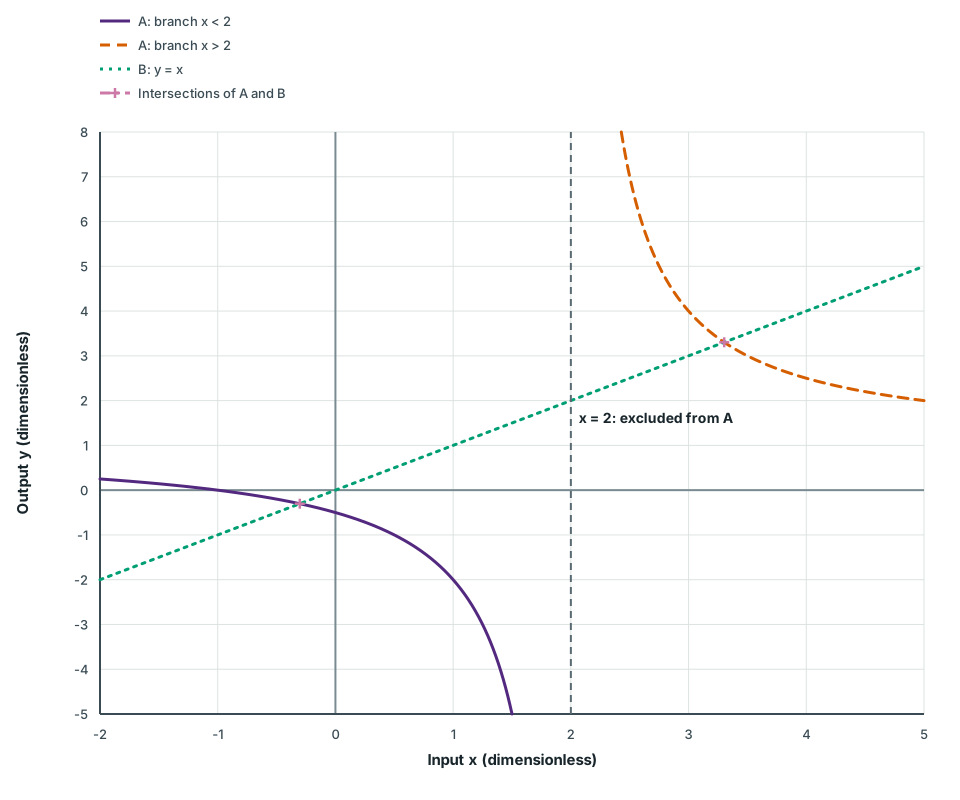
Take A(x) = (x + 1)/(x-2) and B(x) = x. The common domain excludes 2. The equality condition is
with roots α = (3- square root of 13)/2 ≈ -0.303 and β = (3 + square root of 13)/2 ≈ 3.303. Neither is the excluded input 2.
Compare A(x) = (x + 1)/(x − 2) with B(x) = x
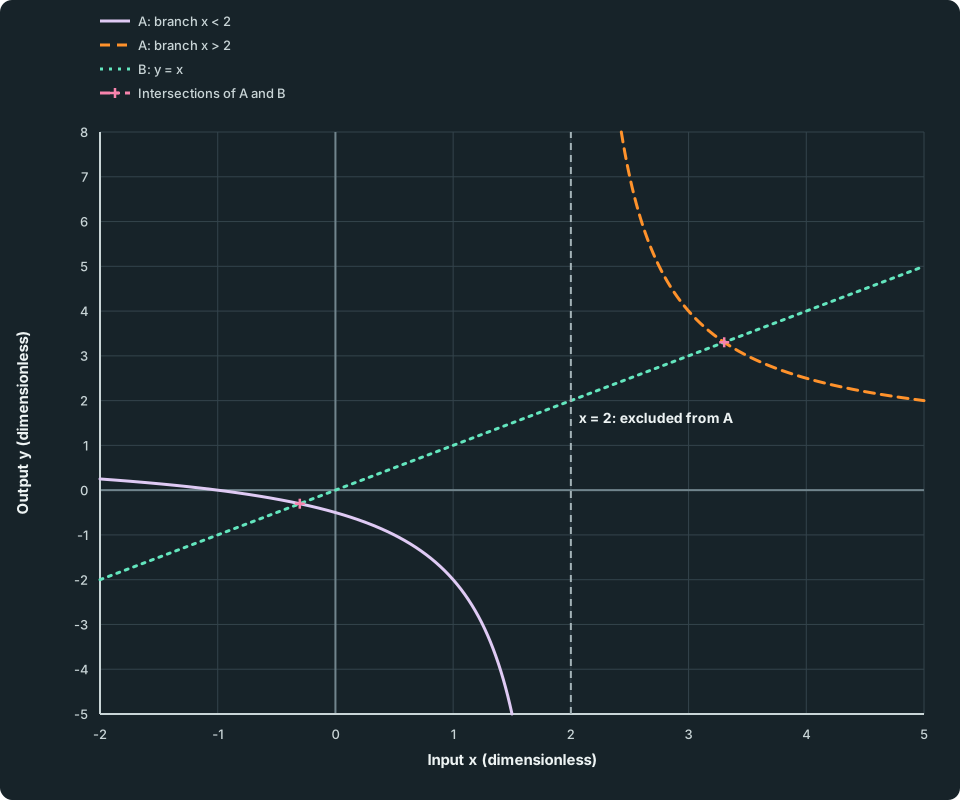
A and B intersect near (−0.303, −0.303) and (3.303, 3.303). The curve A is below B between the first crossing and x = 2, and to the right of the second crossing. A has no point at x = 2, even though the line B does.
Scroll across the figure to read all labels.
View figure data
| Series | Input x (dimensionless) | Output y (dimensionless) |
|---|---|---|
| A: branch x < 2 | -2.00000 | 0.25000 |
| A: branch x < 2 | -1.86375 | 0.22355 |
| A: branch x < 2 | -1.73213 | 0.19617 |
| A: branch x < 2 | -1.60500 | 0.16782 |
| A: branch x < 2 | -1.48220 | 0.13848 |
| A: branch x < 2 | -1.36359 | 0.10809 |
| A: branch x < 2 | -1.24901 | 0.07664 |
| A: branch x < 2 | -1.13834 | 0.04408 |
| A: branch x < 2 | -1.03143 | 0.01037 |
| A: branch x < 2 | -0.92817 | -0.02453 |
| A: branch x < 2 | -0.82843 | -0.06066 |
| A: branch x < 2 | -0.73208 | -0.09806 |
| A: branch x < 2 | -0.63902 | -0.13679 |
| A: branch x < 2 | -0.54912 | -0.17688 |
| A: branch x < 2 | -0.46229 | -0.21838 |
| A: branch x < 2 | -0.37841 | -0.26134 |
| A: branch x < 2 | -0.29740 | -0.30583 |
| A: branch x < 2 | -0.21914 | -0.35188 |
| A: branch x < 2 | -0.14355 | -0.39955 |
| A: branch x < 2 | -0.07053 | -0.44890 |
| A: branch x < 2 | 0.00000 | -0.50000 |
| A: branch x < 2 | 0.06813 | -0.55290 |
| A: branch x < 2 | 0.13393 | -0.60766 |
| A: branch x < 2 | 0.19750 | -0.66435 |
| A: branch x < 2 | 0.25890 | -0.72305 |
| A: branch x < 2 | 0.31821 | -0.78381 |
| A: branch x < 2 | 0.37550 | -0.84672 |
| A: branch x < 2 | 0.43083 | -0.91184 |
| A: branch x < 2 | 0.48428 | -0.97926 |
| A: branch x < 2 | 0.53591 | -1.04906 |
| A: branch x < 2 | 0.58579 | -1.12132 |
| A: branch x < 2 | 0.63396 | -1.19613 |
| A: branch x < 2 | 0.68049 | -1.27357 |
| A: branch x < 2 | 0.72544 | -1.35375 |
| A: branch x < 2 | 0.76886 | -1.43676 |
| A: branch x < 2 | 0.81079 | -1.52269 |
| A: branch x < 2 | 0.85130 | -1.61165 |
| A: branch x < 2 | 0.89043 | -1.70375 |
| A: branch x < 2 | 0.92823 | -1.79910 |
| A: branch x < 2 | 0.96474 | -1.89781 |
| A: branch x < 2 | 1.00000 | -2.00000 |
| A: branch x < 2 | 1.03406 | -2.10579 |
| A: branch x < 2 | 1.06697 | -2.21532 |
| A: branch x < 2 | 1.09875 | -2.32871 |
| A: branch x < 2 | 1.12945 | -2.44610 |
| A: branch x < 2 | 1.15910 | -2.56762 |
| A: branch x < 2 | 1.18775 | -2.69343 |
| A: branch x < 2 | 1.21542 | -2.82368 |
| A: branch x < 2 | 1.24214 | -2.95852 |
| A: branch x < 2 | 1.26796 | -3.09812 |
| A: branch x < 2 | 1.29289 | -3.24264 |
| A: branch x < 2 | 1.31698 | -3.39226 |
| A: branch x < 2 | 1.34025 | -3.54715 |
| A: branch x < 2 | 1.36272 | -3.70750 |
| A: branch x < 2 | 1.38443 | -3.87351 |
| A: branch x < 2 | 1.40540 | -4.04538 |
| A: branch x < 2 | 1.42565 | -4.22330 |
| A: branch x < 2 | 1.44522 | -4.40750 |
| A: branch x < 2 | 1.46411 | -4.59820 |
| A: branch x < 2 | 1.48237 | -4.79562 |
| A: branch x < 2 | 1.50000 | -5.00000 |
| A: branch x > 2 | 2.42857 | 8.00000 |
| A: branch x > 2 | 2.44270 | 7.77662 |
| A: branch x > 2 | 2.45729 | 7.56037 |
| A: branch x > 2 | 2.47237 | 7.35101 |
| A: branch x > 2 | 2.48794 | 7.14834 |
| A: branch x > 2 | 2.50402 | 6.95214 |
| A: branch x > 2 | 2.52063 | 6.76220 |
| A: branch x > 2 | 2.53780 | 6.57832 |
| A: branch x > 2 | 2.55552 | 6.40031 |
| A: branch x > 2 | 2.57384 | 6.22797 |
| A: branch x > 2 | 2.59275 | 6.06114 |
| A: branch x > 2 | 2.61229 | 5.89963 |
| A: branch x > 2 | 2.63247 | 5.74328 |
| A: branch x > 2 | 2.65332 | 5.59191 |
| A: branch x > 2 | 2.67486 | 5.44538 |
| A: branch x > 2 | 2.69710 | 5.30352 |
| A: branch x > 2 | 2.72008 | 5.16619 |
| A: branch x > 2 | 2.74382 | 5.03324 |
| A: branch x > 2 | 2.76834 | 4.90453 |
| A: branch x > 2 | 2.79367 | 4.77993 |
| A: branch x > 2 | 2.81983 | 4.65931 |
| A: branch x > 2 | 2.84685 | 4.54253 |
| A: branch x > 2 | 2.87477 | 4.42948 |
| A: branch x > 2 | 2.90360 | 4.32004 |
| A: branch x > 2 | 2.93339 | 4.21410 |
| A: branch x > 2 | 2.96416 | 4.11153 |
| A: branch x > 2 | 2.99594 | 4.01224 |
| A: branch x > 2 | 3.02877 | 3.91611 |
| A: branch x > 2 | 3.06268 | 3.82305 |
| A: branch x > 2 | 3.09771 | 3.73296 |
| A: branch x > 2 | 3.13389 | 3.64575 |
| A: branch x > 2 | 3.17127 | 3.56132 |
| A: branch x > 2 | 3.20988 | 3.47959 |
| A: branch x > 2 | 3.24976 | 3.40046 |
| A: branch x > 2 | 3.29096 | 3.32386 |
| A: branch x > 2 | 3.33351 | 3.24970 |
| A: branch x > 2 | 3.37747 | 3.17791 |
| A: branch x > 2 | 3.42288 | 3.10841 |
| A: branch x > 2 | 3.46978 | 3.04112 |
| A: branch x > 2 | 3.51823 | 2.97599 |
| A: branch x > 2 | 3.56827 | 2.91293 |
| A: branch x > 2 | 3.61997 | 2.85189 |
| A: branch x > 2 | 3.67337 | 2.79279 |
| A: branch x > 2 | 3.72853 | 2.73558 |
| A: branch x > 2 | 3.78551 | 2.68019 |
| A: branch x > 2 | 3.84436 | 2.62658 |
| A: branch x > 2 | 3.90516 | 2.57467 |
| A: branch x > 2 | 3.96796 | 2.52442 |
| A: branch x > 2 | 4.03283 | 2.47577 |
| A: branch x > 2 | 4.09984 | 2.42868 |
| A: branch x > 2 | 4.16906 | 2.38309 |
| A: branch x > 2 | 4.24056 | 2.33895 |
| A: branch x > 2 | 4.31442 | 2.29622 |
| A: branch x > 2 | 4.39071 | 2.25486 |
| A: branch x > 2 | 4.46951 | 2.21481 |
| A: branch x > 2 | 4.55092 | 2.17605 |
| A: branch x > 2 | 4.63500 | 2.13852 |
| A: branch x > 2 | 4.72186 | 2.10219 |
| A: branch x > 2 | 4.81159 | 2.06701 |
| A: branch x > 2 | 4.90427 | 2.03296 |
| A: branch x > 2 | 5.00000 | 2.00000 |
| B: y = x | -2.00000 | -2.00000 |
| B: y = x | 5.00000 | 5.00000 |
| Intersections of A and B | -0.30278 | -0.30278 |
| Intersections of A and B | 3.30278 | 3.30278 |
Now
The numerator is negative outside [α,β] and positive between its roots. Combining this with the denominator’s sign gives A-B < 0 on (α,2) and (β,∞). Include both equality points for ≤, and keep the pole excluded:
At x = 2, the line B has a point but A does not. A vertical line drawn across the discontinuity by coarse plotting is not a third intersection. Check the expression on either side and use separate branches.
An approximate boundary is still a particular root
Suppose the stated domain is 1 ≤ x ≤ 2 and the condition is H(x) = x³-2x-2 > 0. A numerical solver gives a root γ ≈ 1.769292. To bracket it, substitution gives H(1.7692) < 0 and H(1.7693) > 0.
There is exactly one crossing on this interval. For 1 ≤ u < v ≤ 2,
since each of the three squared or product terms is at least one. Thus H increases throughout the stated interval; also H(1) = -3 and H(2) = 2. The solution is (γ,2], with the exact boundary defined by H(γ) = 0. If asked for three decimal places, report γ ≈ 1.769. Treating the rounded decimal as a newly exact root changes which nearby inputs belong to the solution.
Build equations from the quantities being counted
An order uses exactly 6 gift boxes, 17 labels and 7 ribbons. Type A uses 2 labels and 1 ribbon per box; type B uses 1 label and 2 ribbons; type C uses 4 labels and 1 ribbon. Assume each box is one whole type and all stated labels and ribbons are used, with none left over.
Let x, y and z count types A, B and C. Their allowed values are nonnegative integers. The constraints are
Subtract the first equation from the third to obtain y = 1. Then x + z = 5 and 2x + 4z = 16, giving z = 3 and x = 2. These are allowed counts. Check the original quantities: 2 + 1 + 3 = 6, 4 + 1 + 12 = 17 labels, and 2 + 2 + 3 = 7 ribbons.
For a three-unknown simultaneous-equation solver, keep the columns in the order x, y, z. Enter coefficient rows (1,1,1), (2,1,4) and (1,2,1) with right-hand sides 6, 17 and 7 respectively. A matrix solver uses the same augmented rows. Read the returned values in that column order, then check the original totals and integer domain; the solver cannot infer what a box count means.
A report of no unique solution is a different situation from the unique real solution found here: check whether equations contradict each other or repeat the same constraint. Do not round a numerical failure state into three apparent counts. If the materials were merely upper limits, the corresponding constraints would be inequalities instead; the equalities above follow from the stated exact use, not from the existence of a resource total.
Try it yourself 1
Check the changed order
Problem
Keep the box types and exact-use assumptions above, but change the order to 6 boxes using exactly 16 labels and 7 ribbons. Form the new equations and decide whether the order can be made. A solver returns a unique real solution: is that enough? Explain whether rounding its values could satisfy the order.
Write your answer, then compare it with the solution
Hints
Hint 1
Distinguish solving the equations from meeting the order
Use each stated total once. After solving, compare the values with the kind of quantities the variables count.
Show full solution
Solve the changed constraints
Method
Change only the labels total and eliminate y.Reason
The number of boxes and ribbons stays the same, while the labels equation has a different right-hand side.Working
Answer
x + y + z = 6, 2x + y + 4z = 16 and x + 2y + z = 7. Hence y = 1, x + z = 5 and 2x + 4z = 15, giving z = 5/2 and x = 5/2.Check what the variables represent
Method
Reject fractional box counts under the stated model.Reason
A unique real solution need not lie in the allowed domain of nonnegative integers.Working
Answer
The only real solution is (5/2,1,5/2), so there is no allowed order. Keeping six boxes and seven ribbons requires y = 1 and x + z = 5; the labels total is then 2(5-z) + 1 + 4z = 11 + 2z, always odd for integer z. It cannot equal 16.
Quick check
Rounding the two fractional counts cannot repair the contradiction. For example, counts (2,1,3) use 17 labels, while (3,1,2) use 15; neither uses 16. The equations are consistent over real numbers, but the exact-use order has no solution in its stated domain. Compare the model, algebra and allowed quantities separately.
For any inequality, preserve the original domain, split at every zero or exclusion, and test the actual signs rather than alternating them automatically. For numerical roots, state the accuracy and interval endpoints. For models, a solution must satisfy both the original relations and the allowed kinds of quantity.
Keep track of this lesson
Mark the lesson done when you have worked through it.
Lesson progress is optional and kept on this device.
Loading lesson controls…
Your lesson mark records your own study. Checks are kept separately in My Learning.