Standard series and convergence
Choose standard expansions with their transformed intervals, then distinguish convergence, domain and useful numerical accuracy.
More
Offline pages
Saved on this device only. Connect at least once every 30 days to confirm Premium. Sign-out or a change of account removes saved copies.
Find this activity in your course
On this page
You stopped at:
ContinueRevision Mode is on. Questions and activities are hidden.
A local polynomial matches derivatives at zero
A function can be complicated to evaluate while its first few derivatives at zero are manageable. A Maclaurin polynomial uses those values to model its behaviour near zero. Through degree three,
The factorials make the polynomial’s derivatives match the function’s derivatives at zero. For example, differentiating ax² twice gives 2a, so its coefficient must be f''(0)/2, not f''(0).
For f(x) = e^2x, the successive values at zero are 1,2,4,8, giving P₃(x) = 1 + 2x + 2x² + (4/3)x³. This is a finite polynomial. Replacing f by it is an approximation; an equality with an infinite series additionally needs that series to converge to f.
Check your understanding 1 Derivatives determine the coefficients
Find the Maclaurin polynomial through x² for f(x) = e^3x. A proposed answer is 1 + 3x + 9x². Check its second derivative at zero and explain the coefficient correction.
Show answer
The values are f(0) = 1, f'(0) = 3 and f''(0) = 9, so P₂(x) = 1 + 3x + (9/2)x². Its second derivative is 9. The proposed coefficient 9 would give second derivative 18; dividing by 2! corrects it.
Standard expansions carry their own intervals
The standard exponential and trigonometric series begin
These infinite series converge to their functions for every real x. Trigonometric inputs are in radians. A request for the first three nonzero terms of sine includes x⁵; a request for terms only through x² retains just x. Missing powers have zero coefficients.
The logarithmic series is
with real convergence interval -1 < x ≤ 1. At x = 1, the alternating series converges to ln 2. At x = -1, the logarithm is undefined and the series diverges. The function’s real domain x > -1 is larger than this series interval: for example, ln 3 exists, but substituting x = 2 into this series does not evaluate it.
For a rational exponent n, the binomial expansion begins
For a nonnegative integer n it terminates as a finite polynomial. For other rational n, |u| < 1 is the standard guaranteed open interval; inclusion of an endpoint depends on the exponent and needs its own check. Thus (1 + 2x)³ = 1 + 6x + 12x² + 8x³ is a polynomial identity for every real x, whereas the nonterminating expansion
has the guaranteed open interval -1/2 < x < 1/2. Its cubic polynomial supplies a local approximation, not an exact square root.
Transform the condition along with the expression
For 1/(1 + 2x), the geometric expansion is 1-2x + 4x²-8x³ + …. Its ratio is -2x, so |2x| < 1 gives -1/2 < x < 1/2. Both endpoints fail because the geometric terms do not tend to zero. Scaling the input changes the interval as well as the coefficients.
Check your understanding 2 Transform the convergence condition
Give terms through x³ for 1/(1-3x) and its real convergence interval. Check both endpoints using the geometric ratio, rather than assuming that a finite-looking polynomial makes either endpoint valid.
Show answer
The expansion is 1 + 3x + 9x² + 27x³ + …. The ratio is 3x, so |3x| < 1 gives -1/3 < x < 1/3. At x = 1/3, the terms are all one; at x = -1/3, they alternate between one and minus one. Neither sequence of terms tends to zero, so neither infinite series converges there.
Check your understanding 3 Preserve an included endpoint when the input reverses
Expand ln(1-2x) through x³. Find the full real convergence interval of this logarithmic series by transforming -1 < u ≤ 1. Compare it with the original function’s real domain.
Show answer
Using u = -2x gives -2x-2x²-(8/3)x³ + …. The condition -1 < -2x ≤ 1 becomes -1/2 ≤ x < 1/2. At x = -1/2, the input is u = 1 and the series converges to ln 2; at x = 1/2, the logarithm is undefined.
The function itself is real for every x < 1/2. Its domain includes values below -1/2 where this particular series diverges.
Convergence does not fix the accuracy of a short truncation
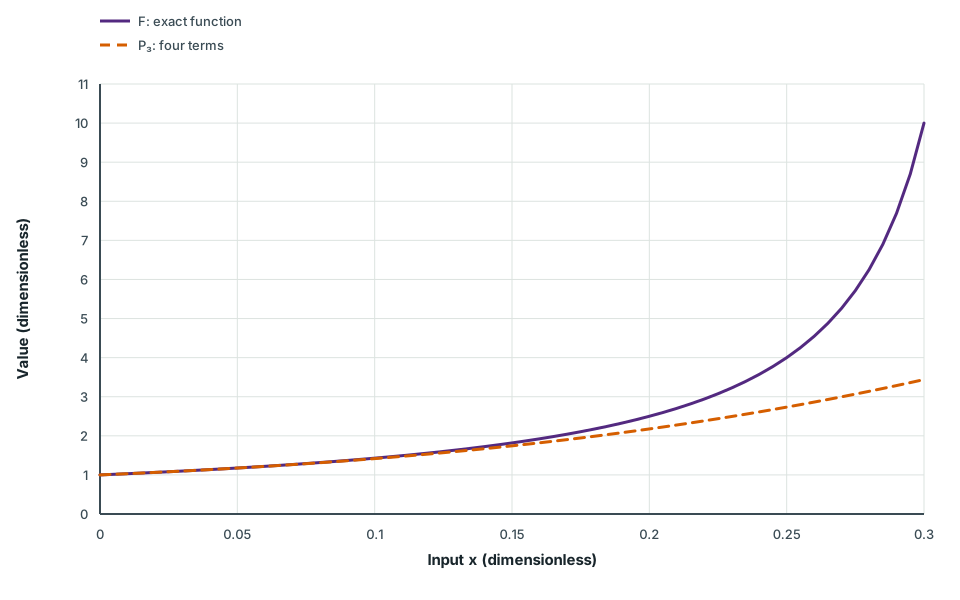
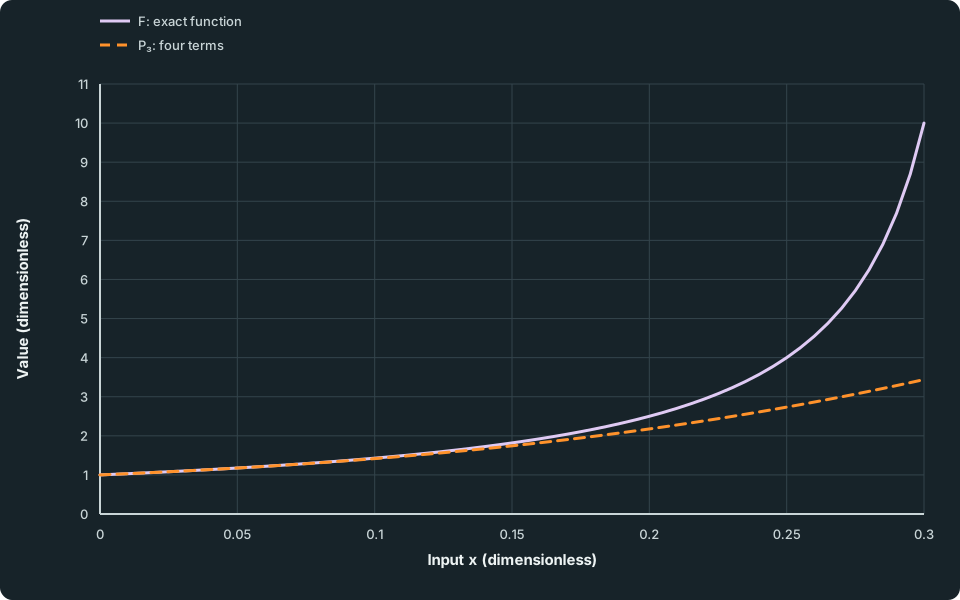
For F(x) = 1/(1-3x), write the four-term polynomial P₃(x) = 1 + 3x + 9x² + 27x³. Direct algebra gives the exact difference
At x = 0.01, this error is about 8.35 × 10⁻⁷. At x = 0.3, the infinite series still converges because its ratio is 0.9, but P₃ = 3.439 while F = 10. The omitted contribution is 6.561. An input inside the convergence interval need not give a useful answer from only four terms.
A convergent series can need more than four terms
On the displayed interval from zero to 0.3, both curves increase. They are close near zero, but the exact function rises much more steeply near the right edge, while the cubic stays below four. Every displayed input is inside the series convergence interval −1/3 < x < 1/3.
Scroll across the figure to read all labels.
View figure data
| Input x (dimensionless) | F: exact function | P₃: four terms |
|---|---|---|
| 0.000 | 1.000 | 1.000 |
| 0.005 | 1.015 | 1.015 |
| 0.010 | 1.031 | 1.031 |
| 0.015 | 1.047 | 1.047 |
| 0.020 | 1.064 | 1.064 |
| 0.025 | 1.081 | 1.081 |
| 0.030 | 1.099 | 1.099 |
| 0.035 | 1.117 | 1.117 |
| 0.040 | 1.136 | 1.136 |
| 0.045 | 1.156 | 1.156 |
| 0.050 | 1.176 | 1.176 |
| 0.055 | 1.198 | 1.197 |
| 0.060 | 1.220 | 1.218 |
| 0.065 | 1.242 | 1.240 |
| 0.070 | 1.266 | 1.263 |
| 0.075 | 1.290 | 1.287 |
| 0.080 | 1.316 | 1.311 |
| 0.085 | 1.342 | 1.337 |
| 0.090 | 1.370 | 1.363 |
| 0.095 | 1.399 | 1.389 |
| 0.100 | 1.429 | 1.417 |
| 0.105 | 1.460 | 1.445 |
| 0.110 | 1.493 | 1.475 |
| 0.115 | 1.527 | 1.505 |
| 0.120 | 1.563 | 1.536 |
| 0.125 | 1.600 | 1.568 |
| 0.130 | 1.639 | 1.601 |
| 0.135 | 1.681 | 1.635 |
| 0.140 | 1.724 | 1.670 |
| 0.145 | 1.770 | 1.707 |
| 0.150 | 1.818 | 1.744 |
| 0.155 | 1.869 | 1.782 |
| 0.160 | 1.923 | 1.821 |
| 0.165 | 1.980 | 1.861 |
| 0.170 | 2.041 | 1.903 |
| 0.175 | 2.105 | 1.945 |
| 0.180 | 2.174 | 1.989 |
| 0.185 | 2.247 | 2.034 |
| 0.190 | 2.326 | 2.080 |
| 0.195 | 2.410 | 2.127 |
| 0.200 | 2.500 | 2.176 |
| 0.205 | 2.597 | 2.226 |
| 0.210 | 2.703 | 2.277 |
| 0.215 | 2.817 | 2.329 |
| 0.220 | 2.941 | 2.383 |
| 0.225 | 3.077 | 2.438 |
| 0.230 | 3.226 | 2.495 |
| 0.235 | 3.390 | 2.552 |
| 0.240 | 3.571 | 2.612 |
| 0.245 | 3.774 | 2.672 |
| 0.250 | 4.000 | 2.734 |
| 0.255 | 4.255 | 2.798 |
| 0.260 | 4.545 | 2.863 |
| 0.265 | 4.878 | 2.929 |
| 0.270 | 5.263 | 2.998 |
| 0.275 | 5.714 | 3.067 |
| 0.280 | 6.250 | 3.138 |
| 0.285 | 6.897 | 3.211 |
| 0.290 | 7.692 | 3.285 |
| 0.295 | 8.696 | 3.361 |
| 0.300 | 10.000 | 3.439 |
The curves match at zero and are close nearby, then separate substantially while still inside the convergence interval. Check the retained order and required accuracy as well as the interval. Printing more decimal places from a truncated polynomial does not establish the function’s value to that precision.
Small-angle approximations use small radian inputs
The leading terms near zero give
The next sine term is -θ³/6, which explains its leading correction. The cosine approximation retains a quadratic change; replacing it by one alone would erase that change. These are local approximations, and their errors depend on the input and the terms retained.
Check your understanding 4 Convert the angle before using the series
Use the leading small-angle formulas to estimate the sine and cosine of 5 degrees, then compare them with calculator values. Explain why the estimates are approximate and why inserting the number 5 directly into the radian formulas is invalid.
Show answer
The radian input is θ = π/36 ≈ 0.08726646. The leading estimates are sin 5° ≈ 0.08726646 and cos 5° ≈ 1-(π/36)²/2 ≈ 0.99619228. Calculator values are about 0.08715574 and 0.99619470 respectively.
The retained polynomial omits higher terms, so its displayed digits are not all guaranteed digits of the original function. The number 5 represents five radians in these formulas, not five degrees; conversion is part of choosing the correct input.
Try it yourself 1
Approximate a quotient near its missing input
Problem
For x ≠ 0, let Q(x) = (1- cos 2x)/x². Find its first two nonzero series terms near zero. Use them to estimate Q(0.05) and give the estimate to four decimal places, checking against a calculator before rounding. Explain why using cos 2x ≈ 1 loses the leading value. Is the original Q(0) defined? Test the claim that your two-term approximation is useful for every real input by considering x = 2.
Write your answer, then compare it with the solution
Hints
Hint 1
Plan the powers after subtracting and dividing
Decide how far to expand cosine so that two nonzero terms remain after the constant terms cancel and the expression is divided by x².
Show full solution
Retain enough terms before cancellation
Method
Expand cosine through its fourth-degree term.Reason
Subtraction removes the constant and division lowers the remaining powers by two.Working
Answer
cos 2x = 1-2x² + (2/3)x⁴-…, so Q(x) = 2-(2/3)x² + … near zero for x ≠ 0. Keeping only cos 2x ≈ 1 would discard the entire leading difference.Evaluate and compare near zero
Method
Use the two-term approximation at x = 0.05 before rounding.Reason
The estimate and original function should be compared with guard digits retained.Working
Answer
The polynomial gives 1.998333333…, while a calculator gives Q(0.05) ≈ 1.998333889. Both round to 1.9983 at four decimal places. Their small difference does not make the two-term expression exact.Keep domain and accuracy separate
Method
Check the missing input and a distant input in the original definition.Reason
A polynomial can have a value where the original quotient is undefined, and a short local approximation can fail far from zero.Working
Answer
Q(0) is undefined, although Q(x) tends to 2 as x tends to zero. At x = 2, the two-term polynomial gives -2/3, whereas the original quotient is nonnegative because 1- cos 4 ≥ 0. The infinite cosine series converges for all real inputs; that fact does not guarantee accuracy from this short truncation.
Quick check
Compare the transformed input, retained powers, original domain and numerical accuracy separately. A limiting value is not an existing value of a quotient with a zero denominator, and a convergent full series is not the same object as a two-term approximation.
Keep track of this lesson
Mark the lesson done when you have worked through it.
Lesson progress is optional and kept on this device.
Loading lesson controls…
Your lesson mark records your own study. Checks are kept separately in My Learning.