Coordinate circles and perpendicular lines
Use perpendicular directions, midpoint and area conditions, then recover a circle and verify tangency on the original equation.
More
Offline pages
Saved on this device only. Connect at least once every 30 days to confirm Premium. Sign-out or a change of account removes saved copies.
Find this activity in your course
On this page
You stopped at:
ContinueRevision Mode is on. Questions and activities are hidden.
Parallel and perpendicular directions
For a non-vertical line, gradient is change in y divided by change in x. Equal gradients give parallel directions; if the intercepts also match, the lines coincide. Vertical lines have equations x = constant and are parallel to other distinct vertical lines, but have no finite gradient.
When both perpendicular lines have finite gradients, m₁m₂ = -1. Thus a line of gradient 1/2 has perpendicular gradient −2. A horizontal line is perpendicular to a vertical one; do not try to represent that pair by dividing by a zero gradient.
A perpendicular bisector needs both conditions
The midpoint of A(x₁,y₁) and B(x₂,y₂) is ((x₁ + x₂)/2,(y₁ + y₂)/2). A perpendicular bisector passes through that midpoint and has direction perpendicular to AB. A line satisfying only one of those conditions is insufficient.
For A(0,0), B(4,2), the midpoint is (2,1) and AB has gradient 1/2. Hence the perpendicular bisector is y − 1 = −2(x − 2), or 2x + y = 5. For example, (0,5) lies on it and is 5 units from each endpoint: √(0² + 5²) = √(4² + 3²) = 5.
Check direction directly when a coordinate difference is zero:
| Direction of AB | Example endpoints | Midpoint | Perpendicular bisector |
|---|---|---|---|
| vertical | (2,−1), (2,5) | (2,2) | y = 2, horizontal |
| horizontal | (−1,3), (5,3) | (2,3) | x = 2, vertical |
Check your understanding 1 Separate the original line from its bisector
A(−3,−2) and B(−3,8) have midpoint (−3,3). A proposal says their perpendicular bisector is x = −3 because that line passes through the midpoint. Decide whether it is correct, give the correct equation and check one point’s distances to A and B.
Show answer
The proposal is the original vertical line AB, so it fails the perpendicular condition. The bisector is the horizontal line y = 3. For instance, (0,3) has squared distance 9 + 25 = 34 from both endpoints, confirming equal distances. No product of finite gradients is needed when AB is vertical.
A circle fixes distance from its centre
A circle with centre (a,b) and radius r > 0 contains exactly the points at distance r from its centre. Squaring the coordinate distance gives
For x² + y²-6x + 4y-12 = 0, first put the constant on the other side. Complete a square in each coordinate:
so (x-3)² + (y + 2)² = 25. The centre is (3,−2) and radius 5, rather than the constant 25. Adding terms inside the squares required adding the same terms to the other side.
In the general form x² + y² + 2gx + 2fy + c = 0, this process gives
The centre is (−g,−f). A positive right side gives radius square root of (g² + f²-c). Zero gives a single point, rather than a positive-radius circle; a negative value gives no real points. Reading the centre with the signs of the linear coefficients reversed follows from the completed squares, rather than an extra sign rule.
A centre is equidistant from the endpoints of every chord, so it lies on that chord’s perpendicular bisector. The midpoint of a chord is not necessarily the centre. For x² + y² = 25, the chord from (−3,4) to (3,4) has midpoint (0,4), while the centre is (0,0). The chord’s perpendicular bisector x = 0 contains the centre. Only a stated diameter lets its midpoint identify the centre directly.
Check your understanding 2 Complete both squares
Find the centre and radius of x² + y² + 4x-10y + 13 = 0, showing the completed-square form. Explain why the radius is not the right-hand constant.
Show answer
Adding 4 and 25 while moving the constant gives (x + 2)² + (y-5)² = 16. The centre is (−2,5) and radius 4. The constant is r², so taking its positive square root gives the radius. The same additions must appear on both sides of the equation.
A tangent is perpendicular to its radius
A tangent at a circle point P passes through P and is perpendicular to the radius ending there. Both conditions matter. First check that P lies on the stated circle, then find the radius direction and its perpendicular line through P.
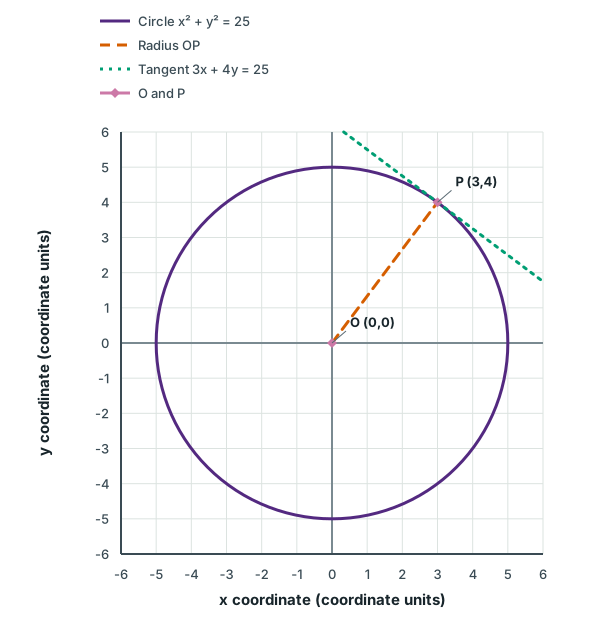
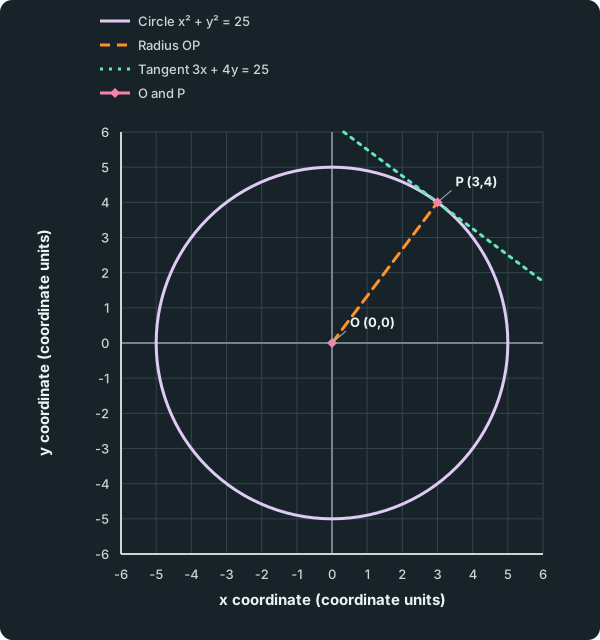
For x² + y² = 25, P(3,4) is on the circle because 3² + 4² = 25. Radius OP has gradient 4/3, so the tangent has gradient −3/4. Through P it is
The point satisfies both equations, and the product of the two finite gradients is −1.
The tangent meets the circle perpendicular to its radius
A circle of radius five with equal scales on both coordinate axes. A radius runs from the origin to the marked point (3,4). A descending tangent meets that point without cutting through the circle.
Scroll across the figure to read all labels.
View figure data
| Series | x coordinate (coordinate units) | y coordinate (coordinate units) |
|---|---|---|
| Circle x² + y² = 25 | 5.0000 | 0.0000 |
| Circle x² + y² = 25 | 4.9931 | 0.2617 |
| Circle x² + y² = 25 | 4.9726 | 0.5226 |
| Circle x² + y² = 25 | 4.9384 | 0.7822 |
| Circle x² + y² = 25 | 4.8907 | 1.0396 |
| Circle x² + y² = 25 | 4.8296 | 1.2941 |
| Circle x² + y² = 25 | 4.7553 | 1.5451 |
| Circle x² + y² = 25 | 4.6679 | 1.7918 |
| Circle x² + y² = 25 | 4.5677 | 2.0337 |
| Circle x² + y² = 25 | 4.4550 | 2.2700 |
| Circle x² + y² = 25 | 4.3301 | 2.5000 |
| Circle x² + y² = 25 | 4.1934 | 2.7232 |
| Circle x² + y² = 25 | 4.0451 | 2.9389 |
| Circle x² + y² = 25 | 3.8857 | 3.1466 |
| Circle x² + y² = 25 | 3.7157 | 3.3457 |
| Circle x² + y² = 25 | 3.5355 | 3.5355 |
| Circle x² + y² = 25 | 3.3457 | 3.7157 |
| Circle x² + y² = 25 | 3.1466 | 3.8857 |
| Circle x² + y² = 25 | 3.0000 | 4.0000 |
| Circle x² + y² = 25 | 2.9389 | 4.0451 |
| Circle x² + y² = 25 | 2.7232 | 4.1934 |
| Circle x² + y² = 25 | 2.5000 | 4.3301 |
| Circle x² + y² = 25 | 2.2700 | 4.4550 |
| Circle x² + y² = 25 | 2.0337 | 4.5677 |
| Circle x² + y² = 25 | 1.7918 | 4.6679 |
| Circle x² + y² = 25 | 1.5451 | 4.7553 |
| Circle x² + y² = 25 | 1.2941 | 4.8296 |
| Circle x² + y² = 25 | 1.0396 | 4.8907 |
| Circle x² + y² = 25 | 0.7822 | 4.9384 |
| Circle x² + y² = 25 | 0.5226 | 4.9726 |
| Circle x² + y² = 25 | 0.2617 | 4.9931 |
| Circle x² + y² = 25 | 0.0000 | 5.0000 |
| Circle x² + y² = 25 | -0.2617 | 4.9931 |
| Circle x² + y² = 25 | -0.5226 | 4.9726 |
| Circle x² + y² = 25 | -0.7822 | 4.9384 |
| Circle x² + y² = 25 | -1.0396 | 4.8907 |
| Circle x² + y² = 25 | -1.2941 | 4.8296 |
| Circle x² + y² = 25 | -1.5451 | 4.7553 |
| Circle x² + y² = 25 | -1.7918 | 4.6679 |
| Circle x² + y² = 25 | -2.0337 | 4.5677 |
| Circle x² + y² = 25 | -2.2700 | 4.4550 |
| Circle x² + y² = 25 | -2.5000 | 4.3301 |
| Circle x² + y² = 25 | -2.7232 | 4.1934 |
| Circle x² + y² = 25 | -2.9389 | 4.0451 |
| Circle x² + y² = 25 | -3.1466 | 3.8857 |
| Circle x² + y² = 25 | -3.3457 | 3.7157 |
| Circle x² + y² = 25 | -3.5355 | 3.5355 |
| Circle x² + y² = 25 | -3.7157 | 3.3457 |
| Circle x² + y² = 25 | -3.8857 | 3.1466 |
| Circle x² + y² = 25 | -4.0451 | 2.9389 |
| Circle x² + y² = 25 | -4.1934 | 2.7232 |
| Circle x² + y² = 25 | -4.3301 | 2.5000 |
| Circle x² + y² = 25 | -4.4550 | 2.2700 |
| Circle x² + y² = 25 | -4.5677 | 2.0337 |
| Circle x² + y² = 25 | -4.6679 | 1.7918 |
| Circle x² + y² = 25 | -4.7553 | 1.5451 |
| Circle x² + y² = 25 | -4.8296 | 1.2941 |
| Circle x² + y² = 25 | -4.8907 | 1.0396 |
| Circle x² + y² = 25 | -4.9384 | 0.7822 |
| Circle x² + y² = 25 | -4.9726 | 0.5226 |
| Circle x² + y² = 25 | -4.9931 | 0.2617 |
| Circle x² + y² = 25 | -5.0000 | 0.0000 |
| Circle x² + y² = 25 | -4.9931 | -0.2617 |
| Circle x² + y² = 25 | -4.9726 | -0.5226 |
| Circle x² + y² = 25 | -4.9384 | -0.7822 |
| Circle x² + y² = 25 | -4.8907 | -1.0396 |
| Circle x² + y² = 25 | -4.8296 | -1.2941 |
| Circle x² + y² = 25 | -4.7553 | -1.5451 |
| Circle x² + y² = 25 | -4.6679 | -1.7918 |
| Circle x² + y² = 25 | -4.5677 | -2.0337 |
| Circle x² + y² = 25 | -4.4550 | -2.2700 |
| Circle x² + y² = 25 | -4.3301 | -2.5000 |
| Circle x² + y² = 25 | -4.1934 | -2.7232 |
| Circle x² + y² = 25 | -4.0451 | -2.9389 |
| Circle x² + y² = 25 | -3.8857 | -3.1466 |
| Circle x² + y² = 25 | -3.7157 | -3.3457 |
| Circle x² + y² = 25 | -3.5355 | -3.5355 |
| Circle x² + y² = 25 | -3.3457 | -3.7157 |
| Circle x² + y² = 25 | -3.1466 | -3.8857 |
| Circle x² + y² = 25 | -2.9389 | -4.0451 |
| Circle x² + y² = 25 | -2.7232 | -4.1934 |
| Circle x² + y² = 25 | -2.5000 | -4.3301 |
| Circle x² + y² = 25 | -2.2700 | -4.4550 |
| Circle x² + y² = 25 | -2.0337 | -4.5677 |
| Circle x² + y² = 25 | -1.7918 | -4.6679 |
| Circle x² + y² = 25 | -1.5451 | -4.7553 |
| Circle x² + y² = 25 | -1.2941 | -4.8296 |
| Circle x² + y² = 25 | -1.0396 | -4.8907 |
| Circle x² + y² = 25 | -0.7822 | -4.9384 |
| Circle x² + y² = 25 | -0.5226 | -4.9726 |
| Circle x² + y² = 25 | -0.2617 | -4.9931 |
| Circle x² + y² = 25 | 0.0000 | -5.0000 |
| Circle x² + y² = 25 | 0.2617 | -4.9931 |
| Circle x² + y² = 25 | 0.5226 | -4.9726 |
| Circle x² + y² = 25 | 0.7822 | -4.9384 |
| Circle x² + y² = 25 | 1.0396 | -4.8907 |
| Circle x² + y² = 25 | 1.2941 | -4.8296 |
| Circle x² + y² = 25 | 1.5451 | -4.7553 |
| Circle x² + y² = 25 | 1.7918 | -4.6679 |
| Circle x² + y² = 25 | 2.0337 | -4.5677 |
| Circle x² + y² = 25 | 2.2700 | -4.4550 |
| Circle x² + y² = 25 | 2.5000 | -4.3301 |
| Circle x² + y² = 25 | 2.7232 | -4.1934 |
| Circle x² + y² = 25 | 2.9389 | -4.0451 |
| Circle x² + y² = 25 | 3.1466 | -3.8857 |
| Circle x² + y² = 25 | 3.3457 | -3.7157 |
| Circle x² + y² = 25 | 3.5355 | -3.5355 |
| Circle x² + y² = 25 | 3.7157 | -3.3457 |
| Circle x² + y² = 25 | 3.8857 | -3.1466 |
| Circle x² + y² = 25 | 4.0451 | -2.9389 |
| Circle x² + y² = 25 | 4.1934 | -2.7232 |
| Circle x² + y² = 25 | 4.3301 | -2.5000 |
| Circle x² + y² = 25 | 4.4550 | -2.2700 |
| Circle x² + y² = 25 | 4.5677 | -2.0337 |
| Circle x² + y² = 25 | 4.6679 | -1.7918 |
| Circle x² + y² = 25 | 4.7553 | -1.5451 |
| Circle x² + y² = 25 | 4.8296 | -1.2941 |
| Circle x² + y² = 25 | 4.8907 | -1.0396 |
| Circle x² + y² = 25 | 4.9384 | -0.7822 |
| Circle x² + y² = 25 | 4.9726 | -0.5226 |
| Circle x² + y² = 25 | 4.9931 | -0.2617 |
| Circle x² + y² = 25 | 5.0000 | 0.0000 |
| Radius OP | 0.0000 | 0.0000 |
| Radius OP | 3.0000 | 4.0000 |
| Tangent 3x + 4y = 25 | 0.3333 | 6.0000 |
| Tangent 3x + 4y = 25 | 6.0000 | 1.7500 |
| O and P | 0.0000 | 0.0000 |
| O and P | 3.0000 | 4.0000 |
At P(5,0) on the same circle, the radius is horizontal and the tangent is vertical, x = 5. At P(0,5), the radius is vertical and the tangent is horizontal, y = 5. These directions give tangents without assigning an undefined gradient or dividing by zero.
Coordinate area needs the actual region
A triangle with vertices (0,0), (6,0) and (2,4) has a horizontal base of 6 and perpendicular height 4, giving area 12 square units. An oblique side is not the perpendicular height.
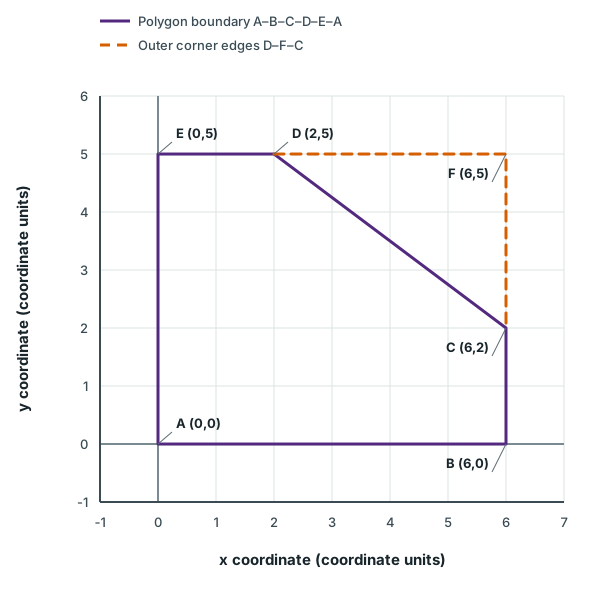
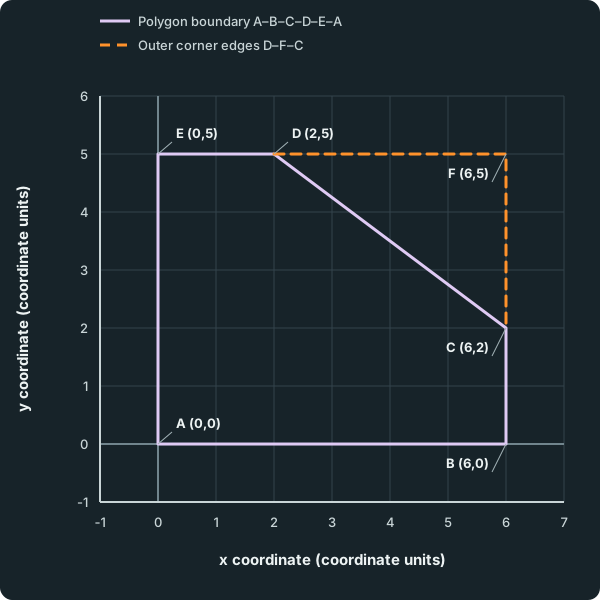
For a composite polygon, follow its boundary first. The region A(0,0)–B(6,0)–C(6,2)–D(2,5)–E(0,5)–A fits inside a 6 by 5 rectangle. The missing upper-right triangle has horizontal width 6 − 2 = 4 and vertical height 5 − 2 = 3.
The ordered boundary determines which area is wanted
A five-sided region is a rectangle with its upper-right corner removed. The dashed outer corner edges run from D(2,5) through F(6,5) to C(6,2), completing the bounding rectangle. All six points are labelled with coordinates.
Scroll across the figure to read all labels.
View figure data
| Series | x coordinate (coordinate units) | y coordinate (coordinate units) |
|---|---|---|
| Polygon boundary A–B–C–D–E–A | 0 | 0 |
| Polygon boundary A–B–C–D–E–A | 6 | 0 |
| Polygon boundary A–B–C–D–E–A | 6 | 2 |
| Polygon boundary A–B–C–D–E–A | 2 | 5 |
| Polygon boundary A–B–C–D–E–A | 0 | 5 |
| Polygon boundary A–B–C–D–E–A | 0 | 0 |
| Outer corner edges D–F–C | 2 | 5 |
| Outer corner edges D–F–C | 6 | 5 |
| Outer corner edges D–F–C | 6 | 2 |
Subtracting that non-overlapping corner gives area 6 × 5 − (1/2)(4)(3) = 24 square units. The same five coordinates joined in another order could describe a different boundary; the point list alone is insufficient.
Check your understanding 3 Keep the points but change the requested boundary
Using the same labelled points in the figure, find the area of triangle ABD, whose boundary is A–B–D–A. How much smaller is it than the five-sided region? State the base and perpendicular height that belong to the triangle rather than using the polygon’s outline.
Show answer
AB is a horizontal base of length 6 and D has perpendicular height 5 above it. Triangle ABD has area (1/2)(6)(5) = 15 square units, which is 24 − 15 = 9 square units smaller than the polygon. Its boundary omits C and E even though those points remain in the figure. Using the same diagram does not mean the same region was requested.
Try it yourself 1
Find the circle and test the proposed tangent
Problem
A circle has diameter endpoints A(−2,1) and B(4,5). Find its equation in completed-square and expanded forms. Check whether P(3,6) lies on it and, if so, find its tangent at P. A proposal says y = 6 is that tangent because it passes through P. Give a decisive mathematical check of the proposal.
Write your answer, then compare it with the solution
Hints
Hint 1
Use the stated diameter before choosing the tangent direction
Distinguish a diameter’s midpoint from the midpoint of an arbitrary chord. Then check the proposed point in the circle before deciding what direction its tangent must have.
Show full solution
Recover the centre and radius
Method
Use the midpoint and half the length of the stated diameter.Reason
A diameter passes through the centre, unlike an arbitrary chord.Working
Answer
The centre is ((−2 + 4)/2, (1 + 5)/2) = (1,3). The diameter has squared length 6² + 4² = 52, so r² = 52/4 = 13 and r = √13. Hence (x-1)² + (y-3)² = 13, or x² + y²-2x-6y-3 = 0.Check the point and construct its tangent
Method
Test P in the circle and use the radius from (1,3) to P.Reason
A tangent at P needs P on the circle and a direction perpendicular to that radius.Working
Answer
At P, (3 − 1)² + (6 − 3)² = 4 + 9 = 13, so P is on the circle. The radius gradient is 3/2, making the tangent gradient −2/3. Thus y − 6 = −(2/3)(x − 3), or 2x + 3y = 24. P satisfies this line, and (3/2)(−2/3) = −1.Test the proposed horizontal line
Method
Check whether y = 6 touches only at P.Reason
Passing through a circle point is necessary but is not sufficient for tangency.Working
Answer
Substituting y = 6 into the circle gives (x − 1)² + 9 = 13, so x = −1 or 3. The line meets the circle at both (−1,6) and P(3,6); it is a secant, rather than the tangent. Its horizontal direction is also not perpendicular to the radius of gradient 3/2.
Quick check
Check the diameter assumption, positive radius, both circle forms, original point and perpendicular direction separately. A different valid method may verify the tangent, but a line’s passage through P alone does not establish tangency.
Keep track of this lesson
Mark the lesson done when you have worked through it.
Lesson progress is optional and kept on this device.
Loading lesson controls…
Your lesson mark records your own study. Checks are kept separately in My Learning.