On this page
Loading guide controls…
Continue lessonNew guided lessons are not available yet.
Guided lesson options
You stopped at:
ContinueRevision Mode is on. Questions and activities are hidden.
The linked question or activity is hidden by Revision Mode.
Many practical questions come down to finding three unknowns that satisfy three conditions: the coefficients of a curve through three points, the quantities in a mixture, or the prices that produce stated totals. This lesson names each unknown and condition, turns them into a system of linear equations, solves it with a graphing calculator, checks the solution in the original context, and recognises what it means when the calculator reports no solution or infinitely many.
Name each unknown and each condition
A system of linear equations comes from a problem only after you decide what the unknowns are. Write each one as a letter with its meaning and unit, for example “let x be the price of one coffee, in dollars”. Then turn each independent piece of information into one equation.
Three unknowns normally need three independent conditions. Two conditions leave a whole family of possible answers. A fourth condition can either repeat information you already have or contradict it, so it must still be consistent with the other three.
A graphing calculator then solves the system you entered. It does not check that the equations describe the situation. Keep your written definitions and equations: they are the working an examiner reads, and they let you check the calculator’s answer in the original conditions.
A curve through points gives linear equations
A curve y = ax² + bx + c is not a straight line, but its coefficients appear linearly once x and y are known. Each point on the curve gives one linear equation in a, b and c.
Worked example 1
A quadratic through three points
Worked example 1
A quadratic through three points
The curve y = ax² + bx + c passes through (1,4), (2,9) and (-1,6). Find a, b and c.
Show full solutionHide solution
Substitute each point
Method
Put each pair of coordinates into the equation of the curve.Reason
A point lies on the curve exactly when its coordinates satisfy the equation.Working
Answer
a + b + c = 4 from (1,4),; 4a + 2b + c = 9 from (2,9),; a-b + c = 6 from (-1,6).Solve the system
Method
Eliminate c by subtracting equations, or use the calculator’s system solver.Reason
Each subtraction removes c and leaves simpler equations in a and b.Working
Answer
Subtracting the third equation from the first gives 2b = -2, so b = -1. Subtracting the first from the second gives 3a + b = 5, so 3a = 6 and a = 2. Then c = 4-a-b = 3.
The curve is y = 2x²-x + 3. A calculator solving the same three equations returns a = 2, b = -1, c = 3.
Check every point
Method
Substitute the points into the fitted curve.Reason
A mistyped coefficient can still give three numbers; the original points reveal it.Working
Answer
At x = 1: 2-1 + 3 = 4. At x = 2: 8-2 + 3 = 9. At x = -1: 2 + 1 + 3 = 6. All three points lie on the curve.
Quick check
Three points constrain one quadratic
The solid parabola passes through three cross-marked observations. Substituting them gives a − b + c = 6, a + b + c = 4 and 4a + 2b + c = 9.
Scroll across to read every label.
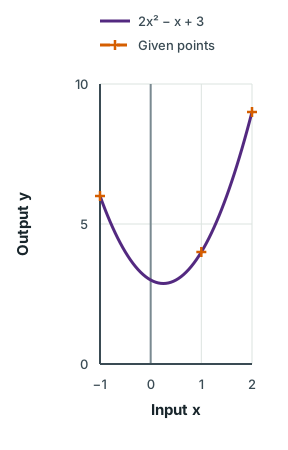
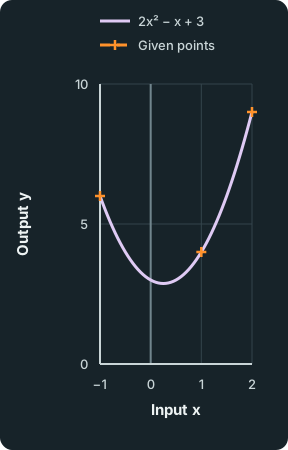
Figure data
This table is included in print while it is open.
| Series | Input x | Output y |
|---|---|---|
| 2x² − x + 3 | -1.00 | 6.000 |
| 2x² − x + 3 | -0.95 | 5.755 |
| 2x² − x + 3 | -0.90 | 5.520 |
| 2x² − x + 3 | -0.85 | 5.295 |
| 2x² − x + 3 | -0.80 | 5.080 |
| 2x² − x + 3 | -0.75 | 4.875 |
| 2x² − x + 3 | -0.70 | 4.680 |
| 2x² − x + 3 | -0.65 | 4.495 |
| 2x² − x + 3 | -0.60 | 4.320 |
| 2x² − x + 3 | -0.55 | 4.155 |
| 2x² − x + 3 | -0.50 | 4.000 |
| 2x² − x + 3 | -0.45 | 3.855 |
| 2x² − x + 3 | -0.40 | 3.720 |
| 2x² − x + 3 | -0.35 | 3.595 |
| 2x² − x + 3 | -0.30 | 3.480 |
| 2x² − x + 3 | -0.25 | 3.375 |
| 2x² − x + 3 | -0.20 | 3.280 |
| 2x² − x + 3 | -0.15 | 3.195 |
| 2x² − x + 3 | -0.10 | 3.120 |
| 2x² − x + 3 | -0.05 | 3.055 |
| 2x² − x + 3 | 0.00 | 3.000 |
| 2x² − x + 3 | 0.05 | 2.955 |
| 2x² − x + 3 | 0.10 | 2.920 |
| 2x² − x + 3 | 0.15 | 2.895 |
| 2x² − x + 3 | 0.20 | 2.880 |
| 2x² − x + 3 | 0.25 | 2.875 |
| 2x² − x + 3 | 0.30 | 2.880 |
| 2x² − x + 3 | 0.35 | 2.895 |
| 2x² − x + 3 | 0.40 | 2.920 |
| 2x² − x + 3 | 0.45 | 2.955 |
| 2x² − x + 3 | 0.50 | 3.000 |
| 2x² − x + 3 | 0.55 | 3.055 |
| 2x² − x + 3 | 0.60 | 3.120 |
| 2x² − x + 3 | 0.65 | 3.195 |
| 2x² − x + 3 | 0.70 | 3.280 |
| 2x² − x + 3 | 0.75 | 3.375 |
| 2x² − x + 3 | 0.80 | 3.480 |
| 2x² − x + 3 | 0.85 | 3.595 |
| 2x² − x + 3 | 0.90 | 3.720 |
| 2x² − x + 3 | 0.95 | 3.855 |
| 2x² − x + 3 | 1.00 | 4.000 |
| 2x² − x + 3 | 1.05 | 4.155 |
| 2x² − x + 3 | 1.10 | 4.320 |
| 2x² − x + 3 | 1.15 | 4.495 |
| 2x² − x + 3 | 1.20 | 4.680 |
| 2x² − x + 3 | 1.25 | 4.875 |
| 2x² − x + 3 | 1.30 | 5.080 |
| 2x² − x + 3 | 1.35 | 5.295 |
| 2x² − x + 3 | 1.40 | 5.520 |
| 2x² − x + 3 | 1.45 | 5.755 |
| 2x² − x + 3 | 1.50 | 6.000 |
| 2x² − x + 3 | 1.55 | 6.255 |
| 2x² − x + 3 | 1.60 | 6.520 |
| 2x² − x + 3 | 1.65 | 6.795 |
| 2x² − x + 3 | 1.70 | 7.080 |
| 2x² − x + 3 | 1.75 | 7.375 |
| 2x² − x + 3 | 1.80 | 7.680 |
| 2x² − x + 3 | 1.85 | 7.995 |
| 2x² − x + 3 | 1.90 | 8.320 |
| 2x² − x + 3 | 1.95 | 8.655 |
| 2x² − x + 3 | 2.00 | 9.000 |
| Given points | -1.00 | 6.000 |
| Given points | 1.00 | 4.000 |
| Given points | 2.00 | 9.000 |
Enter the system and check the solution
Before using the calculator, write every equation in the same order of unknowns, with the constants on the right. A missing unknown has coefficient 0. Then use the calculator’s simultaneous-equation solver, or a matrix row-reduction command, and copy its answer next to your written system.
Check the answer in the original conditions, not just in the equations you typed. If a check fails, compare each typed row with your written equation: a sign or a coefficient in the wrong column is the usual cause. Round only the final answers, to the accuracy the question asks for.
Check your understanding 1
Three café orders
Check your understanding 1
Three café orders
A café charges fixed prices. Two coffees, one tea and three muffins cost $18.10. One coffee, two teas and one muffin cost $11.50. Three coffees, one tea and two muffins cost $18.60. Write a system of three equations and solve it with your calculator. Enter the price of each item in dollars.
Show answerHide answer
Let x, y and z be the prices in dollars of one coffee, one tea and one muffin.
The solver gives x = 3.40, y = 2.60 and z = 2.90. Check the first order: 2(3.40) + 2.60 + 3(2.90) = 6.80 + 2.60 + 8.70 = 18.10. The other two orders check in the same way.
When there is no unique solution
A calculator may report that a system has no unique solution. There are two different reasons.
- A repeated condition. One equation can be built from the others, so it adds no new information. There are infinitely many solutions. You need another independent fact about the situation.
- Contradictory conditions. Combining equations gives a false statement such as 0 = 1. There is no solution at all. The data or the model need to be re-examined.
To tell them apart, combine equations yourself and compare the result with the remaining equation. Do not report a single solution the calculator did not give.
Check your understanding 2
Classify two systems
Check your understanding 2
Classify two systems
Both systems share their first two equations: x + y + z = 10 and x-y = 2. The third equation is 2x + z = 12 in system P and 2x + z = 13 in system Q. Classify each system.
Show answerHide answer
Adding x + y + z = 10 and x-y = 2 gives 2x + z = 12 for every solution of the first two equations.
In P, the third equation is exactly this, so it is a repeated condition: infinitely many solutions. For example, x = 4, y = 2, z = 4 and x = 5, y = 3, z = 2 both satisfy P.
In Q, the third equation needs 2x + z = 13, while the first two need 12. Subtracting gives 0 = 1, so Q has no solution.
Common mistakes
- Using a letter without saying what it represents and in what units.
- Substituting a point into the curve with x and y swapped.
- Entering the equations into the calculator with the coefficients in a different variable order from the one defined.
- Accepting a solution without checking it in every original condition, or accepting negative or non-integer values where the context needs whole positive numbers.
- Reading “no unique solution” as an error, instead of deciding whether the conditions are inconsistent or not independent.
Before you move on
Try it yourself 1
Fit a flight model, then find the landing time
Try it yourself 1
Fit a flight model, then find the landing time
A ball is thrown upwards from a balcony. Its height h metres above the ground, t seconds after release, is modelled by h = at² + bt + c. The model must give heights 6.875, 8.1 and 3.2 metres at t = 0.5, 1 and 2.
- Form and solve a system of linear equations for a, b and c.
- State the meaning of c in this situation.
- Use the model to find when the ball reaches the ground, to three significant figures, and explain why you reject the other solution.
Write your answer, then compare it with the solution
Hint 1
Each observation is one equation
Substitute each pair (t,h) into h = at² + bt + c. The squares of the times become coefficients of a. Then set the fitted height equal to zero.
Show full solutionHide solution
Form the system
Method
Substitute the three observations.Reason
Each observation is one condition on the three coefficients.Working
Answer
0.25a + 0.5b + c = 6.875,; a + b + c = 8.1,; 4a + 2b + c = 3.2.The solver gives a = -4.9, b = 9.8 and c = 3.2, so h = -4.9t² + 9.8t + 3.2. Check t = 0.5: -1.225 + 4.9 + 3.2 = 6.875.
Interpret the constant
Method
Substitute t = 0.Reason
The constant term is the model’s height at the moment of release.Working
Answer
At t = 0, h = c = 3.2. The ball is released 3.2 metres above the ground, the height of the balcony edge in this model.
Solve for the landing time
Method
Set h = 0 and keep only a time during the flight.Reason
The model describes the ball only from release until it reaches the ground.Working
Answer
Solving -4.9t² + 9.8t + 3.2 = 0 graphically, or with the quadratic formula, gives t = 16/7 ≈ 2.29 and t = -2/7.
The negative time is before the ball was released, so it is outside the model’s domain. The ball reaches the ground after about 2.29 seconds.
Quick check
Check the system, the coefficients in an original observation, the meaning of c and the domain of the flight. A fitted model through three points says nothing about heights after the ball lands.
Loading reading progress…
Lesson done
- Monday
- Tuesday
- Wednesday
- Thursday
- Friday
- Saturday
- Sunday
Checking learning on this device…
Change goal
Progress options
Loading questions…
Syllabus and review details
- GCE A-Level H1 Mathematics 2027 · 2027
- H1 Mathematics 2024 · 2024
Last reviewed: