Exponential integrals and between-curve areas
Check inner factors, exact and numerical integrals, and changing upper/lower boundaries for regions on or above the axis.
More
Offline pages
Saved on this device only. Connect at least once every 30 days to confirm Premium. Sign-out or a change of account removes saved copies.
Find this activity in your course
On this page
You stopped at:
ContinueRevision Mode is on. Questions and activities are hidden.
Extend the antiderivative list
Integration reverses a derivative: an antiderivative must differentiate to the whole original integrand, including its coefficient. The linear-inner power rule from the preceding lesson applies to fractional and negative powers as well as positive integer powers, provided the original real function and the antiderivative are valid on the interval used.
For a ≠ 0 and n ≠ −1, the reverse chain rule gives
Differentiation multiplies by n + 1 and by a, so both factors in the denominator are needed. Check the real powers on the stated interval; the formula does not make an originally excluded input valid.
For example,
Differentiation multiplies by 3/2 and then by the inner factor 2, so the coefficient 1/3 returns exactly the original square root. Using the power rule without undoing that inner factor would give twice the required integrand. The derivative check applies for x > −1/2.
For a ≠ 0,
The exponential stays unchanged when differentiating with respect to its own exponent; dividing by a undoes the exponent’s rate of change with x. Thus ∫3e^(2x-1) dx = (3/2)e^(2x-1) + C.
A negative inner coefficient needs its sign too: ∫ e^(2-3x) dx = -(1/3)e^(2-3x) + C. The derivative of the negative antiderivative is the positive integrand. The sign of an antiderivative is not the sign of its derivative or of a geometric area.
The reciprocal case needs a logarithm
The n = −1 power case is logarithmic: ∫1/x dx = ln |x| + C on an interval not crossing zero. For x > 0 it is ln x + C. It is not covered by xⁿ⁺¹/(n + 1), which would divide by zero at n = −1.
Similarly, for x > −3/2,
The derivative is 1/2[2/(2x + 3)] = 1/(2x + 3). The definite integral from 0 to 1 is 1/2[ln 5- ln 3] = 1/2 ln(5/3), a positive exact number. Check that the integrand is defined throughout the chosen interval before evaluating antiderivative endpoints.
Check your understanding 1 Negative antiderivative values can have a positive difference
Evaluate ∫₀¹(2x + 1)⁻² dx exactly. Explain why the integral is positive even if the antiderivative you choose has negative values at both endpoints.
Show answer
An antiderivative is F(x) = -1/[2(2x + 1)]. Differentiating the negative power gives F′(x) = (2x + 1)⁻². Thus F(1) − F(0) = −1/6 − (−1/2) = 1/3.
The integrand is positive on [0,1], so F increases there: −1/6 is greater than −1/2. The integral uses the change F(1) − F(0), not the sign of either endpoint value separately.
Give a complete family on the stated interval
On one connected interval, two antiderivatives of the same function differ by a constant. Writing F(x) + C, with C an arbitrary real constant independent of x, describes the whole family. Omitting C gives just one member. A fixed initial value can select a particular member, but no such condition is supplied in an indefinite-integral request.
The notation F(x) + 2C describes the same family, because 2C ranges over every real number. In contrast, F(x) + C − C has lost the arbitrary constant. The expression F(x) + xC usually has derivative f(x) + C, so its added term is not constant with respect to x.
Check your understanding 2 Check every term and the arbitrary constant
Find the complete antiderivative family of 3 square root of (2x + 1) -2/(x + 1) + e^(2-3x) on x > 0. Check your result by differentiation. Explain whether omitting C, replacing C by 2C, or replacing it by xC would preserve the complete family.
Show answer
One convenient expression for the complete family is
The power term differentiates to (3/2)(2)(2x + 1)^(1/2) = 3 square root of (2x + 1). The logarithm term differentiates to −2/(x + 1). The exponential term supplies the factor (−1/3)(−3), giving e^(2-3x). The derivative of C is zero. All these expressions are valid on the stated x > 0 interval: both 2x + 1 and x + 1 are positive there.
Omitting C leaves one antiderivative rather than the whole family. Replacing it by 2C preserves every possible constant value and changes no derivative. Replacing it by xC introduces the extra derivative C; it does not give antiderivatives of the original integrand for arbitrary C.
The interval also determines the logarithm’s argument. On x < 0, an antiderivative of 1/x is ln(−x) + C, equivalently ln|x| + C. The expression ln x + C is not real there, even though a formal derivative rule might suggest 1/x. Check the original antiderivative as well as the expression obtained by differentiating it.
Use one antiderivative in both endpoint substitutions
For a definite integral, choose one antiderivative F that is defined throughout the integration interval. Evaluate both endpoint values using that same F, then subtract lower from upper:
For example, integrate 3x²-2x + 1 from −1 to 2. One choice is F(x) = x³-x² + x. Its derivative recovers every term in the integrand. The upper value is F(2) = 6 and the lower value is F(−1) = −3, so the integral is 6 − (−3) = 9. The lower endpoint value is subtracted even when it is negative.
Another valid choice is G(x) = F(x) + 5. Now G(2) = 11 and G(−1) = 2, giving 11 − 2 = 9. The additive constant cancels because it occurs in both values. Combining G(2) with F(−1) would mix two antiderivatives and give the incorrect difference 14.
These checks address different possible errors: differentiating F checks the antiderivative; substituting each limit checks the endpoint values; subtracting in the correct order checks the final evaluation. A correct final number alone does not display all those steps.
Check your understanding 3 Keep the endpoint values linked
Evaluate ∫₀²(2x + 3) dx. Show one antiderivative, its two endpoint values and their difference. A learner instead chooses G(x) = x² + 3x + 7. Explain how both endpoint values change and why the definite integral stays the same.
Show answer
With F(x) = x² + 3x, F(2) = 10 and F(0) = 0. Thus the integral is 10 − 0 = 10. Differentiating F gives the original 2x + 3.
For G, the upper value is 17 and the lower value is 7. Their difference is 17 − 7 = 10. Both values increased by 7, so the common constant cancels. Reporting only 17 would omit the lower value; reporting 0 − 10 would reverse the integration bounds.
The integral of a vertical gap gives area
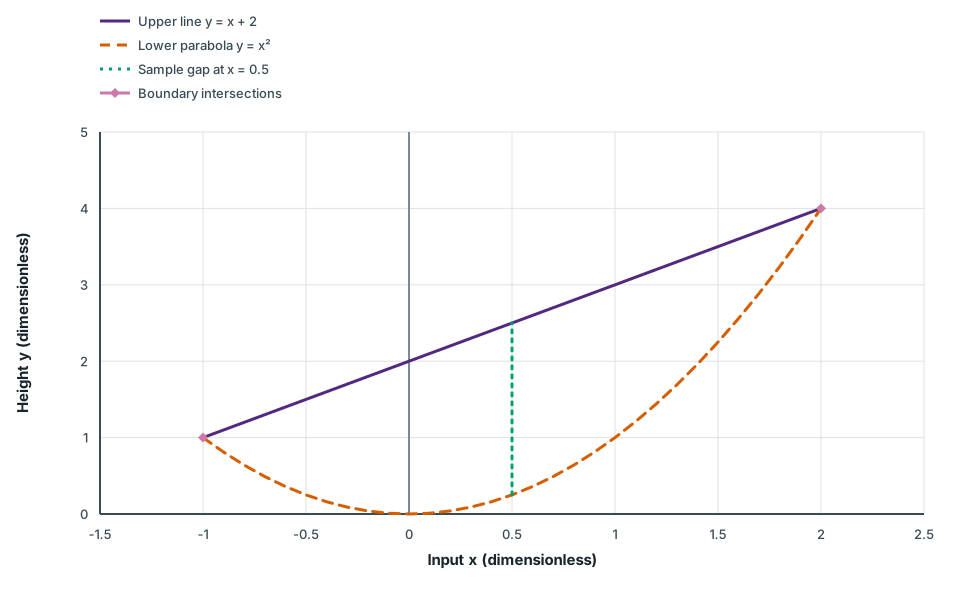
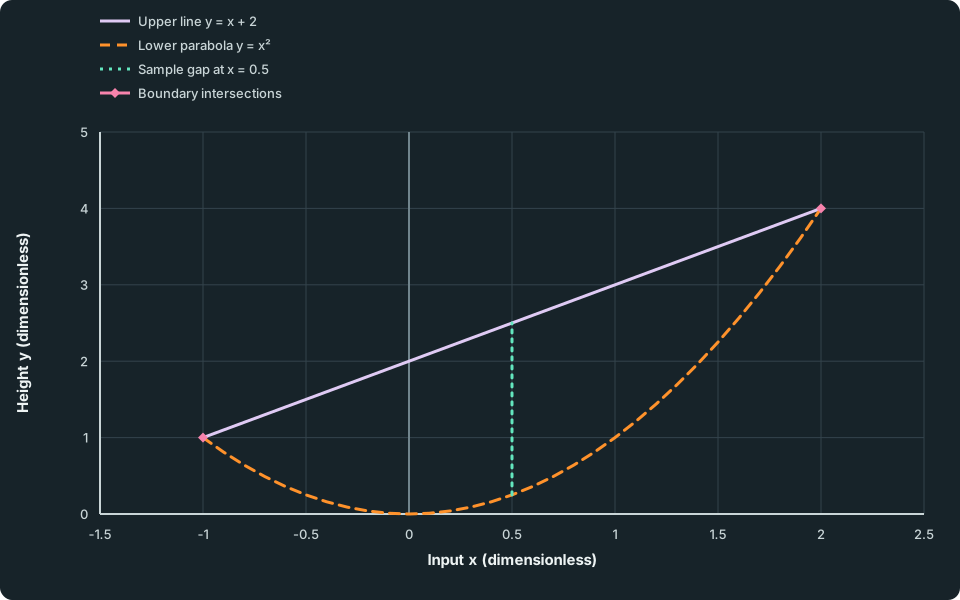
For a region bounded above by y = U(x) and below by y = L(x), its vertical gap is U(x) − L(x). Integrating that non-negative gap over the region’s actual horizontal extent gives its area. The lower boundary is not automatically y = 0.
The curves y = x + 2 and y = x² meet where x² = x + 2, so (x − 2)(x + 1) = 0 gives x = −1 and 2. The matching points are (−1,1) and (2,4). Both curves are on or above the x-axis throughout that interval.
Area uses the vertical gap between the actual boundaries
Both boundary curves are on or above the horizontal axis. The required region lies above the parabola and below the line, rather than extending down to the x-axis. Diamonds mark the two intersections; the illustrative vertical gap has length 2.25.
Scroll across the figure to read all labels.
View figure data
| Series | Input x (dimensionless) | Height y (dimensionless) |
|---|---|---|
| Upper line y = x + 2 | -1.0 | 1.00 |
| Upper line y = x + 2 | -0.9 | 1.10 |
| Upper line y = x + 2 | -0.8 | 1.20 |
| Upper line y = x + 2 | -0.7 | 1.30 |
| Upper line y = x + 2 | -0.6 | 1.40 |
| Upper line y = x + 2 | -0.5 | 1.50 |
| Upper line y = x + 2 | -0.4 | 1.60 |
| Upper line y = x + 2 | -0.3 | 1.70 |
| Upper line y = x + 2 | -0.2 | 1.80 |
| Upper line y = x + 2 | -0.1 | 1.90 |
| Upper line y = x + 2 | 0.0 | 2.00 |
| Upper line y = x + 2 | 0.1 | 2.10 |
| Upper line y = x + 2 | 0.2 | 2.20 |
| Upper line y = x + 2 | 0.3 | 2.30 |
| Upper line y = x + 2 | 0.4 | 2.40 |
| Upper line y = x + 2 | 0.5 | 2.50 |
| Upper line y = x + 2 | 0.6 | 2.60 |
| Upper line y = x + 2 | 0.7 | 2.70 |
| Upper line y = x + 2 | 0.8 | 2.80 |
| Upper line y = x + 2 | 0.9 | 2.90 |
| Upper line y = x + 2 | 1.0 | 3.00 |
| Upper line y = x + 2 | 1.1 | 3.10 |
| Upper line y = x + 2 | 1.2 | 3.20 |
| Upper line y = x + 2 | 1.3 | 3.30 |
| Upper line y = x + 2 | 1.4 | 3.40 |
| Upper line y = x + 2 | 1.5 | 3.50 |
| Upper line y = x + 2 | 1.6 | 3.60 |
| Upper line y = x + 2 | 1.7 | 3.70 |
| Upper line y = x + 2 | 1.8 | 3.80 |
| Upper line y = x + 2 | 1.9 | 3.90 |
| Upper line y = x + 2 | 2.0 | 4.00 |
| Lower parabola y = x² | -1.0 | 1.00 |
| Lower parabola y = x² | -0.9 | 0.81 |
| Lower parabola y = x² | -0.8 | 0.64 |
| Lower parabola y = x² | -0.7 | 0.49 |
| Lower parabola y = x² | -0.6 | 0.36 |
| Lower parabola y = x² | -0.5 | 0.25 |
| Lower parabola y = x² | -0.4 | 0.16 |
| Lower parabola y = x² | -0.3 | 0.09 |
| Lower parabola y = x² | -0.2 | 0.04 |
| Lower parabola y = x² | -0.1 | 0.01 |
| Lower parabola y = x² | 0.0 | 0.00 |
| Lower parabola y = x² | 0.1 | 0.01 |
| Lower parabola y = x² | 0.2 | 0.04 |
| Lower parabola y = x² | 0.3 | 0.09 |
| Lower parabola y = x² | 0.4 | 0.16 |
| Lower parabola y = x² | 0.5 | 0.25 |
| Lower parabola y = x² | 0.6 | 0.36 |
| Lower parabola y = x² | 0.7 | 0.49 |
| Lower parabola y = x² | 0.8 | 0.64 |
| Lower parabola y = x² | 0.9 | 0.81 |
| Lower parabola y = x² | 1.0 | 1.00 |
| Lower parabola y = x² | 1.1 | 1.21 |
| Lower parabola y = x² | 1.2 | 1.44 |
| Lower parabola y = x² | 1.3 | 1.69 |
| Lower parabola y = x² | 1.4 | 1.96 |
| Lower parabola y = x² | 1.5 | 2.25 |
| Lower parabola y = x² | 1.6 | 2.56 |
| Lower parabola y = x² | 1.7 | 2.89 |
| Lower parabola y = x² | 1.8 | 3.24 |
| Lower parabola y = x² | 1.9 | 3.61 |
| Lower parabola y = x² | 2.0 | 4.00 |
| Sample gap at x = 0.5 | 0.5 | 0.25 |
| Sample gap at x = 0.5 | 0.5 | 2.50 |
| Boundary intersections | -1.0 | 1.00 |
| Boundary intersections | 2.0 | 4.00 |
The gap between line and parabola is x + 2 − x² = (2 − x)(x + 1), which is non-negative from −1 to 2. Therefore the line is the upper boundary throughout the bounded region, and its area is
The antiderivative has value 10/3 at 2 and −7/6 at −1; their difference is 9/2 square units. Reversing the subtraction would give a negative integral rather than the positive area of this region. Integrating just x + 2 would include the extra space down to the x-axis below the parabola.
Find the intersections before choosing bounds. A drawing’s visible window edges are not automatically region boundaries. For example, the region between y = 2 + e⁻ˣ and y = 2, from x = 1 to x = 3, has gap e⁻ˣ. Its area is [-e^(-x)]₁³ = e⁻¹-e⁻³ square units. Integrating 2 + e⁻ˣ instead would add an unwanted rectangle of area 2 × 2 = 4.
Use numerical integration honestly
A graphing calculator or graphing software can approximate a definite integral even when the antiderivative rules taught here do not supply a simple expression. For example,
The exponent is quadratic, so the formula for a linear exponent cannot be applied by treating its inner derivative as a constant. Use the tool’s numerical integration operation with integrand exp(−x²), lower bound 0 and upper bound 1. Bracket the complete exponent: exp(−x²) and exp(−x)² are different functions.
On [0,1] the integrand decreases from 1 to e⁻¹ and stays positive. The area over this width-one interval must therefore lie between e⁻¹ and 1, which checks the size of the numerical result. To six decimal places it is 0.746824; to three significant figures it is 0.747. A displayed decimal is an approximation, not a newly discovered elementary antiderivative.
When an exact antiderivative is available, compare the numerical result with F(b) − F(a). If the task asks for an exact answer, keep fractions and exponential expressions rather than replacing them prematurely with decimals.
Check your understanding 4 Differentiate your antiderivative as a check
Evaluate ∫₀¹ 2e^2x dx exactly, then give a decimal check to three significant figures. Explain why replacing the exact expression by the decimal alone would not meet the first request.
Show answer
An antiderivative is e^(2x), so the exact integral is e² − 1, approximately 6.39 to three significant figures. The factor 2 in the integrand cancels the reciprocal inner factor. The decimal checks its size but has discarded digits; it is not an exact replacement for e² − 1.
Check whether the curves exchange order
Before subtracting two curves over a whole interval, check every intersection inside it. If the upper and lower boundaries exchange order, split the interval and use a non-negative upper-minus-lower gap on each part. Taking the absolute value of one final integral cannot generally recover area lost by cancellation between parts.
The regions in this lesson lie on or above the x-axis. Even there, the difference of two heights can change sign when they exchange order. That is a boundary-selection issue between the curves, rather than a region lying below the x-axis.
Try it yourself 1
Find the total area between two curves
Problem
For 0 ≤ x ≤ 2, find the total area between y = x² and y = x. Give an exact answer and show how the positions of the original curves determine your calculation. Both curves remain on or above the x-axis.
A proposed answer takes the absolute value of ∫₀²(x²-x) dx. Decide whether that gives the required total area and explain your conclusion.
Write your answer, then compare it with the solution
Hints
Hint 1
Check the boundary order throughout the interval
An area calculation needs the vertical gap between the upper and lower curves. Decide whether the same curve stays above the other throughout the stated interval, using their intersection condition.
Show full solution
Locate the intersections and compare heights
Method
Solve x² = x and inspect the intervals it separates.Reason
The lower boundary may change inside the stated horizontal extent.Working
Answer
The intersection inputs are 0 and 1. On (0,1), x > x², so the gap is x − x². On (1,2), x² > x, so the gap is x² − x.Add the two non-negative region areas
Method
Integrate the appropriate gap on each part.Reason
Each positive contribution measures geometric area; neither should cancel the other.Working
Answer
∫₀¹(x-x²) dx = 1/6, and ∫₁²(x²-x) dx = 5/6. The total area is 1 square unit.Test the proposed single integral
Method
Compare its contributions before taking an absolute value.Reason
A final absolute value changes an overall sign but does not undo cancellation inside the integral.Working
Answer
The proposed integral is −1/6 + 5/6 = 2/3. Its absolute value is still 2/3, which is smaller than the total area 1. Both original curves are non-negative; the error comes from subtracting the heights in the same order on both subintervals.
Quick check
Check the intersection inputs, which curve is upper on each part, each endpoint evaluation and the final addition. Keep the geometric region distinct from the sign of an arbitrary difference of function values.
Keep track of this lesson
Mark the lesson done when you have worked through it.
Lesson progress is optional and kept on this device.
Loading lesson controls…
Your lesson mark records your own study. Checks are kept separately in My Learning.