Antiderivatives and positive area
Recover antiderivatives with their conditions, then select the correct boundaries and vertical separation for positive area.
More
Offline pages
Saved on this device only. Connect at least once every 30 days to confirm Premium. Sign-out or a change of account removes saved copies.
Find this activity in your course
On this page
You stopped at:
ContinueRevision Mode is on. Questions and activities are hidden.
An indefinite integral names a family
Integration reverses differentiation. If F′(x) = f(x) on an interval, F is an antiderivative of f there. For n ≠ −1,
This holds on an interval where the real powers and derivatives used are defined. Differentiate the result to check it: the factor n + 1 cancels its denominator. The rule increases the power by one and divides by the new power, rather than decreasing the power as differentiation does. It cannot be used for n = −1, when that denominator would be zero.
The constant C matters because every constant differentiates to zero. For example, x² + 3 and x² − 8 both have derivative 2x. The notation ∫2x dx = x² + C represents the whole family, rather than choosing one member without a condition.
Constant multiples, sums and differences integrate term by term. For instance,
Rational and negative powers use the same rule where allowed. On x > 0,
Differentiating gives 3x²-4x⁻² + x^(1/2), including the negative sign from differentiating 4/x. The square root and reciprocal restrict the original expression; an antiderivative formula does not erase that restriction.
Reverse an inner scale, not an arbitrary chain
For a linear inner expression with a ≠ 0,
The extra denominator a undoes the constant inner derivative. Thus ∫(3x + 2)⁴ dx = (3x + 2)⁵/15 + C: differentiating multiplies by 5 and by 3. If a = 0, the integrand is constant in x wherever it is defined; integrate that constant directly rather than dividing by zero.
This shortcut does not apply unchanged to every inner function. For example, differentiating (x² + 1)⁴/4 gives 2x(x² + 1)³, not (x² + 1)³. A nonconstant inner derivative cannot be repaired by dividing the result by a guessed constant. Checking by differentiation is a decisive test of a proposed antiderivative.
A condition can determine C
If dy/dx = 2x − 3 and y = 4 at x = 1, first integrate to y = x² − 3x + C. Then 4 = 1 − 3 + C gives C = 6. The required curve is y = x² − 3x + 6.
Check both pieces of information: its derivative is 2x − 3, and it passes through (1,4). Omitting C would produce a curve with the right gradient function but the wrong stated point.
A definite integral evaluates a net accumulation
For a continuous f on [a,b] with antiderivative F there,
The additive constant cancels. Evaluate the entire expression at each endpoint before subtracting; for ∫₁³2x dx, the result is 3² − 1² = 8, rather than (3 − 1)². An indefinite integral gives a family of functions; a definite integral gives a number for the specified bounds.
The interval condition matters. Although −1/x differentiates to 1/x² when x ≠ 0, the integrand is undefined at zero. Substituting −1 and 1 into that antiderivative across zero does not justify an ordinary definite integral or a finite area. Check the full interval, rather than only its endpoints.
Check your understanding 1 Check by differentiating
Find ∫(2x + 1)³ dx, then evaluate its definite integral from 0 to 1. A proposal omits the inner factor and uses (2x + 1)⁴/4 + C. Explain the error by differentiating it.
Show answer
The antiderivative is (2x + 1)⁴/8 + C. Evaluation gives (3⁴ − 1⁴)/8 = 10. Its derivative is (4/8)(2x + 1)³ × 2 = (2x + 1)³, as required.
The proposal’s derivative is 2(2x + 1)³, twice the requested integrand. Dividing by the new power alone misses the factor needed to reverse the inner derivative.
Draw and identify the boundary
Where f is non-negative, ∫ₐᵇf(x) dx equals the area between its graph and the x-axis from x = a to x = b. For y = 4 − x² on [0,2], the graph is non-negative and its area above the axis is [4x − x³/3]₀² = 16/3 square units.
A different lower boundary changes the integrand. To find the region bounded by y = x² and the line y = 2x, first solve x² = 2x. The intersections have x = 0 and x = 2. On this interval, 2x − x² = x(2 − x) ≥ 0, so the line is the upper boundary and the curve the lower one.
The region lies between the line and the curve
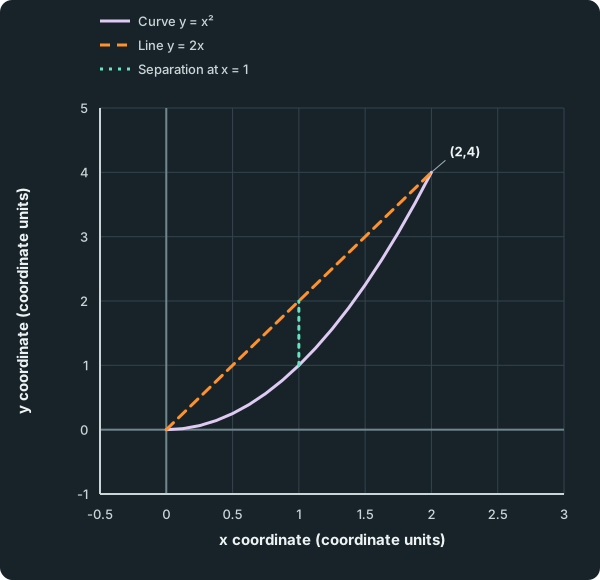
The curve y = x² and dashed line y = 2x meet at (0,0) and (2,4). Between the intersections, the line is above the curve. A dotted vertical segment at x = 1 extends from curve height one to line height two.
Scroll across the figure to read all labels.
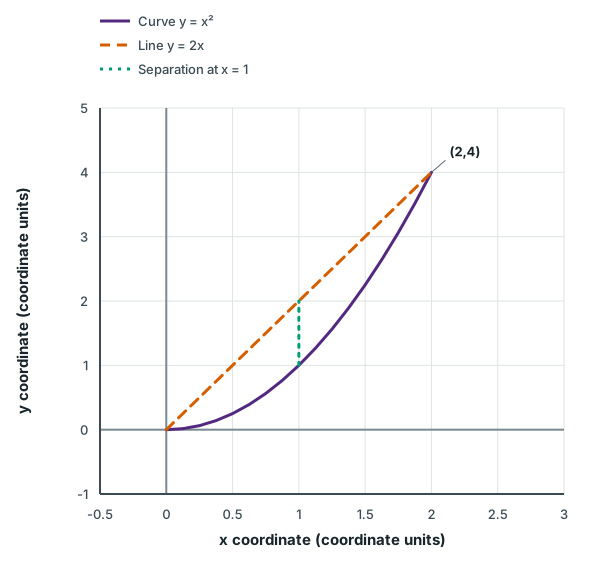
View figure data
| Series | x coordinate (coordinate units) | y coordinate (coordinate units) |
|---|---|---|
| Curve y = x² | 0.000 | 0.000000 |
| Curve y = x² | 0.125 | 0.015625 |
| Curve y = x² | 0.250 | 0.062500 |
| Curve y = x² | 0.375 | 0.140625 |
| Curve y = x² | 0.500 | 0.250000 |
| Curve y = x² | 0.625 | 0.390625 |
| Curve y = x² | 0.750 | 0.562500 |
| Curve y = x² | 0.875 | 0.765625 |
| Curve y = x² | 1.000 | 1.000000 |
| Curve y = x² | 1.125 | 1.265625 |
| Curve y = x² | 1.250 | 1.562500 |
| Curve y = x² | 1.375 | 1.890625 |
| Curve y = x² | 1.500 | 2.250000 |
| Curve y = x² | 1.625 | 2.640625 |
| Curve y = x² | 1.750 | 3.062500 |
| Curve y = x² | 1.875 | 3.515625 |
| Curve y = x² | 2.000 | 4.000000 |
| Line y = 2x | 0.000 | 0.000000 |
| Line y = 2x | 2.000 | 4.000000 |
| Separation at x = 1 | 1.000 | 1.000000 |
| Separation at x = 1 | 1.000 | 2.000000 |
The vertical separation is 2x − x², giving
This is 4/3 square units. Integrating x² alone would find the area below the curve and above the x-axis, which is a different region. An independent check uses the triangle under y = 2x: its area is (1/2)(2)(4) = 4. Subtracting the area 8/3 under y = x² gives 4 − 8/3 = 4/3 again.
Check your understanding 2 A vertical boundary changes the interval
In the same diagram, find the area between the line and curve only for 0 ≤ x ≤ 1. State the upper and lower boundaries and explain why 4/3 is no longer the requested area.
Show answer
The upper boundary is y = 2x and lower boundary y = x², but the added line x = 1 stops the region before the second intersection. The area is [x² − x³/3]₀¹ = 2/3 square units. The value 4/3 includes the additional region from x = 1 to x = 2 and therefore answers the unrestricted diagram instead.
Try it yourself 1
Recover the curve before choosing the region
Problem
A curve has dy/dx = 3x² − 6x and passes through (0,6). Find its equation and the exact area of the finite region bounded by the curve and the line y = 6. A proposal says that integrating the recovered y-value from the left intersection to the right one directly gives the requested area. Test this claim and check your result by another valid area calculation.
Write your answer, then compare it with the solution
Hints
Hint 1
Keep the gradient condition separate from the region boundary
Use the given point to select the integration constant before locating the intersections. Decide what a vertical separation measures, and identify which area an integral of y alone would describe.
Show full solution
Recover and check the curve
Method
Integrate the gradient and use the given point.Reason
The derivative alone leaves the curve’s height undetermined.Working
Answer
y = x³ − 3x² + C. Substituting (0,6) gives C = 6, hence y = x³ − 3x² + 6. Its derivative is 3x² − 6x and its value at zero is 6, satisfying both givens.Find the bounded region's separation
Method
Intersect the recovered curve with y = 6 and identify the upper boundary.Reason
The required area is between the line and curve, rather than between the curve and the x-axis.Working
Answer
x³ − 3x² = x²(x − 3) = 0 gives x = 0 and x = 3. Between them, the vertical separation is 6 − y = 3x² − x³ = x²(3 − x), which is non-negative. Thus the line is above the curve on this region.Evaluate the requested area
Method
Integrate the vertical separation over the intersection interval.Reason
Each small vertical strip has the line-to-curve height.Working
Answer
The area is [x³ − x⁴/4]₀³ = 27 − 81/4 = 27/4 square units.Check by subtracting from a rectangle
Method
Compare the area under the curve with the rectangle below y = 6.Reason
The curve stays above the x-axis: its minimum on [0,3] is 2 at x = 2. The rectangle therefore splits into the required region and the region under the curve.Working
Answer
The rectangle has area 3 × 6 = 18. The curve’s area above the axis is [x⁴/4 − x³ + 6x]₀³ = 45/4. Their difference is 18 − 45/4 = 27/4. The proposed integral of y alone gives 45/4, confirming that it describes the wrong region.
Quick check
Compare the original gradient and point, the intersection bounds, which boundary is above and the meaning of the integrand. Different valid antiderivatives or area decompositions are welcome when they recover the same region. The lesson uses self-review; correct integration alone does not establish that the requested area was selected.
Keep track of this lesson
Mark the lesson done when you have worked through it.
Lesson progress is optional and kept on this device.
Loading lesson controls…
Your lesson mark records your own study. Checks are kept separately in My Learning.