Signed areas and motion
Use sign intervals and initial conditions to distinguish signed area, position, displacement, distance and changing speed.
More
Offline pages
Saved on this device only. Connect at least once every 30 days to confirm Premium. Sign-out or a change of account removes saved copies.
Find this activity in your course
On this page
You stopped at:
ContinueRevision Mode is on. Questions and activities are hidden.
A definite integral can be negative
A definite integral accumulates signed contributions. Above the x-axis, a graph contributes positively; below it, negatively. Geometric area is non-negative, so these quantities agree only when the sign conditions fit the region.
For y = x on [−2,0], [x²/2]₋₂⁰ = −2, while the geometric area is 2 square units. On [0,2], the integral and area are both 2. Across [−2,2], the integral is zero because the contributions cancel, but total area is 2 + 2 = 4 square units.
To find total area, locate the zeros inside the interval, check signs and add each non-negative region area. Taking an absolute value only after adding the signed contributions can hide cancellation. Also verify that the function is defined throughout each integration interval; splitting at a zero does not repair an undefined point.
Check your understanding 1 Split before removing the signs
For y = 2x − 2 on 0 ≤ x ≤ 3, find its definite integral and the total area between the graph and x-axis. Explain why taking the absolute value of the final integral gives the wrong area.
Show answer
The zero is x = 1. With F(x) = x² − 2x, the signed contributions are F(1) − F(0) = −1 and F(3) − F(1) = 4. The definite integral is 3, but total area is 1 + 4 = 5 square units. The negative region has already cancelled part of the positive one before an absolute value of 3 is taken. The two triangular regions independently have areas (1/2)(1)(2) = 1 and (1/2)(2)(4) = 4.
Motion gives the signs physical meanings
Choose a positive direction along the line of motion. Let s(t) be signed position relative to a fixed origin. Velocity is v = ds/dt, acceleration is a = dv/dt, and speed is |v|. A negative velocity means motion in the chosen negative direction; it does not mean negative speed.
Over a time interval, integrating velocity gives the change in position, also called displacement change. Total distance adds the lengths travelled in either direction. Integrate velocity on intervals of constant sign and add the absolute displacement of each interval.
Suppose the numerical velocity in m/s is v(t) = 3t² − 12t + 9 = 3(t − 1)(t − 3), with t in seconds and 0 ≤ t ≤ 4. An antiderivative is F(t) = t³ − 6t² + 9t.
Velocity signs separate the parts of the journey
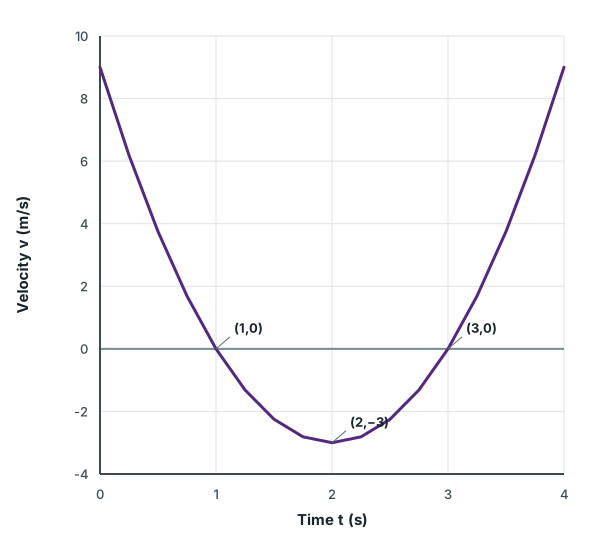
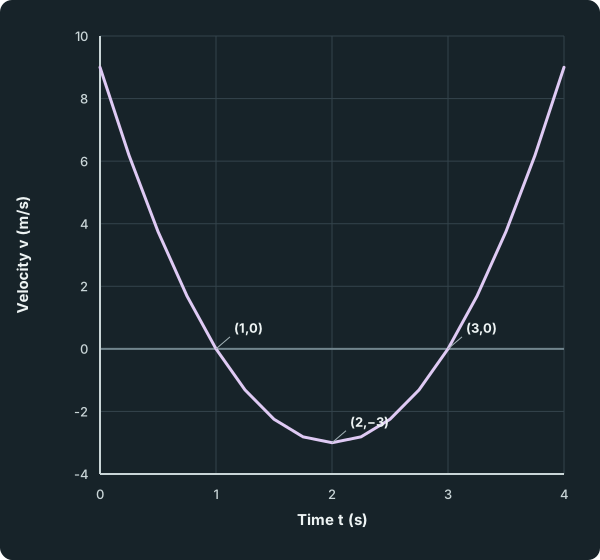
A velocity-time graph starts at nine metres per second, crosses zero at one second, reaches minus three at two seconds, crosses zero at three seconds and finishes at nine at four seconds. The curve is above the time axis before one second and after three seconds, and below it between those times.
Scroll across the figure to read all labels.
View figure data
| Time t (s) | Velocity v(t) |
|---|---|
| 0.00 | 9.0000 |
| 0.25 | 6.1875 |
| 0.50 | 3.7500 |
| 0.75 | 1.6875 |
| 1.00 | 0.0000 |
| 1.25 | -1.3125 |
| 1.50 | -2.2500 |
| 1.75 | -2.8125 |
| 2.00 | -3.0000 |
| 2.25 | -2.8125 |
| 2.50 | -2.2500 |
| 2.75 | -1.3125 |
| 3.00 | 0.0000 |
| 3.25 | 1.6875 |
| 3.50 | 3.7500 |
| 3.75 | 6.1875 |
| 4.00 | 9.0000 |
The zeros at t = 1 and t = 3 separate positive, negative and positive velocity intervals:
| Time interval | Velocity sign | Displacement contribution | Distance contribution |
|---|---|---|---|
| 0 to 1 s | Positive | F(1) − F(0) = 4 m | 4 m |
| 1 to 3 s | Negative | F(3) − F(1) = −4 m | 4 m |
| 3 to 4 s | Positive | F(4) − F(3) = 4 m | 4 m |
Thus displacement change is 4 − 4 + 4 = 4 m, while distance is 4 + 4 + 4 = 12 m. The particle travels forward, backward, then forward again. These results come from the formula and sign intervals; reading a net shaded area alone would not give the total distance.
Rest does not automatically mean reversal
A zero of velocity identifies rest at that instant, but a change of direction requires a change of velocity sign. For v(t) = (t − 2)² on 0 ≤ t ≤ 4, velocity is positive on both sides of t = 2. The particle stops momentarily without reversing. Check signs around each zero rather than counting every root as a turn.
Acceleration and velocity also have different jobs. For the model v = 3t² − 12t + 9, acceleration is a = 6t − 12 m/s². On 0 < t < 1, v > 0 and a < 0, so speed decreases. On 1 < t < 2, v < 0 and a < 0: velocity becomes more negative, so speed increases. Negative acceleration does not always mean slowing down.
Where v ≠ 0, speed increases when velocity and acceleration have the same sign and decreases when they have opposite signs. At a zero of velocity, inspect nearby motion rather than applying this sign test with a zero factor.
Check your understanding 2 A return journey can have zero displacement
A particle has velocity v = 2t − 4 m/s for 0 ≤ t ≤ 4 s. Find displacement change and total distance. State when it reverses and whether its speed increases or decreases on each side of that time.
Show answer
The velocity is zero at t = 2 and changes from negative to positive, so the particle reverses. An antiderivative is F(t) = t² − 4t, with values 0, −4 and 0 at t = 0, 2 and 4. Displacement change is 0 m; distance is 4 + 4 = 8 m.
Acceleration is +2 m/s². Before t = 2, negative velocity increases towards zero, so speed decreases. After t = 2, positive velocity increases, so speed increases. Positive acceleration is consistent with both behaviours because velocity has changed sign.
Initial conditions fix position, not distance signs
Integrating velocity gives s(t) = F(t) + C. A stated position at a stated time fixes C; setting it to zero without information chooses an origin-dependent position that may be wrong. C cancels in displacement differences and does not change the distance obtained from velocity signs.
If acceleration is given instead, first integrate to velocity and use a velocity condition. Then integrate velocity to position and use a position condition. The two constants carry different information. For constant acceleration 2 m/s², v(0) = −4 m/s gives v = 2t − 4. If s(0) = 7 m, then s = t² − 4t + 7. The initial position changes the positions to 7, 3 and 7 m at t = 0, 2 and 4 s; it does not change the displacement change of zero or the distance of 8 m.
Try it yourself 1
Reconstruct the motion from acceleration
Problem
For 0 ≤ t ≤ 3 s, a particle’s numerical acceleration in m/s² is a(t) = 2t. Initially v(0) = −3 m/s and s(0) = 5 m. Find its velocity and position functions, every reversal time in the interval, displacement change and total distance. A proposal says that positive acceleration means its speed is increasing for 0 < t < 1. Test the claim. Explain why returning to its initial position would not by itself mean zero distance travelled.
Write your answer, then compare it with the solution
Hints
Hint 1
Recover velocity before deciding the direction of motion
The acceleration condition alone does not locate a zero of velocity. Use the initial velocity when integrating, then use the separate position condition. Check velocity signs on the allowed time interval before combining displacement contributions.
Show full solution
Recover both functions and their constants
Method
Integrate acceleration, then integrate the resulting velocity.Reason
A velocity condition and a position condition determine different constants.Working
Answer
v = t² + C, and v(0) = −3 gives v = t² − 3 m/s. Integrating again gives s = t³/3 − 3t + D. Since s(0) = 5, s = t³/3 − 3t + 5 m. Differentiating the position gives the recovered velocity, and differentiating velocity gives a = 2t.Locate and verify reversal
Method
Solve v = 0 and inspect signs within 0 ≤ t ≤ 3.Reason
Only an allowed zero with a sign change is a reversal time.Working
Answer
t² − 3 = 0 gives t = ±√3, but only √3 s lies in the interval. Velocity is negative before it and positive afterwards, so that is the only reversal. The turning position is s(√3) = 5 − 2√3 m.Separate displacement from distance
Method
Use the start, turning and final positions.Reason
Opposite displacements cancel in the net change but both contribute to distance.Working
Answer
s(0) = 5 m and s(3) = 5 m, so displacement change is 0 m. The particle first travels from 5 to 5 − 2√3, then back to 5. Each part has length 2√3 m, giving total distance 4√3 m. The nonzero path length explains why equal initial and final positions do not imply zero distance.Test the speed claim using velocity as well
Method
Compare the signs of v and a for 0 < t < 1.Reason
Acceleration describes change in signed velocity, not directly change in its magnitude.Working
Answer
Here t² − 3 < 0 while 2t > 0. Velocity is negative and increasing towards zero, so speed decreases. For example, at t = 1/2, v = −11/4 m/s and a = +1 m/s², showing opposite signs within the requested interval. The claim of increasing speed is false.
Quick check
Check both initial conditions, the original acceleration, allowed root and sign change. Then compare position difference with the sum of travelled lengths. Different valid integral calculations are welcome, but an answer must explain the directions and the speed claim rather than assigning one meaning to every signed quantity. These are self-review criteria, without automatic marking.
Keep track of this lesson
Mark the lesson done when you have worked through it.
Lesson progress is optional and kept on this device.
Loading lesson controls…
Your lesson mark records your own study. Checks are kept separately in My Learning.