On this page
Loading guide controls…
Continue lessonNew guided lessons are not available yet.
Guided lesson options
You stopped at:
ContinueRevision Mode is on. Questions and activities are hidden.
The linked question or activity is hidden by Revision Mode.
A circle on a coordinate grid is fixed by its centre and radius. Given three points on it, you can rebuild both; given a line, you can find exactly where it meets the circle. This lesson uses perpendicular bisectors and substitution to do each, and the discriminant to count the meeting points.
Recover the centre from equal distances
A diameter gives its centre immediately: average the two endpoint coordinates. An arbitrary chord does not. When three non-collinear points determine a circle, its centre lies on the perpendicular bisector of every chord.
Worked example 1
Rebuild a circle from two chord bisectors
Worked example 1
Rebuild a circle from two chord bisectors
Find the circle through A(6,2), B(1,7) and C(-4,2). Give its centre, radius and both equation forms.
Show full solutionHide solution
Use a horizontal chord
Method
Find the midpoint of the chord and its perpendicular bisector.Reason
The centre has equal distances to both chord endpoints, so it lies on their perpendicular bisector.Working
Answer
Chord AC is horizontal, with midpoint (1,2). Its perpendicular bisector is x = 1.
Use an independent chord
Method
Find the perpendicular bisector of the sloping chord and intersect the two bisectors.Reason
One bisector leaves a whole line of possible centres. A second independent condition selects one.Working
Answer
For AB, the midpoint is (7/2,9/2) and the gradient is -1. Its perpendicular bisector has gradient 1:
y-9/2 = x-7/2, y = x + 1.Together with x = 1, this gives centre O(1,2).
Recover the radius and verify every point
Method
Calculate the squared distances from the proposed centre.Reason
All three distances must agree; checking only the chord endpoints would not establish the third condition.Working
Answer
OA² = (6-1)² + (2-2)² = 25,; OB² = (1-1)² + (7-2)² = 25,; OC² = (-4-1)² + (2-2)² = 25.State the reconstructed circle
Working
Answer
The centre is (1,2) and radius is 5. The two equivalent equations are
(x-1)² + (y-2)² = 25,; x² + y²-2x-4y-20 = 0.
Quick check
Complete both squares in the expanded equation: the right side becomes 20 + 1 + 4 = 25. That constant is r², not r. An arbitrary chord midpoint cannot be assumed to be the centre, even though AC happens to be a diameter here.
If a centre and one circle point are given, their squared distance supplies r². For a stated diameter, r² is one quarter of its squared length. Three distinct collinear points cannot lie on one positive-radius circle.
Check your understanding 1
Use two independent centre conditions
Check your understanding 1
Use two independent centre conditions
A circle passes through A(-2,1), B(4,1) and C(1,4). Find its centre, radius and equation. Show why your centre fits all three points, rather than treating AB as a diameter without justification.
Show answerHide answer
AB has midpoint (1,1), so its perpendicular bisector is x = 1. AC has midpoint (-1/2,5/2) and gradient 1, so its perpendicular bisector is y = -x + 2. They meet at (1,1). All three given points are 3 units from this centre, giving (x-1)² + (y-1)² = 9. Here AB happens to be a diameter, but the second condition establishes that rather than assuming it.
An intersection must satisfy both equations
A point belongs to the line and the circle simultaneously. Substitution reduces those two conditions to one quadratic. Each real root supplies one coordinate; use the line to recover its partner.
Worked example 2
Find the complete intersection set
Worked example 2
Find the complete intersection set
Find every intersection of x² + y² = 25 and y = 3.
Show full solutionHide solution
Enforce both conditions
Method
Replace y by 3 in the circle equation.Reason
Every common point must have the line’s y-coordinate and the circle’s squared distance.Working
Answer
x² + 3² = 25,; x² = 16,; x = 4 or -4.Taking only the positive square root loses one point. Pair each x-value with y = 3: (4,3) and (-4,3).
Check the original equations
Method
Test each complete pair in the line and the circle.Reason
A root is useful only when the recovered pair satisfies both original conditions.Working
Answer
Both have y = 3. Also, 4² + 3² = 25 and (-4)² + 3² = 25. The complete set is {(4,3),(-4,3)}; its order does not matter.
Common mistake
Writing only x = 4 loses (-4,3). Both roots give different points on the same line and circle. A repeated root would instead give just one point.
Two, one or no real intersections
Compare three lines on one circle
One circle of radius five about the origin, with horizontal lines at heights three, five and six. The height-five line touches the top; the height-six line is above it.
Scroll across to read every label.
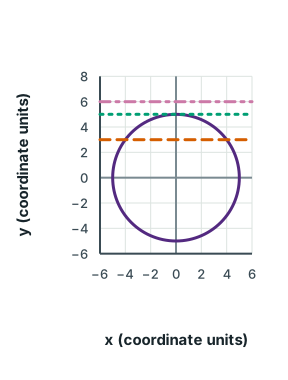
Figure data
This table is included in print while it is open.
| Series | x (coordinate units) | y (coordinate units) |
|---|---|---|
| Circle | 5.0000 | 0.0000 |
| Circle | 4.9931 | 0.2617 |
| Circle | 4.9726 | 0.5226 |
| Circle | 4.9384 | 0.7822 |
| Circle | 4.8907 | 1.0396 |
| Circle | 4.8296 | 1.2941 |
| Circle | 4.7553 | 1.5451 |
| Circle | 4.6679 | 1.7918 |
| Circle | 4.5677 | 2.0337 |
| Circle | 4.4550 | 2.2700 |
| Circle | 4.3301 | 2.5000 |
| Circle | 4.1934 | 2.7232 |
| Circle | 4.0451 | 2.9389 |
| Circle | 3.8857 | 3.1466 |
| Circle | 3.7157 | 3.3457 |
| Circle | 3.5355 | 3.5355 |
| Circle | 3.3457 | 3.7157 |
| Circle | 3.1466 | 3.8857 |
| Circle | 3.0000 | 4.0000 |
| Circle | 2.9389 | 4.0451 |
| Circle | 2.7232 | 4.1934 |
| Circle | 2.5000 | 4.3301 |
| Circle | 2.2700 | 4.4550 |
| Circle | 2.0337 | 4.5677 |
| Circle | 1.7918 | 4.6679 |
| Circle | 1.5451 | 4.7553 |
| Circle | 1.2941 | 4.8296 |
| Circle | 1.0396 | 4.8907 |
| Circle | 0.7822 | 4.9384 |
| Circle | 0.5226 | 4.9726 |
| Circle | 0.2617 | 4.9931 |
| Circle | 0.0000 | 5.0000 |
| Circle | -0.2617 | 4.9931 |
| Circle | -0.5226 | 4.9726 |
| Circle | -0.7822 | 4.9384 |
| Circle | -1.0396 | 4.8907 |
| Circle | -1.2941 | 4.8296 |
| Circle | -1.5451 | 4.7553 |
| Circle | -1.7918 | 4.6679 |
| Circle | -2.0337 | 4.5677 |
| Circle | -2.2700 | 4.4550 |
| Circle | -2.5000 | 4.3301 |
| Circle | -2.7232 | 4.1934 |
| Circle | -2.9389 | 4.0451 |
| Circle | -3.1466 | 3.8857 |
| Circle | -3.3457 | 3.7157 |
| Circle | -3.5355 | 3.5355 |
| Circle | -3.7157 | 3.3457 |
| Circle | -3.8857 | 3.1466 |
| Circle | -4.0451 | 2.9389 |
| Circle | -4.1934 | 2.7232 |
| Circle | -4.3301 | 2.5000 |
| Circle | -4.4550 | 2.2700 |
| Circle | -4.5677 | 2.0337 |
| Circle | -4.6679 | 1.7918 |
| Circle | -4.7553 | 1.5451 |
| Circle | -4.8296 | 1.2941 |
| Circle | -4.8907 | 1.0396 |
| Circle | -4.9384 | 0.7822 |
| Circle | -4.9726 | 0.5226 |
| Circle | -4.9931 | 0.2617 |
| Circle | -5.0000 | 0.0000 |
| Circle | -4.9931 | -0.2617 |
| Circle | -4.9726 | -0.5226 |
| Circle | -4.9384 | -0.7822 |
| Circle | -4.8907 | -1.0396 |
| Circle | -4.8296 | -1.2941 |
| Circle | -4.7553 | -1.5451 |
| Circle | -4.6679 | -1.7918 |
| Circle | -4.5677 | -2.0337 |
| Circle | -4.4550 | -2.2700 |
| Circle | -4.3301 | -2.5000 |
| Circle | -4.1934 | -2.7232 |
| Circle | -4.0451 | -2.9389 |
| Circle | -3.8857 | -3.1466 |
| Circle | -3.7157 | -3.3457 |
| Circle | -3.5355 | -3.5355 |
| Circle | -3.3457 | -3.7157 |
| Circle | -3.1466 | -3.8857 |
| Circle | -2.9389 | -4.0451 |
| Circle | -2.7232 | -4.1934 |
| Circle | -2.5000 | -4.3301 |
| Circle | -2.2700 | -4.4550 |
| Circle | -2.0337 | -4.5677 |
| Circle | -1.7918 | -4.6679 |
| Circle | -1.5451 | -4.7553 |
| Circle | -1.2941 | -4.8296 |
| Circle | -1.0396 | -4.8907 |
| Circle | -0.7822 | -4.9384 |
| Circle | -0.5226 | -4.9726 |
| Circle | -0.2617 | -4.9931 |
| Circle | 0.0000 | -5.0000 |
| Circle | 0.2617 | -4.9931 |
| Circle | 0.5226 | -4.9726 |
| Circle | 0.7822 | -4.9384 |
| Circle | 1.0396 | -4.8907 |
| Circle | 1.2941 | -4.8296 |
| Circle | 1.5451 | -4.7553 |
| Circle | 1.7918 | -4.6679 |
| Circle | 2.0337 | -4.5677 |
| Circle | 2.2700 | -4.4550 |
| Circle | 2.5000 | -4.3301 |
| Circle | 2.7232 | -4.1934 |
| Circle | 2.9389 | -4.0451 |
| Circle | 3.1466 | -3.8857 |
| Circle | 3.3457 | -3.7157 |
| Circle | 3.5355 | -3.5355 |
| Circle | 3.7157 | -3.3457 |
| Circle | 3.8857 | -3.1466 |
| Circle | 4.0451 | -2.9389 |
| Circle | 4.1934 | -2.7232 |
| Circle | 4.3301 | -2.5000 |
| Circle | 4.4550 | -2.2700 |
| Circle | 4.5677 | -2.0337 |
| Circle | 4.6679 | -1.7918 |
| Circle | 4.7553 | -1.5451 |
| Circle | 4.8296 | -1.2941 |
| Circle | 4.8907 | -1.0396 |
| Circle | 4.9384 | -0.7822 |
| Circle | 4.9726 | -0.5226 |
| Circle | 4.9931 | -0.2617 |
| Circle | 5.0000 | 0.0000 |
| y = 3 | -6.0000 | 3.0000 |
| y = 3 | 6.0000 | 3.0000 |
| y = 5 | -6.0000 | 5.0000 |
| y = 5 | 6.0000 | 5.0000 |
| y = 6 | -6.0000 | 6.0000 |
| y = 6 | 6.0000 | 6.0000 |
For the same circle, y = 5 gives x² = 0: the single point (0,5). A repeated quadratic root is one point, not two distinct intersections. The radius there is vertical and the tangent horizontal.
For y = 6, substitution gives x² = -11, so there is no real intersection. An empty point set is a complete answer; it is different from leaving the response blank. In a general substituted quadratic, a positive, zero or negative discriminant distinguishes two, one or no real roots. Always recover and check the corresponding coordinate pairs.
Keep the pairs together on an oblique line
Try it yourself 1
Solve with a sloping line
Try it yourself 1
Solve with a sloping line
Find every real intersection of x² + y² = 25 and y = x + 1. Show the equation you solve, give complete coordinate pairs and check them in both original equations.
Write your answer, then compare it with the solution
Hint 1
Let one original equation eliminate a coordinate
Use the line to replace y in the circle. After solving, recover y separately for each x-value; do not cross-pair the coordinates.
Show full solutionHide solution
Substitute and solve
Method
Use y = x + 1 in the circle.Reason
The roots must represent points common to both equations.Working
Answer
x² + (x + 1)² = 25,; 2x² + 2x-24 = 0,; (x + 4)(x-3) = 0.Thus x = -4 or x = 3. The line gives y = -3 or y = 4 respectively, so the set is {(-4,-3),(3,4)}.
Verify the paired answers
Method
Test each pair rather than only the separate coordinate lists.Reason
Cross-pairing can satisfy neither original equation.Working
Answer
For (-4,-3), -3 = -4 + 1 and 16 + 9 = 25. For (3,4), 4 = 3 + 1 and 9 + 16 = 25. Both points satisfy both equations. Reversing their order changes nothing. The pairs (-4,4) and (3,-3) fail the line condition.
Quick check
Check y = x + 1 for each pair before testing its squared distance. The cross-paired points fail the line even if their separate coordinates appeared in your calculations.
Common mistakes
- Using the midpoint of any chord as the centre. Only a diameter’s midpoint is the centre.
- Splitting coordinates from their pairs. Each x found gives its own y; report complete points.
- Counting a repeated root as two points. A discriminant of zero means one point, where the line is a tangent.
- Dropping the negative root. x² = 9 gives x = 3 or x = -3: two intersection points, each with its own y.
Loading reading progress…
Lesson done
- Monday
- Tuesday
- Wednesday
- Thursday
- Friday
- Saturday
- Sunday
Checking learning on this device…
Change goal
Progress options
Loading questions…
Syllabus and review details
Last reviewed: