Quadratic extrema and sign
Connect completed squares and discriminants to strict sign conditions, model restrictions and feasible quadratic extrema.
More
Offline pages
Saved on this device only. Connect at least once every 30 days to confirm Premium. Sign-out or a change of account removes saved copies.
Find this activity in your course
On this page
You stopped at:
ContinueRevision Mode is on. Questions and activities are hidden.
Factor the leading coefficient before completing the square
Completing the square exposes a quadratic’s distance from its vertex. A square cannot be negative, so the coefficient outside the square tells us whether moving away from the vertex raises or lowers the output. This gives an extremum without testing a long list of input values.
For q(x) = 2x²-8x + 9, first factor 2 from the terms involving x:
Inside the brackets, x² − 4x = (x − 2)² − 4. The outside 2 multiplies both parts:
The square is smallest at x = 2, where it is zero. Thus q has minimum 1 at x = 2, and its vertex is (2,1). Every other input adds a positive amount to that output, so q is strictly positive for every real x.
Writing 2(x-2)² + 5 would expand to 2x² − 8x + 13. It has the right x² and x terms but the wrong constant. Check all three coefficients; a plausible vertex is not a substitute for an algebraically equal expression.
In general, for a ≠ 0,
The vertex input is −b/(2a), and its output is c − b²/(4a). A positive a gives a minimum; a negative a gives a maximum. For example, −2x² + 12x − 11 = −2(x − 3)² + 7, so its maximum is 7 at x = 3. It does not have a minimum over all real inputs: its outputs decrease without bound as the square grows.
A root condition and an orientation work together
“Always positive” means greater than zero at every real input, including the vertex. Having a positive leading coefficient only tells us which way the parabola opens. It does not tell us whether its minimum is above, on or below the axis.
For x² + 2x + k = (x + 1)² + k − 1, the minimum is k − 1. It is always positive exactly when k > 1. At k = 1 it touches zero at x = −1; at k < 1 it takes negative values near that input.
Scroll across the figure to read all labels.
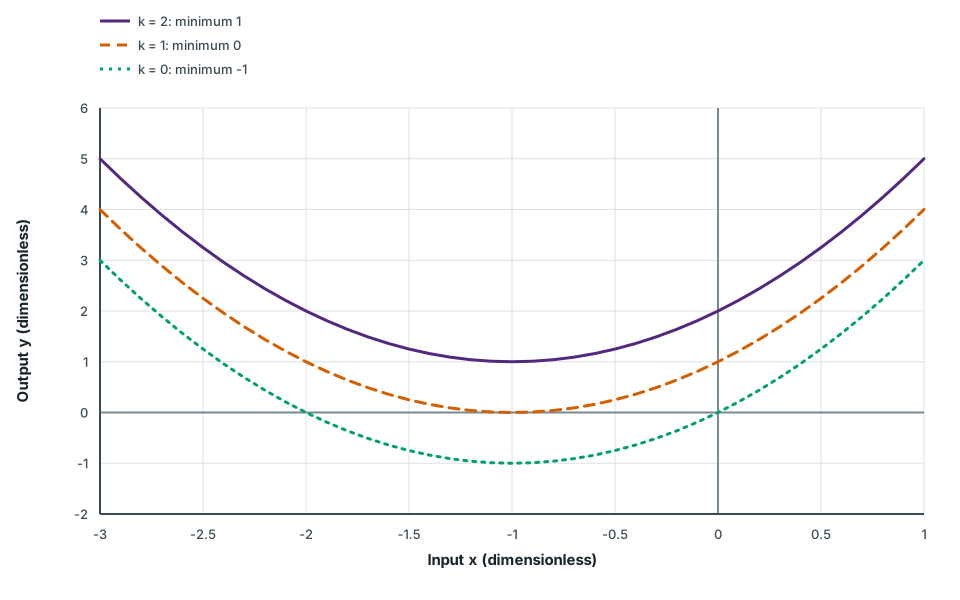
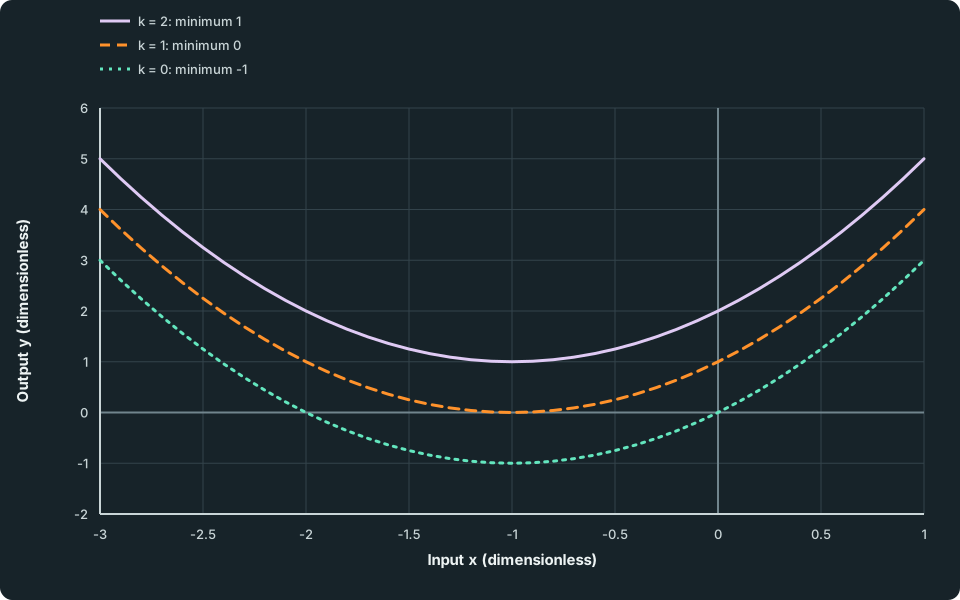
View figure data
| Input x (dimensionless) | k = 2: minimum 1 | k = 1: minimum 0 | k = 0: minimum -1 |
|---|---|---|---|
| -3.0 | 5.00 | 4.00 | 3.00 |
| -2.9 | 4.61 | 3.61 | 2.61 |
| -2.8 | 4.24 | 3.24 | 2.24 |
| -2.7 | 3.89 | 2.89 | 1.89 |
| -2.6 | 3.56 | 2.56 | 1.56 |
| -2.5 | 3.25 | 2.25 | 1.25 |
| -2.4 | 2.96 | 1.96 | 0.96 |
| -2.3 | 2.69 | 1.69 | 0.69 |
| -2.2 | 2.44 | 1.44 | 0.44 |
| -2.1 | 2.21 | 1.21 | 0.21 |
| -2.0 | 2.00 | 1.00 | 0.00 |
| -1.9 | 1.81 | 0.81 | -0.19 |
| -1.8 | 1.64 | 0.64 | -0.36 |
| -1.7 | 1.49 | 0.49 | -0.51 |
| -1.6 | 1.36 | 0.36 | -0.64 |
| -1.5 | 1.25 | 0.25 | -0.75 |
| -1.4 | 1.16 | 0.16 | -0.84 |
| -1.3 | 1.09 | 0.09 | -0.91 |
| -1.2 | 1.04 | 0.04 | -0.96 |
| -1.1 | 1.01 | 0.01 | -0.99 |
| -1.0 | 1.00 | 0.00 | -1.00 |
| -0.9 | 1.01 | 0.01 | -0.99 |
| -0.8 | 1.04 | 0.04 | -0.96 |
| -0.7 | 1.09 | 0.09 | -0.91 |
| -0.6 | 1.16 | 0.16 | -0.84 |
| -0.5 | 1.25 | 0.25 | -0.75 |
| -0.4 | 1.36 | 0.36 | -0.64 |
| -0.3 | 1.49 | 0.49 | -0.51 |
| -0.2 | 1.64 | 0.64 | -0.36 |
| -0.1 | 1.81 | 0.81 | -0.19 |
| 0.0 | 2.00 | 1.00 | 0.00 |
| 0.1 | 2.21 | 1.21 | 0.21 |
| 0.2 | 2.44 | 1.44 | 0.44 |
| 0.3 | 2.69 | 1.69 | 0.69 |
| 0.4 | 2.96 | 1.96 | 0.96 |
| 0.5 | 3.25 | 2.25 | 1.25 |
| 0.6 | 3.56 | 2.56 | 1.56 |
| 0.7 | 3.89 | 2.89 | 1.89 |
| 0.8 | 4.24 | 3.24 | 2.24 |
| 0.9 | 4.61 | 3.61 | 2.61 |
| 1.0 | 5.00 | 4.00 | 3.00 |
The discriminant D = b² − 4ac expresses the same boundary through roots. For a genuine quadratic:
| Claim for every real x | Conditions |
|---|---|
| ax² + bx + c > 0 | a > 0 and D < 0 |
| ax² + bx + c ≥ 0 | a > 0 and D ≤ 0 |
| ax² + bx + c < 0 | a < 0 and D < 0 |
| ax² + bx + c ≤ 0 | a < 0 and D ≤ 0 |
The vertex output is −D/(4a), so the completed square and discriminant tests agree. A zero discriminant permits equality with zero and cannot establish a strict claim. Also D < 0 alone does not choose the sign: x² + 1 is always positive, whereas −x² − 1 is always negative, and both have discriminant −4.
Check your understanding 1 Check the equality case in an “always” claim
A claim says that 2x²-8x + k is always positive when k ≥ 8. Find the correct condition for strict positivity, then the condition for non-negativity. Use an original input to test the boundary k = 8.
Show answer
The expression is 2(x − 2)² + k − 8, with minimum k − 8. Strict positivity requires k > 8; non-negativity requires k ≥ 8. At k = 8 and x = 2 the original expression is 8 − 16 + 8 = 0, disproving strict positivity at that parameter boundary.
A model has an input interval
A stated height model is h(t) = -5t² + 20t + 1 metres for 0 ≤ t ≤ 4 seconds. Here t is the numerical elapsed time in seconds. Completing the square gives h(t) = −5(t − 2)² + 21, so the maximum is 21 m at 2 s. The vertex is allowed, and substituting t = 2 into the original expression returns that height.
If the task instead concerns only 3 ≤ t ≤ 4, the vertex is unavailable. In that interval (t − 2)² grows from 1 to 4, so multiplying it by −5 makes the height decrease. The greatest allowed height is h(3) = 16 m, rather than the unrestricted vertex height 21 m. The formula and the task’s permitted interval must both be used.
Check your understanding 2 Strict and non-strict claims differ
Find the maximum of -3x² + 12x-7 over all real inputs and decide whether it is always negative. Explain why the sign of its leading coefficient is insufficient.
Show answer
The expression is -3(x-2)² + 5, with maximum 5 at x = 2. It is not always negative because it takes positive values near that vertex. A negative leading coefficient alone is insufficient.
Check a restricted interval
For q(x) = 2(x − 2)² + 1 above, suppose only 3 ≤ x ≤ 5 is allowed. The vertex x = 2 is unavailable. The square (x − 2)² is smallest at x = 3 and largest at x = 5, giving least value q(3) = 3 and greatest value q(5) = 19 on that interval.
On a closed interval, compare distances from the vertex rather than assuming an endpoint must win. An upward-opening quadratic is smallest at a closest permitted input and largest at a farthest one; a downward-opening quadratic reverses those choices. If the vertex is allowed, its distance is zero. Check included endpoints, and for integer-only inputs compare the feasible integers nearest the continuous vertex too, keeping any ties.
Try it yourself 1
Choose the dimensions of a plot
Problem
A rectangular plot sits against a straight wall. Exactly 43 m of fencing encloses the other three sides: two equal depths x and the far side y. Neglect fence thickness. The depth must be a whole number of metres from 4 to 18 inclusive.
Sketch and label the arrangement, form its area model, then find the allowed dimensions giving the greatest area. Explain why a continuous vertex calculation alone does not finish the task, and check that the chosen dimensions use the available fencing.
Write your answer, then compare it with the solution
Hints
Hint 1
Identify the three lengths that use fencing
The wall supplies one side of the rectangle. Express the remaining far-side length using the two equal depths, then decide which values of the area model the task actually permits.
Show full solution
Form the constraint and area
Method
Use 2x + y = 43, so y = 43 − 2x.Reason
The two depths both consume fencing; the side against the wall does not.Working
Answer
The area is A = x(43-2x) = -2x² + 43x square metres. The stated integers 4 through 18 give positive far-side lengths, so all are feasible.Locate the continuous vertex and enforce the allowed inputs
Method
Complete the square and compare the nearest permitted integers.Reason
The largest continuous output need not be attainable by a whole-metre depth.Working
Answer
A = -2(x-43/4)² + 1849/8. The continuous vertex is at x = 10.75, with area 231.125, but that depth is not permitted. Of the allowed integers, 11 is closest to 10.75; comparing gives A(10) = 230 and A(11) = 231. Every other allowed integer is farther from the vertex and gives a smaller area.Return to the original lengths
Method
Recover y and verify the fence total.Reason
An extremum of the algebraic model must still describe a permitted rectangle.Working
Answer
At x = 11 m, y = 43 − 22 = 21 m. The greatest allowed area is 11 × 21 = 231 m², and 2(11) + 21 = 43 m uses the full fence. Reporting the continuous area 231.125 m² would ignore the integer-depth condition.
Quick check
Check the two fenced depths, the area expression, the vertex and the permitted inputs separately. The geometry chooses the quadratic; the restrictions decide which of its outputs can actually occur.
Keep track of this lesson
Mark the lesson done when you have worked through it.
Lesson progress is optional and kept on this device.
Loading lesson controls…
Your lesson mark records your own study. Checks are kept separately in My Learning.